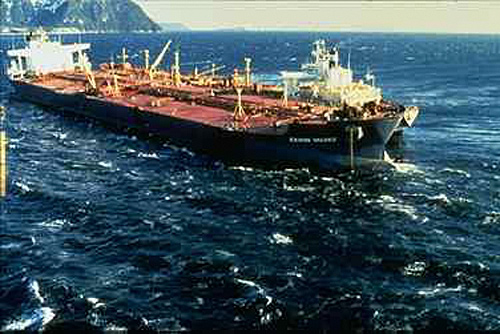
The Exxon Valdez.
Applying maritime common law, the Supreme Court today slashed a punitive damages award against Exxon Mobil to $507.5 million in the Exxon Valdez case. The Alaska federal jury originally awarded $5 billion (on top of $507.5 million in actuals), but the Ninth Circuit halved it to $2.5 billion. Adopting a 1:1 ratio between actual damages and punitives as the upper limit in maritime cases, the 5-3 Court further reduced the punitive award to equal the $507.5 million award of actual damages. Exxon Shipping Co. v. Baker, No. 07-219 (U.S. June 25, 2008).
Justice Alito having recused himself earlier, the Court divided equally on the question of whether maritime law allows imposition of punitive damages on a company that didn’t acquiesce in the wrongdoing.
All justices agreed that the Clean Water Act, by omitting a punitive remedy, didn’t preempt one.
Justices Stevens, Breyer, and Ginsburg dissented on the reduction of the award, concluding that Congress — not the Court — should make judgments about limits on punies under maritime law.
Blawgletter mentioned, when the Court accepted the case last October, our suspicion that the Court would "fashion yet another way to stop punitive damages awards — by ruling that the malfeasor didn’t get enough notice that mere malfeasance could subject it to punitive damages." We also observed that "reaching out for the Exxon Valdez case continues a pro-business trend by the Court" and "suggests distrust, or worse, of juries." In the event, the Court’s equal division on the permissibility of awarding punitives in the first place prevented a precedential decision on that point, but the Court did for sure signal (again) a determination to establish "predictability" of civil punishment and deterrence. Hence the 1:1 ratio.
