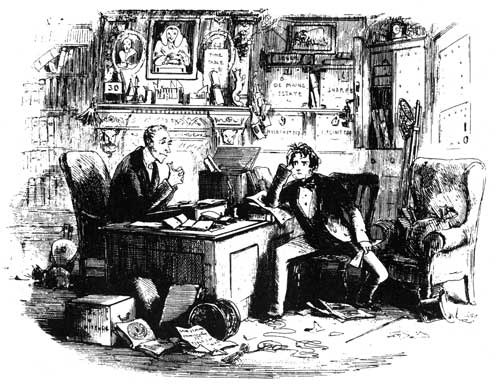
In Bleak House (1852-53), the cost of litigation exhausted the Jarndyce estate.
In The Washington Post today, business columnist Steven Pearlstein offers a contrarian take on the capping of punitive damages as a matter of federal common law in Exxon Shipping Co. v. Baker, No. 07-219 (U.S. June 25, 2008). (Blawgletter post here.) In "Altering the Economics of Civil Litigation", Mr. Pearlstein opines that "the problem with court’s decision in the Exxon case is not that it went too far in trying to reform the civil justice system, but that it didn’t go far enough."
He explains that the Court did a good thing in Exxon Shipping but that the Justices should also rein in defense-side abuses:
[I]t ought to be equally offensive to our sense of justice that corporate defendants are routinely allowed to manipulate the judicial process with an endless stream of motions, depositions and appeals, many as frivolous as anything served up by the plaintiff’s bar. For years, federal and state judges have turned a blind eye to this obvious and rampant abuse of process, which rivals anything conjured up by Charles Dickens in his famous novel, "Bleak House." Symbolically, the case of Exxon Shipping Co. v. Baker is to 21st-century jurisprudence what Dickens’ Jarndyce v. Jarndyce was to the 19th century.
By limiting abusive punitive damage awards without limiting the abusive tactics of the corporate defense bar, Justice Souter and his colleagues have fundamentally altered the economics of civil litigation and slammed the courthouse door on average citizens with legitimate claims against big and negligent corporations.
To which Blawgletter says, on this Independence Day, amen.