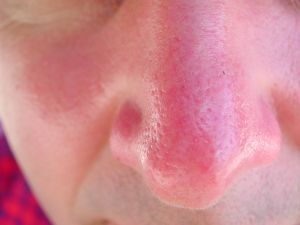
A little cocoa butter will fix that right up, buddy.
As we enter the Dog Days of Summer — and temperatures in Blawgletter’s vicinity spike to 107 Fahrenheit — let us pause to consider skincare products. Specifically ones that feature an unguent of choice, the mother of moisturizers, the very queen of summertime salves: cocoa butter.
A decision today out of the Third Circuit furnishes the occasion. In the case, E.T. Browne Drug Company accused Cococare Products of infringing Browne’s trademark in "Cocoa Butter Formula". Browne called its product "Palmer’s Cocoa Butter Formula", and Cococare named its — what else? — "Cococare Cocoa Butter Formula". The district court threw the trademark infringement case out on summary judgment.
The Third Circuit affirmed in a soothing yet sunny opinion. The court first identified the (eventually fatal) weakness in Browne’s case — that its trademark in "Cocoa Butter Formula" appeared only on the Patent and Trademark Office’s Supplemental Register and deserved, at best, the lowest level of trademark protection. The court parted with the district court on the question of whether Browne’s evidence raised a fact question as to whether the mark qualified as unprotectibly "generic" or instead made it to the bottom-most protectibility rung, where "descriptive" marks sit.
Still, the court pointed out, a descriptive mark acquires trademark protection under the Lanham Act only if it obtains "secondary meaning" in the minds of customers. Here, the court held, Browne slipped. Browne’s proof showed, at best, that "Palmer’s Cocoa Butter Formula" had entered consumer consciousness. That counted as no evidence that "Cocoa Butter Formula", by itself, had obtained secondary meaning (such that people associated it with Browne/Palmer’s as the source). E.T. Browne Drug Co. v. Cococare Products, Inc., Nos. 06-4543 & 06-4658 (3d Cir. Aug. 5, 2008).
