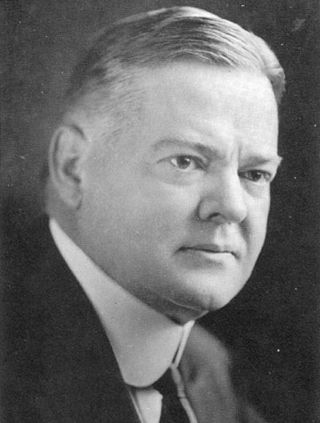
Did Herbert Hoover like juries?
Have you ever picked a jury? By which Blawgletter means have you stood in front of a venire and asked questions whose answers might assist you, your opponent, and the judge to select the right jurors for your case?
Whether you have or not, do you believe in seating the first group of citizens who show up? Or do you think lawyers should probe the potential jurors' attitudes, biases, and preconceptions before accepting them as the final judges of the facts?
We ask because we recently witnessed a presentation in which an appellate judge told why we oughtn't worry about juror bias. Any random assemblage of people, the judge implied, qualifies to sit on pretty much any civil jury.
The rationale, as we understand it, derives from the jurist's reading — and embrace — of James Surowiecki's The Wisdom of Crowds: Why the Many Are Smarter Than the Few and How Collective Wisdom Shapes Business, Economies, Societies and Nations (2004). The book argues that a big group of people, operating independently, most often arrive collectively at correct answers to even highly complex questions. As where hundreds or thousands of people guess the number of jelly beans in a jar or how much a cow carcass weighs; the average of their independent answers comes startlingly close to the right number.
The judge extended the Surowiecki thesis to the idea that putting any 12 people together on a jury will assure a better result than a single judge could come to. And that, thus, trial by jury deserves protection.
Please allow us a measure of skepticism. The same judge opposes, with eerie certitude, the advisability of asking prospective jurors whether or not they hate lawsuits. Or belong to organizations that despise litigation. The judge has also earned a reputation for enthusiasm in overturning jury verdicts that, in the judge's view — but not in the opinion of the jurors, the trial judge, and other appellate judges – lack evidentiary support. And the judge has never blushed, as far as we can tell, at reaching beyond traditional measures of jurisdiction to take cases in order to correct judgments that by the judge's lights didn't come out right.
The judge's cheery endorsement of Americans' seventh amendment right because it replicates the accuracy of jelly-bean-in-a-jar collective guessing seems to us a frightening point of view. For it implies a shockingly low opinion of jurors' intelligence. It also reflects, we fear, the judge's wishful reasoning by false analogy. An anonymous crowd of individuals who independently answer a question may result in the factually correct answer about carcass weight, but juries don't work that way. Jurors aren't anonymous, and they deliberate together in a collective effort to reach the find facts based on the evidence.
We love juries. Not least because, after a proper voir dire that identifies and eliminates those with bias, the jurors who serve have no financial, political, social, neighborly, professional, or personal stake in the outcome. Shouldn't we aim for the best jury possible in each case? And not for just a random group whose small size and tendency to give undue weight to opinions of dominating members, whose influence robs the group of independent thinking (thus destroying the conditions that Surowiecki holds crucial to group wisdom)?
