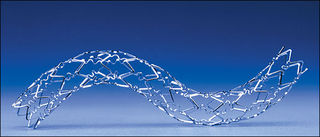
Boston Scientific sued Cordis for making Cyper stents like this one.
Recall that KSR Int'l Co. v. Teleflex, Inc., 127 S. Ct. 1727 (2007) (see post), eased the test for patent-invalidating "obviousness" – whether a practitioner in the relevant art would have found the invention obvious in light of existing art. Pre-KSR decisions by the Federal Circuit had complexified the obviousness question. KSR simplified matters, directing courts to give obviousness its ordinary, common-sense meaning.
The Federal Circuit has gradually caught onto KSR, having at first pretended that it hadn't really obliterated a line of Federal Circuit cases that added factors like "motivation". Yesterday the court showed that it knows from obvious.
The lawsuit related to Boston Scientific's patent on a drug-eluting stent. Boston Scientific accused Johnson & Johnson and Cordis of infringing the patent and won a jury verdict and judgment. The Federal Circuit affirmed the district court's construction of language in the patent but held the invention of the patent obvious in light of an earlier patent that disclosed — surprise! — a drug-eluting stent. Boston Scientific Scimed, Inc. v. Cordis Corp., No. 08-1073 (Fed. Cir. Jan. 15, 2009).
Descriptions of patent lawsuits involving Boston Scientific covers pages 20-29 of its latest Form 10-Q report.
 And they spend, oh, about $334 million a year in legal fees.