The post below comes from the June 2008 issue of Barnett’s Notes on Commercial Litigation.
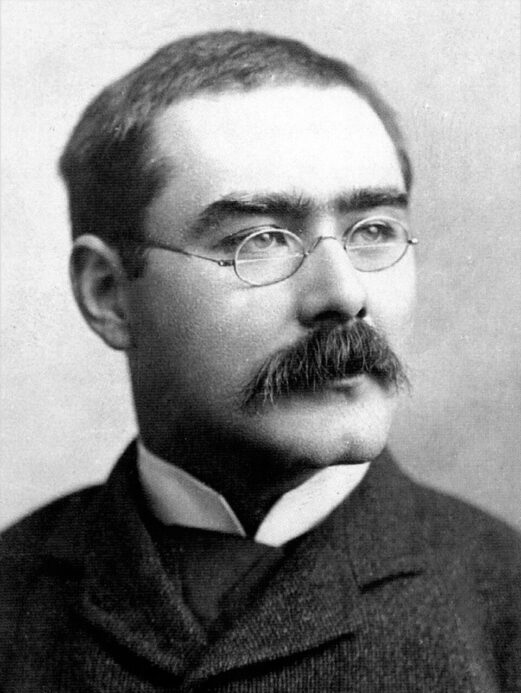
Rudyard Kipling (1865-1936).
Kipling‘s Just So Stories (1902) include the marvelous one about “The Elephant’s Child”. It tells how the elephant got its trunk.
In what manner did he obtain it. Kipling tells us that, because of Elephant Child’s “‘satiable curiosity”, he wanted to know what Crocodile eats for dinner. Questing for and then finding the object of his interest, he believes Crocodile’s promise to whisper the answer and leans close to hear.
But Crocodile means to devour him and so clamps toothy jaws on Elephant Child’s diminutive proboscis. Elephant Child tries to pull away, and soon his friend the Bi-Coloured-Python-Rock-Snake coils around his back legs and commences a-pulling too. The double-teaming works, separating Elephant Child from hungry Crocodile, but not before stretching the pachydermous pug to five feet and more.
If we stop here, we would think that Kipling intended a cautionary tale about nosiness. But the author of The Jungle Book, If–, and Kim meant no such thing. His tale instead goes on to demonstrate how useful the accidental product of ‘satiable curiosity became to Elephant Child and his posterity.
“That may all seem well and good to you, Mr. Editor,” we hear you say, “but what does that have to do with the judiciary and its acquisition of inefficiency. Please, good sir, do get to the point. And do it efficiently, mind!”
We shall endeavor to start doing so now.
In 1905 — his “miracle year” — a Kipling contemporary, physicist Albert Einstein (1879-1955), wrote four path-breaking papers. One of them revealed his special theory of relativity . In it, he disclosed that electromagnetic waves, including light, always travel at a constant speed — about 186,000 miles per second — but that our observation of them depends on our movement relative to their source.
Got that?
Your Editor confesses a sensation of doubt. Big time.
But I feel more confident that our current subject — the efficiency vel nonof federal courts — depends ever so much on the judiciary’s perception of case velocity relative to some reference point. Huh.
Consider that federal judges hold Vast Power. They display a great deal of Independence. And, with few exceptions, they enjoy Near Invisibility outside the courtroom.
All of which leaves Their Honors with tremendous discretionary influence over their dockets. They can move the cases or not move them, push them fast or slow them down, work them hard or hardly at all.
Your Editor hypothesizes that how quickly judges choose to dispatch their dockets depends on whether they look at cases as moving towards trial too fast, too slow, or at just the right speed.
Next time, I’ll attempt an approximation of which view predominates in 2008 — and, more important perhaps, why.