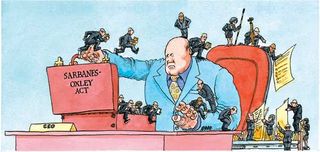
Corporate types complain a lot about the burdens of the Sarbanes-Oxley Act. A decision yesterday by the Ninth Circuit may give them a wee lift.
George Diaz, a shareholder of Digimarc Corporation, a supplier of "secure personal identification systems", sued several of the company's officers and directors for breaching fiduciary duties and violating section 304 of Sarbanes-Oxley. The misdeeds centered around Digimarc's restatement of income because of $2.7 million worth of accounting errors.
The district court dismissed the federal claim on the ground that section 304 doesn't create a private cause of action. The statute provides in relevant part that "an accounting restatement due to material noncompliance of the issue" requires the CEO and CFO of the issuer to reimburse the company for "any bonus or other incentive-based or equity based compensation" they received plus any profits from their trading in company stock during a 12-month period. 15 U.S.C. 7243(a).
The Ninth Circuit agreed. Noting that the Act lacks an explicit authorization of private suits, the court also found in the statute nothing that implied congressional intent to create a private claim for violation of section 304. Diaz v. Davis (In re Digimarc Corp. Deriv. Litig.), No. 06-35838 (9th Cir. Dec. 11, 2008).
