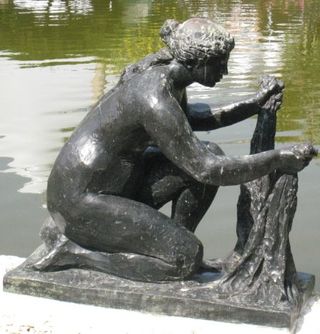
The Washerwoman (1917) by Renoir and Guino.
Between 1913 and 1917, Pierre-Auguste Renoir and an assistant, Richard Guino, collaborated in the creation of 11 sculptures. Guino later obtained the exclusive right to produce and reproduce the objects from the original plaster casts. In 1984, Guino's successor, a trust, registered copyright in the sculptures with the U.S. Copyright Office. In 2003, a great-grandson of Renoir sold some of the sculptures and castings of them in Arizona. The Guino trust sued for copyright infringement. The district court granted summary judgment to them on liability, and a jury later awarded $125,000 in damages.
The Ninth Circuit affirmed. Societe Civile Succession Richard Guino v. Renoir, No. 07-15582 (9th Cir. Dec. 10, 2008).
Blawgletter discovered a couple of things from the opinion. First, that copyright law protects sculptures. (Okay, we kinda knew that already.) And, second, that 17 U.S.C. 303(a) of the Copyright Act of 1976 extends the protection to works someone created before January 1, 1978 but that previously had neither fallen into the public domain nor been copyrighted.
Section 303(a) confers that protection for 70 years after the death of the last surviving author. Because Guino died in 1973, the copyright will last until 2043.
