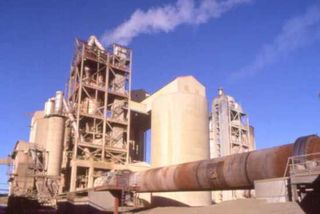
Kilns like this one cook limestone and clay or shale into "clinker".
The European Commission announced yesterday that antitrust enforcers raided offices of the world's five largest cement makers. The Commission's press release said:
The European Commission can confirm that on the 4th and the 5th of November of 2008 Commission officials carried out unannounced inspections at the premises of companies active in the cement and related products industry in several Member States. The Commission has reason to believe that the companies concerned may have violated EC Treaty antitrust rules that prohibit cartels and restrictive business practices and/or abuse of a dominant market position (Articles 81 and 82 respectively).
Reuters reports that the raidees included Lafarge, Holcim, HeidelbergCement, Dyckerhoff, and Cemex.
Do the inspections signify cartel activity in the U.S.? Before you rush out to file a complaint, consider the Second Circuit's recent treatment of allegations that a European conspiracy spilled over into the U.S.:
Plaintiffs provide an insufficient factual basis for their assertions of a worldwide conspiracy affecting a global market for elevators and maintenance services. Allegations of anticompetitive wrongdoing in Europe–absent any evidence of linkage between such foreign conduct and conduct here–is merely to suggest (in defendants' words) that "if it happened there, it could have happened here." And, regarding the nature of the elevator market, plaintiffs offer nothing more than conclusory allegations: for example, there are no allegations of global marketing or fungible products, see Empagran S.A. v. F. Hoffmann-LaRoche, Ltd., 368 U.S. App. D.C. 18, 417 F.3d 1267, 1270 (D.C. Cir. 2005), no indication that participants monitored prices in other markets, see Dee-K Enters., Inc. v. Heveafil Sdn. Bhd, 299 F.3d 281, 295 (4th Cir. 2002), and no allegations of the actual pricing of elevators or maintenance services in the United States or changes therein attributable to defendants' alleged misconduct. See generally Todd v. Exxon Corp., 275 F.3d 191, 200 (2d Cir. 2001). "To survive a Rule 12(b)(6) motion to dismiss, an alleged product market must bear a rational relation to the methodology courts prescribe to define a market for antitrust purposes–analysis of the interchangeability of use or the cross-elasticity of demand, and it must be plausible." (citations and internal quotation marks omitted)). Without an adequate allegation of facts linking transactions in Europe to transactions and effects here, plaintiffs' conclusory allegations do not "nudge [their] claims across the line from conceivable to plausible." [Bell Atlantic Corp. v.] Twombly, 127 S. Ct. [1955,] 1974 [(2007)].
Transhorn, Ltd. v. United Techs. Corp. (In re Elevator Antitrust Litig.), 502 F.3d 47, 52 (2d Cir. 2007). Although the court upheld dismissal of the Elevators complaint, its opinion does suggest factors that could suffice — "global marketing or fungible products", monitoring of prices in the U.S., and "actual pricing" and "changes therein" in the U.S.
Blawgletter would also want to know more about things like market structure (do a handful of cement makers dominate the market?), pricing methodology (do manufacturers publish per ton list prices?), changes in capacity and inventory (have cement makers reduced output despite rising prices?), and areas of effective and potential competition (what effect does the high weight-to-value ratio of cement have on the distance that manufacturers can profitably deliver their product?).
