Who will stay, and who will go?
The next president will appoint dozens of federal appellate judges during his four-year term – plus dozens more should he win re-election in 2012. What does that portend for the federal judiciary? Does it matter?
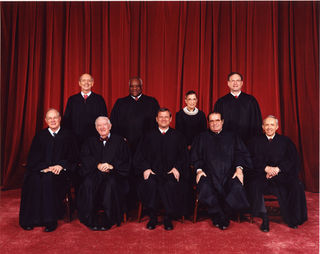
Let's start with the numbers. Not since 1971 have Democratic appointees formed a majority on the Court. On the current Roberts Court, Republican appointees hold seven seats (Roberts, Scalia, Thomas, Souter, Stevens, Alito, Kennedy) while picks of Democratic presidents occupy two (Breyer and Ginsburg).
Since Ronald Reagan's second term, each president has named two justices to the Supreme Court. That seems about right for 2008-12.
The composition of the 13 U.S. courts of appeals has shown more movement. In 1980, the appointees of Democratic presidents outnumbered their Republican colleagues by 86 to 50. The ratio dwindled to 76-66 by 1984 and reversed to 62-96 four years later. Since then, the Democratic-Republican split shifted to 62-96 in 1988, 42-119 in 1992, 54-105 in 1996, 78-76 in 2000, 69-94 in 2004, and 66-101 in 2008. Republican appointees account for 60 percent of all circuit judges today.
On a circuit-by-circuit basis, Republican appointees currently hold 82 percent of the seats on the Eighth Circuit, 76 percent on the Fifth Circuit, 70 percent on the Seventh and D.C. Circuits, 67 percent on the Tenth and Federal Circuits, 60 percent on the First and Sixth, 58 percent on the Eleventh, 54 percent on the Fourth, 50 percent on the Second and Third, and 41 percent on the Ninth.
Appointments of circuit judges clustered in the 25-40 range during each presidential term since President Reagan's first term. (President Carter elevated 59 in his 1976-80 term.) The next president's appointments look likely to tend towards the higher end of the historical range.
Do the numbers matter? A 2006 study showed that appointees of Republican presidents since Reagan voted for the "conservative" outcome in cases 62 percent of the time. The book, Are Judges Political?: An Empirical Analysis of the Federal Judiciary, also found:
- "In ideologically contested cases, involving the most controversial issues of the day, a judge's ideological tendency can be predicted by the part of the appointing president: Republican appointees vote very differently from Democratic appointees."
- "A judge's ideological tendency is likely to be dampened if she is sitting with two judges of a different political party."
- "A judge's ideological tendency, in ideologically contested cases, is likely to be amplified if she is sitting with two judges from the same political party."
(That accords, btw, with Blawgletter's unscientific look at the effect of party balance and party dominance at the Supreme Court of Texas.)
So what would the courts of appeals look like in 2012? An article in Politico.com notes:
Russell Wheeler, a Brookings expert on the courts, calculates that the new president will immediately have 15 appellate vacancies to fill, and would likely get another 14 in the probable event that Congress expands the courts soon to accommodate rising caseloads. Retirements from among the 164 appeals court justices now sitting.
“A reasonable estimate,” Wheeler wrote in a recent study, “is that a President McCain would increase the total proportion of Republican appointees from 56% to 74% and reduce the proportion of Democratic appointees from 36% to 26%.
“That would make for the second most lopsided appellate judiciary in modern history, after 1953, following 20 years of Roosevelt and Truman appointees,” Wheeler said in his study. “A President Obama, by contrast, would reduce the proportion of Republican appointees [from 56%] to 42% and increase the proportion of Democratic appointees from 36 to 58%,” he wrote.
A presidential candidate once told Blawgletter that the vast majority of American voters could not care less about judicial appointments. Perhaps.
But we suspect that people sense when things get out of kilter. The federal judiciary hasn't reached a truly scary level of imbalance. Yet.
