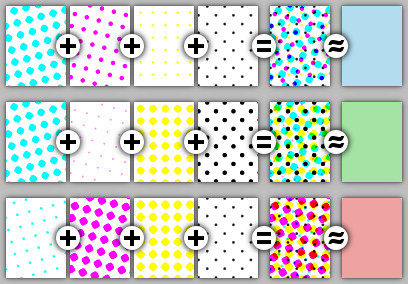
Overlaying dots tricks the eye into seeing one color.
Today the Federal Circuit reversed a decision that invalidated patents for inequitable conduct. The court also held that the district court so deviated from proper analysis as to justify directing the Chief Judge of the originating district to reassign the case.
The dispute involved patents relating to digital halftoning. The invention permits representation of images with dots. Lots of dots.
The court tossed the inequitable conduct conclusion because the district court focused, improperly, on post-filing publication of a paper that explored ways to make halftone images more pleasing. The public disclosure, the court held, didn’t prove the "materiality" prong of the inequitable conduct defense. Research Corp. Technologies, Inc. v. Microsoft Corp. , No. 06-1275 (Fed. Cir. Aug. 1, 2008).
Blawgletter notes, as we must, that the opinion uses the phrase "this court" 19 times — and the word "indeed" four times — in the course of 14 pages. While we generally admire judicial modesty, we marvel at the extent of judicial self-effacement. Indeed.
