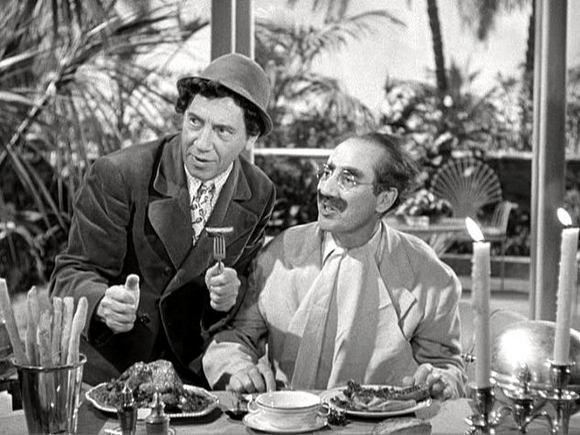
Chico and Groucho Marx in A Night in Casablanca.
As visions of Sea Smoke start dancing in Blawgletter’s head — for tonight Oxford promises to uncork some — the time seems right to close out Groucho Marx’s epistolary feud with Warner Brothers over the then-impending release of A Night in Casablanca (1946).
We’ve seen Mr. Marx’s first two letters, in which he responds to missives from the Warner legal department. His opening salvo questions whether the studio owned the name "Casablanca" and from there ponders intellectual property rights in other monikers, including "Brothers", "Burbank", and "Jack". The next, which answers a second Warner letter asking for a summary of A Night in Casablanca‘s plot, has Mr. Marx as a doctor of divinity who hawks can openers and pea coats.
The final instalment follows:
Dear Brothers:
Since I last wrote you, I regret to say there have been some changes in the plot of our new picture, "A Night in Casablanca." In the new version I play Bordello, the sweetheart of Humphrey Bogart. Harpo and Chico are itinerant rug peddlers who are weary of laying rugs and enter a monastery just for a lark. This is a good joke on them, as there hasn’t been a lark in the place for fifteen years.
Across from this monastery, hard by a jetty, is a waterfront hotel, chockfull of apple-cheeked damsels, most of whom have been barred by the Hays Office for soliciting. In the fifth reel, Gladstone makes a speech that sets the House of Commons in an uproar and the King promptly asks for his resignation. Harpo marries a hotel detective; Chico operates an ostrich farm. Humphrey Bogart’s girl, Bordello, spends her last years in a Bacall house.
This, as you can see, is a very skimpy outline. The only thing that can save us from extinction is a continuation of the film shortage.
Fondly,
Groucho Marx
And so it ended. Warner Brothers never responded, and the world today can watch A Night in Casablanca to our heart’s content.
