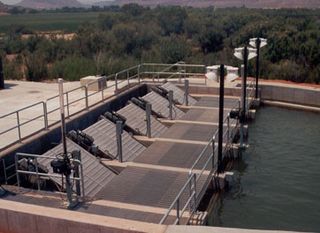
A water intake system for a power plant. Note the screens.
Big power plants "remove" huge quantities of water from "various nearby . . . sources" — presumably including oceans, seas, lakes, rivers, creeks, brooks, and possibly even rills. They use the H20 to cool the heat that results from burning gas, coal, and other fuel. But the intake of 214 billion gallons per day does damage to aquatic organisms by squishing them or carrying them along to the superhot place.
The Clean Water Act (section 1326(b)) mandates use of the "best technology available for minimizing adverse environmental impact" from such activity. Does that requirement allow the Environmental Protection Agency to weigh costs against benefits of different ways to save the water-denizens from injury and death through "impingement and entrainment"?
The Supreme Court said yes today. Five justices voted with the majority (Chief Justice Roberts, Alito, Kennedy, Scalia (author), and Thomas), one concurred in part and dissented in part (Justice Breyer), and three dissented (Justices Ginsburg, Souter, and Stevens (author)). The power plant operators therefore don't have to install "closed-cycle" systems that impinge and entrain less than other types. Entergy Corp v. Riverkeeper, Inc., No. 07-588 (U.S. Apr. 1, 2009).
The Court also held that a union member must abide by a collective bargaining agreement that "unmistakably" required arbitration of an Age Discrimination in Employment Act claim. The Court rejected the argument that an arbitration clause lacks enforceability simply because the union, in agreeing to it, ignored the interests of union members in retaining their option to pursue ADEA and like claims in court. Along the way, the 5-4 majority (Chief Justice Roberts and Justices Alito, Kennedy, Scalia, and Thomas (author)) explained that its old precedents didn't actually decide the controlling question and reflected an arbitration-averse attitude that the Court has since discarded. Justices Breyer, Ginsburg, Souter (author), and Stevens (also an author) respectfully disagreed. 14 Penn Plaza, LLC v. Pyett, No. 07-581 (U.S. Apr. 1, 2009).
