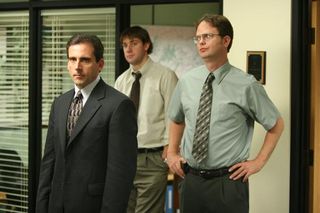
Snarky reference to The Office helps earn reversal.
Company A wrote manuals to train employees. The works included "Positive Power & Influence", "Positive Negotiation Program", and "Promoting and Implementing Innovation". Big companies paid actual money to get the workbooks — and presumably to inflict them on their workers.
Several Company A veterans formed Company B. Company B did pretty much the same thing Company A did. Company A complained that Company B's training materials seemed a touch too similar to Company A's. Company B stiffed Company A, which then sued the offshoot for copyright infringement.
The district court, on a "case stated" basis, found no infringement of "original" material and that Company A's stuff fell within an exclusion for "processes and systems". The court said, among other things, that Company A's "works exemplify the sorts of training programs that serve as fodder for sardonic workplace humor that has given rise to the popular television show The Office and the movie Office Space. They are aggressively vapid — hundreds of pages filled with generalizations, platitudes, and observations of the obvious." Situation Mgmt. Sys., Inc. v. ASP. Consulting Group, 535 F. Supp. 2d 231, 239 (D. Mass. 2008).
The First Circuit reversed and remanded. The district court erred in applying too tough a test for the "originality" requirement of copyright protection. An original work doesn't mean a novel one, the court held. Aggressive vapidity doesn't disqualify a work so long as it displays at least some minimal "creative spark". Nor did the "processes and systems" exclusion apply because the workbooks didn't embody a process or system but instead "expressed" a description of such. The district court should try again. Situation Mgmt. Sys., Inc. v. ASP. Consulting LLC, No. 08-1543 (1st Cir. Mar. 19, 2009).
Blawgletter suspects that the court of appeals frowned on what it described as the district court's "pejorative disdain for the value of [Company A's] works." But we suspect that, despite the workbooks' qualification for copyright protection, little will come of Company A's suit. Company B likely expressed vapidity in a sufficiently different way to avoid a finding of "substantial similarity" on remand.
 Our feed shuns observations of the obvious. Most of the time.