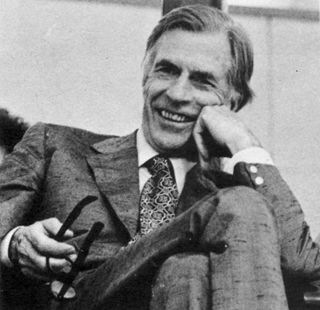
John Kenneth Galbraith (1908-2006).
During Blawgletter's college years, a Harvard economics professor visited as a Chubb Fellow for a few days, and we got to join other students with him over lunch. We'd read one of Professor Galbraith's books, The Affluent Society (1953), and found a particular concept in it unpersuasive — his notion of "want creation". He argued that producers of goods and services create "wants" instead of satisfying "needs". He predicted someday the process would fail, with grim consequences.
We asked him whether, some 25 plus years after he posited the idea, he saw signs of want creation faltering. The question seemed to irritate him. He answered that the failure of the phenomenon might yet come to pass.
The current financial turmoil in a way vindicates the Galbraithian hypothesis in part. Firms did indeed continue to seduce consumers into purchasing stuff they don't really need — from iPods to Facebook pages and, indeed, to blogs. But the real trouble lay in the mushrooming (and ever-riskier) debt that paid for it.
Galbraith, to our ear, sounds prophetic on the calamity we've reaped from years of sowing credit excess:
As we expand debt in the process of want creation, we come necessarily to depend on this expansion. An interruption in the increase in debt means an actual reduction in demand for goods. Debt, in turn, can be expanded by measures which, in the nature of the case, cannot be indefinitely continued.
* * * *
In fact, we do not really know the extent of the danger. A tendency to liquidation of consumer debt, with accompanying contraction in current spending, could be offset by prompt and vigorous government action to cut taxes, increase public outlays and so compensate with spending from other sources. . . . But taxation and expenditure beyond the range of . . . automatic stabilizers require Executive and Congressional action. Such decision and action could be in a radically slower tempo from that of debt liquidation and the consequent slump in spending.
A possibility of trouble is not a prediction of trouble. Not many, if told of the vast expansion in consumer debt when it lay ahead, would have thought it safe. Perhaps the expansion can continnue and possibly it will one day taper off in benign fashion. But we would do well to keep an alarm signal flying over the consumer-debt creation into which the process of want creation impels us. In a society into which the production and sale of goods seem sacrosanct, there will be extreme hesitation over measures which will seem to restrain the financing of consumer's goods and hence their sale. Measures to prevent the competitive liberalization of consumer credit will encounter the heaviest resistance. . . .
Though such regulation is a commonplace in the United Kingdom and has been used in the United States in wartime, it is unlikely to be authorized in the future except in the aftermath of disaster. Interference with the process of want creation cum debt creation will be thought wrong.
John Kenneth Galbraith, The Affluent Society 148 & 151-52 (1998 ed.).
