Does asking jurors to "imagine" a story that blends evidence and fantasy cross the line into impermissible jury argument?  What if you add "abusive references" to opposing counsel?  Will the combination exceed the outer boundaries of what a lawyer may properly argue to a jury?

The Tenth Circuit held in Whittenberg v. Werner Enterprises Inc., No. 07-6063 (10th Cir. Apr. 3, 2009), that plaintiffs' counsel went too far and that therefore the ensuing $3.2 million verdict could not stand.  The case involved the Whittenbergs' claim that a trucking company, Werner Enterprises, and a trainer-trainee team of drivers negligently caused Mack Whittenberg to drive into a Werner semi-trailer truck as it straddled a dark highway after an abortive attempt to make a u-turn. 

The lawyer for Mack and his five children said this in his closing, during which defense counsel twice objected:

And so I want to take you back to November 30th, and I want you to do just an imagining thing with me.

You recall Ann Whittenburg sitting there on the stand and saying, “Sunday afternoon we saw Mack off that day that he went to the ranch.”

Now, just bear with me; think with me.

Imagine that there’s Brit, and there’s Ann, and they sent Mack off, he’s on his way out there Sunday afternoon, maybe six o’clock. Mack turns around the corner as he leaves Palacio back to I-40 and he’s going to take 35 north on his way to 287 out of the Amarillo.

Brit turns around and gets ready to walk back in the house, and there’s an envelope sitting there on the floor, and he reaches down and he picks it up, and he gives it to Ann, and Ann opens it, and she looks at it, and it’s a letter.

It’s a letter to Brit and to Sarah and to Cecily and to Justin and to Amanda.

I’m just imagining, but listen to these facts.

This letter’s dated November 30th, 2003, and it’s from Werner Enterprises.

“Brit:

“That was the last time you will ever see your dad as you now know him. You should let your siblings know this.  “In just a little while, our company drivers, Jon Morlan and Marisela Neff, are going to get in one of our big semi-trucks in Limon, Colorado, and we’re going to head south toward Amarillo pulling a loaded trailer.

Ms. Neff will be driving. She’s too inexperienced to make this trip safely, and Mr. Morlan will be too tired to properly supervise her, and, while Mr. Morlan crawls in the truck sleeper and goes to sleep –

. . .

“Ms. Neff will be unable to properly follow the route that she and Mr. Morlan laid out, and she will be too confused to read the upcoming road signs.

“Our drivers will arrive in Boise City, Oklahoma, just ahead of your dad, sometime around midnight or thereafter. Ms. Neff will take a wrong turn west of Boise City, and Mr. Morlan – Mr. Morlan will be too in much of a – he’ll be in too much of a blue funk to be of any help to her after she does call on him for help.

“He will refuse to take the steering wheel when she calls for his help, and she will high-center the truck on the highway when she attempts a Uturn, rather than taking a little extra time to find a place that – safe place to turn around or to call for help. And Ms. Neff will center – will high-center this semi-truck out on the same highway that your dad will be traveling on his

make excuses, and our lawyers will try to blame the collision on your dad, saying it was just an accident and that he had the last clear chance to avoid it. We will never take responsibility for our driver’s actions.

“We will hire own – our own lawyers who will take your dad’s life apart. Our lawyers will focus on the fact that your dad comes from a prominent Texas Panhandle family, and our lawyers will expose every part of your dad’s professional and personal life in an attempt to make the jurors think poorly of him.

“Our lawyers will accuse him of being a trust-fund baby who intentionally remained under-employed just so he could bring this lawsuit and prove damages.

“Our lawyers will hire experts and will force your dad’s lawyers to hire experts in order to prove that he wasn’t at fault.

“We will fight to keep out of evidence that our driver-trainee pleaded guilty to unlawfully stop – unlawfully parking a stopped vehicle that night, and we will spend thousands of dollars to have –

. . .

“We will have our experts spend – we will spend thousands of dollars to have our expert perform a nighttime photo shoot in an effort to persuade your dad and possibly jurors that he was just not paying attention on that fateful morning.

“Our lawyers will spend whatever it takes to try to talk our way out of having to be accountable for what our inept trainer and our inexperienced driver did.

“We will subject your dad to a trial if we have to. We will do everything in []our power to convince the jury that your dad was really not all that injured in the first place, and that your dad is overreaching in trying to prove his damages.

“Of course, if none of that works, our lawyers will accuse your dad of being a failure because his law firm used to have 20 members and now it only has five.

“We will point out that he apparently lived off your Uncle George and your Aunt Ann Whittenburg simply because he couldn’t make it on his own.

“We w[i]ll not mention the fact that your dad sacrificed greatly as a single father to take care of the five of you while you were growing up and then devoted years as a nighttime caregiver for your Granny Grace so she could live with honor and dignity prior to her death.

“We will ignore the fact that your dad has a sense of pride in what your Grandfather Roy accomplished before him, and we will ridicule his 

love and respect for his family’s heritage, and then demean him by calling his love of the Spool Ranch a mere hobby.

“Oh, and while we’re at it, our lawyers will also try and discredit your dad’s lawyers by hinting throughout the trial that they have attempted to influence witness testimony against us.

“Of course, none of this is true, but we’ll keep using smoke and mirrors and half truths the best we can to try and shift the jury’s focus away from the real issue in this case, and that is our inexperienced driver trainee and our inept driver trainer attempted an improper U-turn and got highcentered and then failed to warn oncoming traffic – traffic of the danger it created, and that is what really caused, directly caused the collision in this case.

“Sincerely, Werner Enterprises.”

Id. slip op. at 4-7.  The vice in the argument, according to the court, consisted in its use of "invented facts" that aimed to arouse the jurors' sympathy and its heaping of "vituperative attacks on defendants and their counsel."  Id. at 11 & 12-13.

Blawgletter agrees that the argument would tend to evoke strong emotion.  What kind of company would deliver to a man's children a letter that foretells their father's impending accident and serious injuries, admits the company's fault, and confesses sharp tactics to deny them and their father a semblance of justice?  An evil one.

We feel less certain than the court that the argument must have so swept up the jurors that their verdict had to have resulted from unreasoning passion.  And surely a lawyer may argue that defendants knowingly took risks and didn't care about the consequences.  

May the lawyer also say the defendants made litigating and trying the case into an ordeal?  That they intended to do so even before the accident?   In the form of an imaginary letter to the victim's kids?

Despite their flat-out refusal to comply with the District Court’s lawful orders, the Uzans now have the chutzpah to seek post-judgment, equitable relief from complying with those orders.

Motorola Credit Corp. v. Uzan, No.07-2076-cv, slip op. at 6-7 (2d Cir. Mar. 31, 2009) (per Jose A. Cabranes, J.) (affirming refusal to grant relief from judgment for $3 billion under Fed. R. Civ. P. 60(b)).

FeedIcon Blawgletter Twitters not.

A Ninth Circuit panel split 2-1 on whether a California wholesale buyer of clean-burning CARB gasoline alleged a viable claim under section 1 of the Sherman Act.  (CARB seems to stand for California Air Resources Board.) 

The wholesaler accused major oil producers of tying up their refinery capacity by entering into "bilateral exchange agreements" – 44 of them.  It also asserted that the producer's agreements, by limiting production of CARB gasoline, caused anticompetitive effects in the form of prices "above competitive levels".  The district court dismissed the case on the ground that the complaint failed to allege that each contract, individually, produced supracompetitive prices.

The Ninth Circuit majority reversed.  William O. Gilley Enterprises, Inc. v. Atl. Richfield Co.  No. 06-5069 (9th Cir. Apr 3, 2009).  It held that the wholesaler adequately pleaded the elements of a section 1 claim.  The complaint specified the "agreement" element alright — actually quite a few agreements.  That the pleading didn't also assert an intent to cause harm to competition didn't matter. 

The big fight concerned whether the district court properly declined to credit the wholesaler's allegations that the producer's bilateral exchange agreements cumulatively exerted "market power" and that they produced an "anticompetitive effect".  The court noted that Supreme Court precedent and its own have "allowed aggregation of multiple contracts when evaluating the legality of an individual contract."  Id., slip op. at 4025.  Nor could defendants save the day with arguments that only certain kinds of agreements (tying and exclusive dealing ones) warrant aggregate consideration and that bilateral exchange agreements actually enhance competition. 

"At this stage of a motion to dismiss for failure to state a claim," the majority said, it is not our role to determine the soundness of Plaintiffs' economic theory.  Even if we, as a savvy court, view actual proof of the facts pleaded in the [complaint] as improbable and conclude that a recovery is remote and unlikely, the complaint should still proceed. . . . The analysis we would have to unertake to dismiss the complaint is not appropriate at the Rule 12 stage."  Id. at 4027 (citing Bell Atl. Corp. v. Twombly, 127 S. Ct. 1964, 1965 (2007)).

FeedIcon Our feed feels a cert. petition coming on.

WaterIntake 
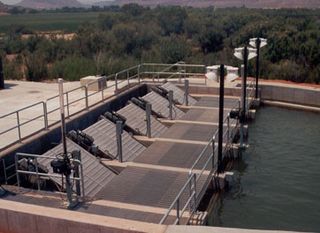
A water intake system for a power plant.  Note the screens.

Big power plants "remove" huge quantities of water from "various nearby . . . sources" — presumably including oceans, seas, lakes, rivers, creeks, brooks, and possibly even rills.  They use the H20 to cool the heat that results from burning gas, coal, and other fuel.  But the intake of 214 billion gallons per day does damage to aquatic organisms by squishing them or carrying them along to the superhot place.

The Clean Water Act (section 1326(b)) mandates use of the "best technology available for minimizing adverse environmental impact" from such activity.  Does that requirement allow the Environmental Protection Agency to weigh costs against benefits of different ways to save the water-denizens from injury and death through "impingement and entrainment"?

The Supreme Court said yes today.  Five justices voted with the majority (Chief Justice Roberts, Alito, Kennedy, Scalia (author), and Thomas), one concurred in part and dissented in part (Justice Breyer), and three dissented (Justices Ginsburg, Souter, and Stevens (author)).  The power plant operators therefore don't have to install "closed-cycle" systems that impinge and entrain less than other types.  Entergy Corp v. Riverkeeper, Inc., No. 07-588 (U.S. Apr. 1, 2009).

The Court also held that a union member must abide by a collective bargaining agreement that "unmistakably" required arbitration of an Age Discrimination in Employment Act claim.  The Court rejected the argument that an arbitration clause lacks enforceability simply because the union, in agreeing to it, ignored the interests of union members in retaining their option to pursue ADEA and like claims in court.  Along the way, the 5-4 majority (Chief Justice Roberts and Justices Alito, Kennedy, Scalia, and Thomas (author)) explained that its old precedents didn't actually decide the controlling question and reflected an arbitration-averse attitude that the Court has since discarded.  Justices Breyer, Ginsburg, Souter (author), and Stevens (also an author) respectfully disagreed.   14 Penn Plaza, LLC v. Pyett, No. 07-581 (U.S. Apr. 1, 2009).

Feed-icon-14x14 Click here to entrain our feed.

Anne Reed at Deliberations explains the U.S. Supreme Court's unanimous decision on "peremptory challenges" to potential jurors yesterday in Rivera v. Illinois, No. 07-9995 (U.S. Mar. 31, 2009).  Bottom line:  A judge's good faith error in rejecting a peremptory doesn't entitle you to a new trial.

That presumably applies not only in criminal cases (like Rivera) but also in civil ones.

SupremeCourtBldg 

On March 26, Chief Justice John Roberts transmitted to Congress a slew of revisions to four different sets of federal procedural rules.  By their terms and under the Rules Enabling Act, the changes will take effect December 1, 2009 – unless the House and Senate pass legislation invalidating them.

Blawgletter glanced at one group — those affecting the Federal Rules of Civil Procedure – and noticed what looks like a welcome improvement.  It pertains to every lawyer's favorite — the computation of time.

Rule 6(a)(2), for example, has vexed and confounded lawyers by calling on them to exclude "intermediate Saturdays, Sundays, and legal holidays when the period [for taking some action, such as filing a pleading or motion] is less than 11 days."  The exclusion had the effect of giving you at least 14 days to take the action that a rule or order seemed to require you to do in 10.

New Rule 6(a)(1)(B) will eliminate the mental gymnastics.  It provides that you must "count every day, including intermediate Saturdays, Sunday, and legal holidays" no matter what.

Other fixes extend the time for doing stuff.  Existing Rule 6(c)(1), for instance, demands notice "at least 5 days" before a hearing; under the new regime, you'll generally get a minimum of 14.

The alterations to Rule 56 will add a time requirement for responding to a motion for summary judgment — 21 days after service of the motion — and for a reply — 14 days after that.  In the past, local rules governed those time limits.

Don't think we've come anywhere near exhausting the rules nouveau.  Indeed, we suspect that the continuing legal education folks will promptly set to fashioning seminars that will orient us to the procedural vicissitudes that await us eight months hence.

[Bonus:  You can scan the innovations to other sets of rules at Federal Rules of Appellate Procedure, Federal Rules of Bankruptcy Procedure, and Federal Rules of Criminal Procedure.]

Feed-icon-14x14 Our feed wishes it could rule from the bench.

The New York Court of Appeals today upheld an agreement to pay a referring law firm "one-third of the entire fee recovered" in a medical malpractice case.  The "entire fee" included the amount attributable to the efforts of a third law firm.  That the referring lawyer may not have contributed one-third of the productive work didn't matter, the court held.  Nor could the firm that agreed to pay one-third of the fee complain about non-compliance with ethical rules, which in any event the referring firm satisfied.  Samuel v. Druckman & Sinel, LLP, No. 39 (N.Y. Mar. 31, 2009).

Adam Liptak usually writes about interesting stuff — interesting, at least, to lawyers.  Today he takes the measure of a new study about American Bar Association ratings of nominees for U.S. court of appeals judgeships between 1985 and 2008.

The report, Bias and the Bar: Evaluating the ABA Ratings of Federal Judicial Nominees, summarizes its conclusions thus:

We find both that, all else being equal, Democatic/liberal nominees are more likely to receive the ABA's highest rating of "Well Qualified" than their Republican counterparts, but also that the ABA relies on more traditional measures of professional qualifications, such as prior experience as a judge or Circuit Court clerk, when rating nominees to the federal appellate courts.  Our results lead us to conclude that the ABA should take affirmative steps to ensure liberal candidates are not being unconsciously favored and rated.  In particular, our findings suggest that there is some systematic component of the evaluation process, possibly the use of the "judicial temperament" criterion, which lends itself to lower ratings of more conservative nominees.

Mr. Liptak notes a possible limitation in the data — that, during the Clinton presidency (1993-2000), potential nominees underwent a secret ABA vetting but that President George W. Bush (2001-08) nominated candidates before the ABA rated them.  He says that "[w]hat cannot be known is how many [Clinton] nominations were never formally presented after the bar association confidentially conveyed a low rating to the White House."

No doubt the subject deserves discussion.  What do you think?

Feed-icon-14x14 Our feed subscribes to itself.

AirTaxi 
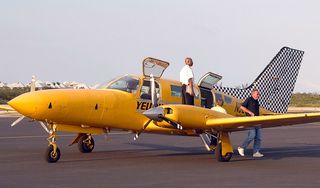
An air taxi.

A service mark associates services with a specific provider in the same way that a trademark identifies the furnisher of goods.  Someone who misuses a service mark or trademark may suffer the consequences in an infringement action under the Lanham Act.

[Blawgletter briefly explained the different "strengths" of marks in Annals of Trademark Law:  "It's bus!  It's a boat!  It's a Super Duck!".]

Today the Federal Circuit explored the "use in commerce" requirement for registration of a service mark.

The applicant for registration of "AIRFLITE", Aycock Engineering, told the U.S. Patent and Trademark Office in the early 1970s that it planned to offer a service that would link people who wanted "air taxi" service to operators capable of flying them hither and yon.  But, as the court put it, Aycock's "operation never got off the ground."  Aycock Eng'g, Inc. v. Airflite, Inc., No. 08-1154, slip op. at 3 (Fed. Cir. Mar. 30, 2009).

The failure to connect even a single passenger with just one air taxi vendor proved fatal to the supplemental registration in 1974 of "AIRFLITE".  In 2001, AirFlite, Inc., challenged the registration before the Trademark Trial and Appeal Board.  The TTAB concluded that Aycock had never "used" the mark "in commerce" before 1974 and ordered cancellation. 

The Federal Circuit affirmed on the same ground.

Feed-icon-14x14 So to speak.

T-MobileLANPCCard 
The Chalks alleged a T-Mobile wireless card wouldn't work in their ThinkPad.

The Ninth Circuit yesterday reversed dismissal of a putative consumer class action.  The decision turned on whether a class arbitration waiver in a subscriber contract violated principles of unconscionability under Oregon law.  The court held it did.  Chalk v. T-Mobile USA, Inc., No. 06-35909 (9th Cir. Mar. 27, 2009).

The court followed Vasquez-Lopez v. Beneficial Oregon, Inc., 152 P.2d 940 (Ore. Ct. App. 2007) (post here), in concluding that the arbitration clause itself — without evidence showing its unconscionable effects — sufficed to invalidate the class waiver.

Feed-icon-14x14 Our feed welcomes new subscribers.