May a federal judge force a lawyer to keep representing an hourly client that refuses to pay?

The Sixth Circuit answered no — so long as the client gets "reasonable warning" and the lawyer's withdrawal won't cause the client "severe prejudice".  Proskauer Rose met those requirements, the court held, because it notified the client, Richard Jonathan Blech, three weeks in advance that it would ask for court permission to get out unless he paid overdue bills and because an pre-existing and ongoing stay of the case precluded a finding of prejudice.  Brandon v. Blech, No. 08-5355 (6th Cir. Mar. 24, 2009).

[Blech had pleaded guilty to securities fraud, but Douglas C. Brandon went to trial on the same charge and lost.  Brandon sued Blech for causing Brandon's criminal culpability.  The district court stayed Brandon's civil case pending his criminal appeal.  After Blech got behind on Proskauer Rose's bills for defending him against Brandon's claim, the firm gave Blech notice of its intent to move for withdrawal if he failed to get current.  Blech balked, and Proskauer Rose filed a motion for leave to exit.  The district court denied the request.  Proskauer Rose appealed under the "collateral order" doctrine.  The Sixth Circuit reversed the denial.]

Blawgletter notes that, although withdrawal left the client without counsel, the loss of representation by itself didn't "prejudice" him in a way that would require the firm to stay on.  The lack of activity in the case (due to the stay) assured that nothing bad would happen to his rights in the foreseeable future. 

By contrast, a fast-moving case — one on the eve of trial, for example – could present a tougher challenge.  That would hold especially true, as the court noted, if a firm delayed its demand to increase pressure on the client and thereby coerce payment.

Feed-icon-14x14 Our feed says hello to its friends at Proskauer Rose.

JuryBox 
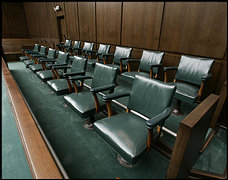
An empty jury box.

A couple years ago, Blawgletter reported a Disturbing Trend in the number of jury trials that Lone Star State civil district courts conducted during 2006 versus a decade earlier.  We said:

Skeptical of growing complaints about the vanishing jury trial, Blawgletter did a little research.  It found that, in 1996, according to the "Jury Activity" report by the Texas Office of Court Administration (available here), Texas district courts tried 2,971 civil cases to verdict and directed verdicts in 253.  Ten years later, the same courts put 1,335 civil cases to juries while instructing verdicts in 459 cases.

What accounts for the 55 percent drop in jury trials and the 81 percent increase in taking cases out of jurors' hands?  Has the [Texas Supreme] Court's recent record of overturning verdicts, restricting expert evidence, curtailing class actions, and taking other steps that make cases harder to win for plaintiffs produced filing of fewer cases, more (and cheaper) settlements, and greater boldness by trial judges to kick cases out of court?  Blawgletter shudders to think that the subject deserves study.

Study the subject did indeed deserve.  Today we update you.

To see what jury trials have done over the last decade, we looked at the year ending August 31, 1998 and compared it to the year that terminated the same late-summer day in 2008.  [We chose the dates to avoid the effects of statistics-reporting anomaly in pre-2003 reports.]  What did we find?  More discouraging news:

  • In the 1997-98 time frame, parties paid jury fees in 31,059 cases; 2,517 went to verdict; and trial judges directed verdicts in 286.
  • During the 2007-08 period, the jury-fee payers dropped to 22,386 (a 27.9 percent decrease); 1,472 produced a verdict (down 41.5 percent); and directed verdicts rose to 365 (an uptick of 27.6 percent).

We decline this time to speculate on why jury trials continued their downward spiral, directed verdicts proliferated, or – especially distressing — so many fewer parties bothered even to pay the fee to get a trial by jury.

Feed-icon-14x14 Democrats lost every state-wide office in 1998.

May manufacturers, consistently with section 1 of the Sherman Act, instruct distributors that they must charge their customers no less than $X for the manufacturers' products?  

They can, the Fourth Circuit held today, if the makers and distributors stand in a "genuine principal-agent relationship".  Valuepest.com of Charlotte, Inc. v. Bayer Corp., No. 07-1760 (4th Cir. Mar. 24, 2009).

The court explained that a true agent simply does the will of its principal and that, therefore, an agreement requiring the agent to mind the principal when the former goes to set prices doesn't count as a contract, combination, or conspiracy to restrain trade.  The court accordingly affirmed summary judgment for pesticide producers Bayer and Aventis CropScience on the strength of their "agency defense" to the section 1 claim.

You seldom see a federal judge grant a motion for recusal.  And an appellate court that reverses denial of such a motion shares much with a unicorn.

Today an Eighth Circuit panel split 2-1 in overturning a district judge's refusal to step aside.  The judge's errors in imposing a death penalty sanction for discovery abuse, together with intemperate comments from the bench, created the appearance of partiality, the court held.  Reversing the sanction, the court ordered reassignment of the case on remand.  Sentis Group, Inc. v. Shell Oil Co., No. 07-2308 (8th Cir. Mar. 24, 2009).

The majority opinion didn't recite all of the statements that the judge himself characterized as "mere expressions of frustration at the course of discovery in this case."  The remarks it did mention strike Blawgletter as not so bad.  The judge said "hell, yes" and "goddamn" twice in a hearing and, in total, "directed profanities at Plaintiffs or Plaintiffs' counsel over fifteen times."  Id. at 26.  But what seems to have troubled the majority most consisted in the emotion the judge's words and actions seemed to betray.

Perhaps to soothe the feelings of a colleague, the majority laid blame on the parties, which it said "provoked the district court into making untempered comments, using profane language, and taking actions that created an appearance of partiality."  Id. at 2.  While not condoning the plaintiffs' evasive "behavior or tactics", the majority said, "it seems clear that at some point in the proceedings, Defendants' goal shifted from conducting effective discovery to fanning the flames of the court's frustration and building a case for sanctions."  Id.  The defendants put so much into the effort that they "made an hour-long PowerPoint presentation", which the majority implied so bestirred the judge that he lapsed into something like a rage.  Id. at 12-14.

The dissent cited the general rule that an appearance of partiality, for purposes of recusal, must arise from "extrajudicial" matters (things that arise outside of court proceedings) or from displays of "a deep-seated favoritism or antagonism that would make fair judgment impossible."  Id. at 29 (Gruender, J., dissenting) (quoting Liteky v. United States, 510 U.S. 540, 555 (1994)).

Anybody who has practiced more than a few years has encountered an angry judge.  The anger makes clear thinking and error-free deciding far more difficult.  Ire — whether smoldering or flaming — thus endangers fairness.  We commend the majority on reaching a difficult but probably right conclusion.  Dispassionately.

Globalization exploits what economist call the "comparative advantage" of one country over another in the production of particular goods or services.  We may suppose, for example, that the snooty French produce superior fashion designers and more pleasing perfumers and that the grim Germans engineer the finest sports cars.  We may also posit that nations with an abundance of skillful workers enjoy an edge over ones with a shortage; their labor costs less.

India fits the description in the latter example.  And apparently the Subcontinent's plenitude of low-wage software developers prompted a dispute that today landed before the Fourth Circuit.

Structure Works, a Colorado outfit, retained Geometric Software, an Indian corporation, to help with a structural design and software project.  Structure Works also brought in Consulting Engineers, a Virginia company that operated branch offices in India, to, um, consult.  The interactions resulted in two non-disclosure agreements, one between Consulting Engineers and Structure Works and another between Consulting Engineers and Geometric Software.  Both prohibited hiring of Consulting Engineers employees.

The role of Consulting Engineers didn't work out in the project, but the contacts seem to have led Geometric Software to breach the no-hire clause when it gave a job to Manoj Kumar.  Consulting Engineers sued Structure Works and Geometric Software in Virginia.  The district court dismissed for lack of personal jurisdiction.

The Fourth Circuit upheld the dismissal.  The few contacts that touched Virginia did not, the court concluded, satisfy due process requirements.  Yes, Structure Works and Geometric Software participated in telephone calls and emails involving Consulting Engineers, but none of that amounted to purposeful availment of the right to do business in the Old Dominion.  And of course the dispute centered on an outsourcing arrangement for work on the other side of the world and, particularly, the improper luring away of an Indian employee in India.  Consulting Engineers Corp. v. Geometric Ltd., No. 07-1453 (4th Cir. Mar. 23, 2009).

FeedIcon  Our feed offers its apologies to E. M. Forster.

The hubbub over bonuses for masters of the financial universe (examples here and here) reminds Blawgletter of something a partner once said about "Money River".  The partner alluded to the hazards of drinking from that stream.  It sounded mysterious.

We've since learned that the partner had reference to a Kurt Vonnegut novel, God Bless You, Mr. Rosewater — or Pearls Before Swine (1965).

A little more research produced the relevant passages.  Vonnegut has the protagonist explain the concept thus:

The Money River [is] where the wealth of the nation flows.  We were born on the banks of it — and so were most of the mediocre people we grew up with, went to private schools with, sailed and played tennis with.  We can slurp from that mighty river to our hearts' content.

An American can still find fortune, the protagonist goes on, but only at the stream:

Sure[, a poor person can become rich] – provided somebody tells him when he's young enough that there is a Money River, that there's nothing fair about it, that he had damn well better forget about hard work and the merit system and honesty and all that crap and get to where the river is.  "Go where the rich and powerful are," I'd tell him, "and learn their ways.  They can be flattered and they can be scared.  Please them enormously or scare them enormously, and one moonless night they will put their fingers to their lips, warning you not to make a sound.  And they will lead you through the dark to the widest, deepest river of wealth ever known to man.  You'll be shown your place on the riverbank, and given a bucket all your own.  Slurp as much as you want, but try to keep the racket of your slurping down.  A poor man might hear."

Ah.  The Wall Street wizards committed the gross error of slurping too loudly.  Worse, they imbibed public money.

And yet they seem oblivious.  Vonnegut foresaw that, too:

Born slurpers . . . can't imagine what the poor people are talking about when they say they hear somebody slurping.  They don't even know what it means when somebody mentions the Money River.

FeedIcon To the barricades!

TheOffice 
Snarky reference to The Office helps earn reversal.

Company A wrote manuals to train employees.  The works included "Positive Power & Influence", "Positive Negotiation Program", and "Promoting and Implementing Innovation".  Big companies paid actual money to get the workbooks — and presumably to inflict them on their workers.

Several Company A veterans formed Company B.  Company B did pretty much the same thing Company A did.  Company A complained that Company B's training materials seemed a touch too similar to Company A's.  Company B stiffed Company A, which then sued the offshoot for copyright infringement.

The district court, on a "case stated" basis, found no infringement of "original" material and that Company A's stuff fell within an exclusion for "processes and systems".  The court said, among other things, that Company A's "works exemplify the sorts of training programs that serve as fodder for sardonic workplace humor that has given rise to the popular television show The Office and the movie Office Space.  They are aggressively vapid — hundreds of pages filled with generalizations, platitudes, and observations of the obvious."  Situation Mgmt. Sys., Inc. v. ASP. Consulting Group, 535 F. Supp. 2d 231, 239 (D. Mass. 2008).

The First Circuit reversed and remanded.  The district court erred in applying too tough a test for the "originality" requirement of copyright protection.  An original work doesn't mean a novel one, the court held.  Aggressive vapidity doesn't disqualify a work so long as it displays at least some minimal "creative spark".  Nor did the "processes and systems" exclusion apply because the workbooks didn't embody a process or system but instead "expressed" a description of such.  The district court should try again.  Situation Mgmt. Sys., Inc. v. ASP. Consulting LLC, No. 08-1543 (1st Cir. Mar. 19, 2009).

Blawgletter suspects that the court of appeals frowned on what it described as the district court's "pejorative disdain for the value of [Company A's] works."  But we suspect that, despite the workbooks' qualification for copyright protection, little will come of Company A's suit.  Company B likely expressed vapidity in a sufficiently different way to avoid a finding of "substantial similarity" on remand.

Feed-icon-14x14 Our feed shuns observations of the obvious.  Most of the time.

Blawgletter shares the Public Anger over the use of the Public Fisc to enable American International Group to pay questionable debts to (1) buyers of credit default swaps and (2) the AIG people who sold them.

Category (2) — involving several hundred millions — summons especial perplexity.  The bonuses, we suspect, conjure images of fat cat brokers laughing at hapless taxpayers as they (the fat cats) convert their six- and seven-figure checks into celebratory champagne and caviar, Bentleys, and chortling disparagement of the hoi polloi.  Everybody gets the wrongness of paying bonuses for failure.

Oddly, the far bigger category (1) – several tens of billions — draws less attention.  That happens, we suppose, because almost nobody understands how a credit default swap works.  Indeed, the words "financial derivative" probably put most people in mind of the moment, in fifth or sixth grade, when they realized that they definitely wouldn't make high-level mathematics their life's work.

Congress and the administration, on the other hand, presumably do grasp the finer points of credit default swaps, interest rate swaps, and all manner of other derivatives.  And we imagine they comprehended the likelihood that a Great Deal of bail-out money would inevitably flow through ailing financial institutions into the pockets of your Goldman Sachses, your Morgan Stanleys, your Bank of Americas, and even — horrors! — hedge funds and suchlike.

Why do they permit it?  We can surmise only that policymakers believe the current crisis requires dipping Big Finance — including speculators who brought us to this pass – in a great steaming bath of liquid money.  For in that way the malefactors will rehydrate and regain enough stiffness to stand on their own.  Whether they deserve it or not.  Which they don't.

But woebetide the institutions that swim in the bail-out bathtub.  They will no longer enjoy the freedom to gamble with government funds.  The feds will put them on a Short Leash.

At least until we forget what just happened — probably in about 15 years.