The Fifth Circuit concluded yesterday that Hall Street Assocs., L.L.C. v. Mattel, Inc., 128 S. Ct. 1396 (2008), killed off whatever remained of "manifest disregard of law" as a non-statutory basis for vacating an arbitration award under the federal Arbitration Act.  Citigroup Global Markets Inc. v. Bacon, No. 07-20670 (5th Cir. Mar. 5, 2009).

The underlying dispute involved a claim by Debra M. Bacon that Citigroup messed up when it allowed her husband to make withdrawals from her individual retirement accounts.  She hadn't given him permission.  The claims proceeded to arbitration, which resulted in an award in her favor.  Citigroup moved to vacate the award on the ground that the arbitration panel manifestly disregarded the law.  The district court granted the motion.

The Fifth Circuit surveyed Supreme Court case law dating back to 1828 as well as the history of "manifest disregard" in the courts of appeals before concluding that Hall Street meant what it said when it said sections 10 and 11 of the FAA furnish "the exclusive regimes for the review provided by the statute".  Hall Street, 128 S. Ct. at 1406.  The court respectfully disagreed with the Second, Sixth, and Ninth Circuits to the extent they have held otherwise but noted that the Second and Ninth merely regarded "manifest disregard" as a different way to say arbitrators exceeded their powers within the meaning of section 10(a)(4).  Citigroup Global Markets, slip op. at 11-15.

Feed-icon-14x14 Our feed still doesn't need no stinkin' badges.

The Federal Trade Commission settled with Whole Foods over the organic grocer's acquisition of rival Wild Oats, according to the WSJ.  The deal calls for Whole Foods to sell 32 Wild Oats shops, including19 it already shut.

The FTC's press release said:

The consent order will restore competition in 17 geographic markets that were impacted by the acquisition. In addition to requiring the transfer or divestiture of all rights to 32 stores, Whole Foods also is required to divest related Wild Oats intellectual property, including unrestricted rights to the “Wild Oats” brand, which retains significant name recognition and loyalty among consumers. These assets will allow one or more Commission-approved buyers to re-establish competition with Whole Foods in the majority of the markets in which the agency alleged the acquisition would reduce competition and harm consumers through higher prices and reduced quality and services.

“As a result of this settlement, American consumers will see more choices and lower prices for organic foods,” said FTC Chairman Jon Leibowitz. “It allows the FTC to shift resources to other important matters and Whole Foods to move on with its business.”

The Commission’s June 6, 2007 federal court complaint for a temporary restraining order (TRO) and preliminary injunction (PI) and its subsequent June 28, 2007 administrative complaint for permanent relief charged that Whole Foods’ acquisition of Wild Oats would violate federal antitrust laws. The Commission charged that Whole Foods, the largest premium natural and organic supermarket chain in the United States, would unlawfully acquire its closest competitor and longtime rival, Wild Oats. In each of the markets in which they overlapped, Whole Foods and Wild Oats were each other’s closest competitor and competed directly on quality, service, and price.

“Over the past two years we never wavered in our belief that Whole Foods’ acquisition of Wild Oats was anticompetitive, and we were prepared to demonstrate in court the actual, real-world consumer harm that resulted from the transaction,” said David P. Wales, Acting Director of the FTC’s Bureau of Competition. “The consent order announced today is a major win for consumers and is the result of the superb work done by all the FTC staff.”

The 32 former Wild Oats stores that Whole Foods must divest comprise 13 currently operating and 19 formerly operating stores. These stores represent a significant portion of the Wild Oats stores that Whole Foods acquired and is currently operating, as well as all of the formerly operating Wild Oats stores for which leases still exist, within the alleged geographic markets. The divestitures will provide competitive relief in the majority of geographic markets defined in the Commission’s administrative complaint and will allow consumers in these markets to once again enjoy competition among premium organic markets. The newly divested stores also could provide a “springboard” from which an acquirer might expand into other geographic markets.

The order will immediately place the responsibility for marketing and selling the stores with a divestiture trustee, who will have six months to sell the Wild Oats stores and related assets to one or more FTC-approved buyers. If the trustee has not sold the assets within six months, the Commission may extend the time provided to do so for an additional six months. The order also will require Whole Foods to maintain the viability and competitiveness of the stores until the divestiture is complete.

Blawgletter heartily agrees with Chairman Leibowitz on the importance of allowing the FTC "to shift resources to other important matters."  We expressed the view last year "that antitrust regulators ought to focus on more pressing matters than grocery store sales of tofu, organic blueberries, and Sonoma chicken salad.  International price-fixing cartels, perhaps?"

Feed-icon-14x14 Cartels, indeed.


Should you ever ask a federal judge to appoint an expert?  Ought you to object if the judge comes up with the idea herself?  If the other side does?

A Federal Circuit decision today didn't directly address those questions, but they lurked about anyway. 

The case involved an invention involving "power inverter circuitry for laptop computers."  At a case management conference, Her Honor told the lawyers:

On the technical issues here . . . I find this extremely difficult to understand.  And the notion that a jury is going to understand it, to me, is foolishness.  You can talk for months and the jury isn't really going to understand this in the sense of being able to make a reasoned, rational decision about it.

They will make a decision, we hope.  Maybe they will hang because they'll say that we can't possibly understand this, but in my experience, they make a decision.  But what is it based on? . . . It is kind of trial by ordeal or by sort of a champion, like a jousting contest rather than on the actual scientific merits of who is right and who is wrong.

The judge also mused about retaining her own expert under Rule 706 of the Federal Rules of Evidence.  The expert, she said, "would essentially, I can't say decide the case, but would testify and [the jury] would be told 'This is the court's expert on these points.'"

The patentholder, 02 Micro International Limited, objected; but the infringement defendant, Monolithic Power Systems, said fine.  U.S. District Judge Claudia Wilken directed 02 and MPS to agree on a technical expert and to pay the freight for the help.  They settled on one, and he did indeed prepare an analysis, give a deposition, and testify at trial.

Guess which side his conclusions favored?  Correct!  The party that didn't oppose his appointment, MPS.

The jury found the 02 patent invalid for obviousness as well as for violation of the on-sale bar.  It also refused to find literal infringement but determined that 02 did infringe two claims of the patent under the doctrine of equivalents.  Judge Wilken entered judgment according to the verdict.  MPS appealed.

The Federal Circuit affirmed.  It held that, due to the complexity of the technology, the trial judge didn't abuse her discretion in appointing the expert.  It did so despite the fact that "[t]he predicaments inherent in court appointment of an independent expert and revelations to the jury about the expert's neutral status trouble this court to some extent."   Monolithic Power Systems, Inc. v. 02 Micro Int'l Ltd., No. 08-1128, slip op. at 10 (Fed. Cir. Mar. 5, 2009).  The court also sustained the judgment for 02 on the basis of the jury's findings as to obviousness.

Regarding the questions we posed at the outset, Blawgletter recognizes that answering them will depend on a host of considerations in each case.  But we'll hazard one generalization:  the side that favors a Rule 706 appointment enhances its credibility, and the party that opposes hurts its.  That holds true whether the judge ultimately appoints an expert or not. 

We can't help but think that MPS earned a break or two before and during trial simply by showing confidence that an independent expert would get it right.  And a break or two can make all the difference in the world.

FeedIcon Our feed diverges in a yellow wood.

ChocolateBar

U.S. District Judge Christopher C. Conner today declined to dismiss federal antitrust claims against the world's largest makers of confectionery chocolate.  His Honor did remove certain common law and consumer protection claims from the mix and deferred ruling on challenges to personal jurisdiction pending discovery into foreign defendants' contacts with the U.S.  In re Chocolate Confectionary Antitrust Litig., No. 1:08-MDL-1935 (M.D. Pa. Mar. 4, 2009).

The case involves class and individual claims on behalf of direct and indirect purchasers of chocolate.  Blawgletter's firm serves as Discovery Co-Chair for the direct purchaser class.

Feed-icon-14x14 Yummy!

The U.S. Supreme Court today upheld a verdict and judgment for a Vermont woman who lost her forearm to amputation after injection of Wyeth's anti-nausea drug, Phenergan.  Wyeth argued that approval of its Phenergan labeling by the Food and Drug Administration pre-empted any state law claim for injuries resulting from failure to warn of the drug's dangers.  The five-justice majority held that the FDA okay didn't provide a complete defense to Diana Levine's claim.  Wyeth v. Levine, No. 06-1249 (U.S. Mar. 4, 2009).

Justice Stevens wrote the Court's majority opinion, in which Justices Breyer, Ginsburg, Kennedy, and Souter joined.  Justice Thomas concurred in the judgment.  Justice Alito wrote the dissent; Chief Justice Roberts and Justice Scalia joined him.

Patently-O — which styles itself "[t]he nation's leading patent law blog" — today tucks in to "non-practicing entities or 'patent trolls'" and "the same small set of contingent fee plaintiff's lawyers asserting patent claims against the same small set of companies."  Their principal crime?  Suing Google for patent infringement.

Patently-O diagnoses the problem thus:

Unfortunately, the temptations and opportunities for abuse have gotten too high. Lawyers and plaintiffs have seen the potentially huge payoffs available in patent litigation. Before 1990, there had been just one patent damage award of over $100 million. Since 1990, there have been at least 15, with at least five topping $500 million.

Blawgletter would like to know  how many of those post-1990 $100 million+ awards:

  • produced a $100 million+ judgment;
  • survived an appeal;
  • resulted in payments exceeding, say, $50 million; and
  • happened in the last, oh, five years rather than in the preceding 14 (i.e., between 1990 and 2004).

Patently-O might also consider explaining why it considers large awards, as such, problematic.  Google's quarterly revenues now exceed $5.5 billion, and Microsoft's latest quarterly take tops $15 billion.  Small wonder that a jury would assess damages in the hundreds of millions on occasion?

Finally, haven't the courts already addressed "abuses" in patent litigation?  During the last three years, the Supreme Court handed down four defendant-friendly patent decisions.  The Court:

We also note that the Federal Circuit, for cases pending in the Fifth Circuit, liberalized the availability of mandamus relief to overturn refusals to transfer venue of patent cases in In re TS Tech USA Corp., Misc. No. 888 (Fed. Cir. Dec. 29, 2008) (post here).

The campaign for "long overdue" patent reform, for our money, aims less at leveling the battlefield than at bayoneting the survivors of battles that patent infringement defendants already won.

UPDATE:  Turns out that the Patently-O post simply republished a post by Michelle Lee, Google's Head of Patents and Patent Strategy, on the Google Public Policy Blog.  Imagine our surprise.

Feed-icon-14x14 Our feed aims to please. 

RepublicTexasFlag
The first flag of the Republic of Texas (1836-45).

Welcome, y'all, to the 201st Blawg Review.

March 2 marks the 173rd anniversary of Texas Independence from Mexico.  Four days before the Alamo fell, and all its defenders perished, 59 Texian delegates adopted the Texas Declaration of Independence at Washington-on-the-Brazos.  The document included this charge against the Mexican government:

It has failed and refused to secure, on a firm basis, the right of trial by jury, that palladium of civil liberty, and only safe guarantee for the life, liberty, and property of the citizen.

In honor of them — and that palladium of civil liberty – Blawg Review #201 takes Texas and Texans, warts and all, as its theme. 

As we look back at the blawgosphere in the last week, let's have fun, too — shall we?

I'm going to leave old Texas now (not).

RichTexan 
Rich Texan from The Simpsons.  Originally from Connecticut, he has a daughter, Paris Texan.

Over at EDTexweblog.com, Michael C. Smith mixed Star Trek with In re Volkswagen II and In re TS Tech to achieve "j2 II Leaves Spacedock".  The Star Trek reference adverted to the forthcoming movie, while the In re's  signified the recent Fifth Circuit and Federal Circuit mandamus rulings that some speculated would depopulate the Eastern District of Texas's patent docket.  Judge Love declined to transfer the j2 case notwithstanding motions to reconsider his original ruling in light of Volkswagen II and TS Tech.  The rocket docket lives.

Roy Bean's successors.

RoyBean 
Phantly Roy Bean, Jr. (1825-1903).

Judge Roy Bean called himself the law west of the Pecos – meaning the river that separates extreme West Texas from the rest of the Lone Star State.  He held court in a saloon, required jurors to buy drinks during trial breaks, and burned new law books.

Texas has produced many outstanding judges.  Recent events highlight some others who have, er, fallen short.

The WSJ Law Blog offered a pregame analysis of the then-impending criminal trial for U.S. District Judge Sam Kent, who once terrorized lawyers from his bench and molested court staff in his chambers on Galveston Island.  The post noted the defense position that the sex with a former case manager "was 'enthusiastically consensual'" and added that a conviction would expose the judge to life in prison.

Sentencing Law and Policy reported on Judge Kent's ignominious guilty plea to one obstruction of justice count.  It also spotted several "sentencing issues", including "should Judge Kent have to register as a sex offender?"  (Do bees buzz?)

Mary Flood's Legal Trade updated us on the Kentian saga — particularly his desire to protect his "reputation".  Ahem.

The Volokh Conspiracy piled on.

Another now-notorious Texas judicial officer also has some explaining to do.  On September 25, 2007, the Presiding Judge of the Texas Court of Criminal Appeals, Sharon Keller, refused to accept an application for stay of execution on behalf of Michael Wayne Richard, who died by lethal injection a few hours later.  The Texas Commission on Judicial Conduct has charged her with "willful or persistent conduct" that violated the Texas Constitution and Code of Judicial Conduct.  Grits for Breakfast speculated on whether Presiding Judge Keller will resign and concluded she likely won't: 

I think Judge Keller should have resigned in disgrace a year and a half ago when all this first came down. But she clearly has plenty of chutzpah and I'd guess she'll stay on the job, similar to Illinois Governor Blagojevich, until she's dragged out kicking and screaming.

If she does stay on, Grits continued, Keller "could easily become the first statewide Republican candidate in more than a decade to lose their job to a Democrat at the ballot box."  See Grits follow-up here.

Andrew Perlman at Legal Ethics Forum added his thoughts about Judge Keller.  Simple Justice expressed its outrage too.

More generally, The Defense Perspective whacked away at judicial countenancing of faulty forensic science in criminal cases.  It noted that "a recent report from the National Academy of Sciences says much of what passes for forensic 'science' does not meet minimal scientific standards."

"Memo:  Keep an Eye on Those Muslims" griped about what the left-leaning (okay, almost falling over) Texas Observer Blog sees as a paranoid Texas law enforcement bulletin "riddled with John Birch Society-ish statements."

Texas Humorists (plus a few from elsewhere).

MollyIvins 
Molly Ivins sure liked to laugh.

NEWS FLASH! – Bryan, Texas—–Texas's worst air disaster occurred when a small two-seater Cessna 152 plane, piloted by two Texas A&M University students, crashed into a cemetery earlier today in College Station. Texas search and rescue workers have recovered 300 bodies so far and expect the number to climb as digging continues into the evening.

Lawyer-artist Charles Pugsley Fincher of South Padre Island cartooned on his LawComix blawg.  Fincher's oeuvre includes "Bitcher & Prickman" and "ScribbleBeach".

Cleve Clinton and Jamie Ribman, they of Tilting the Scalesflirted with "love contracts" — which "to no one’s surprise [probably] originated in California in the entertainment industry."  The post opened with denials of romantic involvement by co-workers Dale Dalliance and Connie Canoodle "until the new company security camera caught them in a compromising situation in the warehouse last week."  Should their employer make Dale and Connie sign a love contract?  Ought the love-birds avoid the warehouse?  Should I stop asking rhetorical questions?

Say What?!, by U.S. District Judge Jerry Buchmeyer of Dallas, excerpted a trial examination, in which a lawyers asks the plaintiff:

Q. Did you ever actually commit suicide — or — I'm sorry.

(Laughter)

The Movie Court reached six years of bloggery with cinematographical reviews by, among others, The Movie Snob, Nick at Nite, and The Borg Queen.

A semi-bizarre Texas blawg, The Tattler by Roland Darby, shared this among several other "Comprehending Engineers" riffs:

To the optimist, the glass is half full.  To a pessimist, the glass is half empty.  To the engineer, the glass is twice as big as it needs to be.

David Mills at Courtoons lampooned partners who wait until just before 5:00 p.m. on Fridays to give assignments to associates.

Lowering the Bar disclosed the withdrawal of an anti-beer pong bill in the Old Line State (whatever the heck that means).  The bill's sponsor faced "a coalition of infuriated Maryland beer-pong players."  And we know how mean they can get.

WSJ's Law Blog enlightened us about the Supreme Court's February 25th ruling against Summum, a shall-we-say non-mainstream religious group that wanted a city in California to place a granite marker on municipal property.  The marker sported Summum's Seven Aphorisms.  The Court said ix-nay on the arker-may.  (Bonus:  Corky Ra founded Summum.)

And Bitter Lawyer furnished a video of Hear Say, in which a guy interviewed people on the street about law stuff.  The episode quizzed respondents about "Sullivan & Cromwell", "Big Law", "Skadden Arps", "Simpson Thacher", and "Dewey, Cheatem & Howe".  Nobody heard of them, except the last one, which a woman said she would "trust".  Funny.

Stanford in Texas.

AllenStanford 
Would you buy a CD from this man?

Sir Robert Allen Stanford, who grew up in Mexia, Texas, built a certificate of deposit empire that hauled in more than $8 billion from investors.  He presided over the operation from headquarters in Houston but put the CD-issuing bank offshore, on the lovely Caribbean island of Antigua.  Sir Robert once claimed a family connection to Leland Stanford, Jr., the founder of Stanford University, which then sued him for trademark infringement.

On February 16, Sir joined Bernie Madoff in the annals of financial infamy.  The Securities and Exchange Commission sued him, the Stanford International Bank, Ltd., and several other individuals and entities in the U.S. District Court for the Northern District of Texas, Dallas Division.  The SEC amended its complaint on February 27 to add allegations that Stanford operated a "massive Ponzi scheme".  Imagine that.

Yours truly's Blawgletter scooped the fact that an order of February 17 in SEC v. Stanford Int'l Bank, Ltd., restrained and enjoined — "except in this Court" — the "commencement or continuation" of any "judicial, administrative, or other proceeding . . . against any of the defendants" if it arises "from the subject matter of this civil action".  [Lawyers have filed cases in Houston federal court.  Perhaps they'll reconsider?]

Mexico Law Blog revealed the federales' investigation into the possibly fraudulent doings of Stanford Fondos, the Mexican unit of Stanford International Bank, Ltd.

Blawgs by Texans (including transplants).

 DavyCrockett 
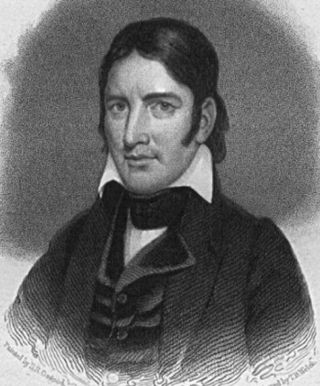
David Stern "Davy" Crockett (1786-1836).

Alamo hero and Texas transplant Davy Crockett said of losing his seat as a Tennessee Congressman in 1834:  "Since you have chosen to elect a man with a timber toe to succeed me, you may all to go hell and I will go to Texas." 

Texas blawgers have a bit of Davy in them.

Wayne Schiess, Director of Legal Writing at the UT School of Law, discussed the perks of teaching law types how to write good on Blog.Legalwriting.net.

The hazards of blogging for public employees received treatment on LUKEGILMAN.COM:  THE BLAWGRAPHY.

"How Federal Courts Got Their Inefficiency" appeared in Barnett's Notes on Commercial Litigation.

The State Bar of Texas Blog repeated its call for YouTube videos on "Ideals That Unite Us".

Beloblawg provided an example of crossing the line between blawging and advertising.  Its post did include information about the pending "ultrasound bill", which would mandate that Texas doctors take an ultrasound before performing an abortion and pressure the pregnant woman to watch and listen to it, but then notes that "we have attorneys who practice in the area".  Come on.

Perlmutter & Schuelke lamented past and ongoing efforts to restrict tort claims in Texas.

Stockbroker Fraud Blog pointed to the merits of arbitrating securities disputes.

Brenda Sapino Jeffries brought us up to date on a Texas lawyer's case against Cisco Systems for defamation-by-blawg — specifically via the now-defunct Patent Troll Tracker, in which an in-house IP lawyer at Cisco gave hell to patentholders that sued manufacturers for a living. 

The ever-meticulous Peter Vogel expounded on the "Impact of e-Discovery on the CIO" at his insightful Internet, Information Technology, & e-Discovery Blog.

Over at Current Trends in Trademark, Copyright & Entertainment Law, Tamera Bennett warbled about Senator John McCain's copyright tiff with singer-songwriter Jackson Browne over a political ad that featured Browne's "Running on Empty".  The tune ends with "I'm running behind."  Prophetic?  Freudian?

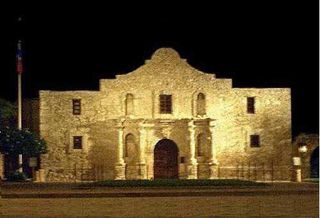
Remember the Alamo!

Alamo

Ireland gave birth to 10 of the 189 Heroes of the Alamo – Samuel E. Burns, Andrew Duvalt, Robert Evans, Joseph M. Hawkins, Thomas Jackson, James McGee, James Nowlan, Jackson J. Rusk, Burke Trammel, and William B. Ward.

The historical connection between the Emerald Isle and revolutionary Texas likely isn't familiar to Irish blawger Eoin O'Dell, of the School of Law, Trinity College Dublin.  He nonetheless contributed "Who Will Keep the Keepers II", in which he argued that "general-purpose search engines are better characterized not as media outlets . . . but as common carriers" and "should therefore come under common law duties that govern public utilities".  He proposed international agreement and cooperation in regulation of the Internet but concedes "there are deep issues of global governance here".

The fierce battle shaping up over competition policy had D. Daniel Sokol guessing about "Who Will Be the Fifth Commissioner?" at the Federal Trade Commission on the Antitrust & Competition Policy Blog.  He added that "I am assuming that the next Commissioner will have an antitrust or consumer protection background and will not be a political hack.  This assumption may be incorrect."  Charming!

Antitrust Review commented about the Supreme Court's "price squeeze" decision on February 25.  Hanno Kaiser deems it "not particularly surprising".  Blawgletter didn't like the lineLINK opinion so much, noting the likelihood that The Current Majority will never choose a case in which they find a violation of a section 2 "antitrust duty".

In Drug and Device Law, Beck/Hermann argued "Class Actions and Punitive Damages – Unconstitutional Together".

The struggle to make a good impression on jurors received further attention on Deliberations, Anne Reed's nifty blawg on juries and jury trials.  "Looks Can Kill" analyzed a study of how people react to appearances, concluding:

Understand the visual impact you and your witnesses make, and if it needs to be changed, change it.  And if your witness looks different from what the jury needs to understand she really is, spend extra time to make sure her real qualities come through.  Looks matter.

The Runaway Scrape.

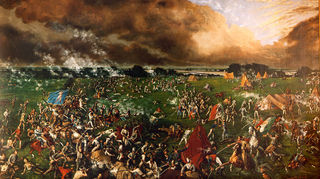
BattleSanJacinto 
The Battle of San Jacinto ended the Texas Revolution — but not until the Texians had a good fright.

The fall of the Alamo scared the bejesus out of the Texans under Sam Houston.  They and a great many civilians fled before Santa Anna's swift advance eastward from San Antonio.  They called their headlong evacuation "The Runaway Scrape".

It reminds me a little of stuff happening in the legal business, um, profession.

Above the Law rattled out of the box with "This Week in Layoffs:  2.28.09".  The post counted the dead and dying and, helpfully, pointed to the Layoff Tracker feature at Lawshucks.

The jovial Richard Posner said "[o]ne reason that we are in a depression and not merely the 'severe recession' that is the preferred euphemism is that, because of those [budget] deficits, we cannot spend our way out of the depression without increasing the national debt to a point at which either horrendous inflation or huge tax increases will be required to pay it down."  Yikes.

"Statistical Juxtaposition" — on the delightful 3 Geeks and a Law Blog — reviewed the numbers on clients who say they want alternative fee arrangements (a big majority) and on the cutbacks in law department budgets (painful ones) and concluded:

The economic downturn presents numerous opportunities. Firms and in-house counsel are now willing to embrace ideas and approaches they would have never considered in the past. Law firms and their clients both want and need AFAs and are apparently ready to embrace them (per our stats above).

PrawfsBlog remarked on law school budget pressures that force some professors to attend conferences on the cheap even to the point of reclining "on a meager mattress at a Budget Sleep a Creep Motel."

Ubiquitous commentator Michael P. Maslanka also chimed in about layoffs at law firms on Work Matters.

Molly Rogers of Texas Rio Grande Legal Aid, writing about the Homeowner Affordability and Stability Plan on ForeclosureBuzz.org, noted that, "if you’re a loan servicer, the Obama administration will give you $75 billion if you’ll be its best friend."  Pick me!

Jim Calloway's Law Practice Tips Blog asks "Where was his Cone of Silence?" of a lawyer whose indiscreet cell phone conversation outed the fact of impending layoffs at his firm.

The Young Texas Lawyer, in the guise of Robert B. Abtahi, fussed about "Problems with the Billable Hour".

Tom Kirkendall posted videos on "The Price of Progress" to illustrate his point about "the beneficial aspects of liquidating unprofitable businesses" on Houston's Clear Thinkers.

Janet Moore at her elegant International Lawyer Coach Blog offered sage advice on how to "Outsmart the Economy".

Troy Foster, in that's what she said, continued to evaluate potential claims against fictional Dunder Mifflin (from The Office) with "The Taming of the Schrute".  (Dwight seems to have let the air out of Meredith's tires.)

The "contract-drafting guy" Ken Adams mused at ADAMSDrafting on "Law, the Working Life, and Innovation".

Opinionistas said "The Law Firm Revolution Will Be Blogged" and ended with this:

The “easy money” routes are gone. And guess what: They were never easy (or fulfilling) in the first place. So if you’re talented and driven and smart, find something useful to do with your law degree. It may not include a $160K starting salary and a five-figure bonus, but neither will Cravath in a few years. Peace.

Going about 180 degrees the other way, f/k/a gave us poetry and winterscapes in "rivers, sunset, metaphors galore".

Finally, SportsBiz wondered if the hunger for economic stimulus will result this year in repeal of a 2006 statute that illegalized online gaming.  SportsBiz imagined that the current administration will like the idea despite "the likely opposition of the professional sports leagues, the NCAA and the conservative family values crowd."  But what about the liberal family values crowd?

*  *  *  *

Blawgletter has enjoyed our time with you this week.  Now get out there and uphold that palladium of civil liberty!

Blawg Review has information about next week's host, and instructions how to get your blawg posts reviewed in upcoming issues.

A new issue of Barnett's Notes on Commercial Litigation went up this afternoon.  Check it out here.

In this Issue

1. How Federal Courts Got Their Inefficiency.   In which Your Editor blames procedural excess stemming from judicial risk-aversion.

2. Did You Know?  A resurgent Antitrust Division opens an investigation into possible anticompetitive behavior in the "hermetic compressor" industry.

3.  Squeeze This!  Supreme Court finds "no antitrust duty" not to thwart dependent competitors through pricing.

4. Contingent Fees in a Down Economy.  A way for commercial litigants to align interests, reduce risk, and save scarce cash.

5.  Does the Bankruptcy Code Favor Credit Default Swaps?   Yes.  Yes, it does.

6.  Cartoon.  Speaking of money management.

7.  Hot Lunch.   Fortune (magazine) favors the bold (litigant).

8. Links & Info.

FeedIcon Blawg Review #201 on Monday!