John Yoo wrote memos that purported to legalize aggressive interrogation techniques in the service of national security and the war on terror. 

Today the WSJ published a piece in which Mr. Yoo opined that "Obama Made a Rash Decision on Gitmo" – referring to President Barack Obama's executive order directing closure of part of the U.S. base at Guantanamo Bay, Cuba — the part that houses people the George W. Bush administration deemed "enemy combatants".

Mr. Yoo argues, among other things, that "[e]liminating the Bush system [that Mr. Yoo's memos justified] will mean that we will get no more information from captured al Qaeda terrorists."

Leaving to one side the question of whether torture and near-torture yield more reliable information than other methods, Blawgletter wonders whether Mr. Yoo's current convictions about the necessity of waterboarding and other, what he calls, "coercive techniques, threats and promises, and the good-cop bad-cop routines used in police stations throughout America" bled over into his legal analysis.

Perhaps his legal research led him to those convictions.  Perhaps his objective look at the case law produced them.  But perhaps he held those views already?
ChristineRadogno 
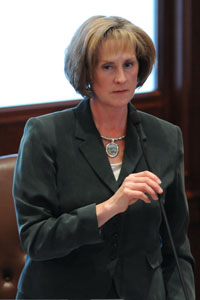
State Senator Christine Radogno (R-Ill.)

He gives a good speech.  He’s a performer. He’s very good at that. Perhaps he can get a job in the arts.

Illinois State Senator Christine Radogno, Jan. 29, 2009, referring in a NYT interview to Governor Rod Blagojevich's closing statement before the Illinois Senate a few hours before his conviction and removal from office.

Feed-icon-14x14 Remind us not to cross Senator Radogno.

FlyingSpaghettiMonster 
The Flying Spaghetti Monster.

Blawgletter has remarked on how so dadburn much litigation flows from arbitration.  We've even called the phenomenon arbitragation.  Today we find ourselves drowning in it again.

Let's start with the Ninth Circuit case.  Improv West alleged in an arbitration that Comedy Club and Al Copeland Investments lost their exclusive license to use Improv West's "Improv" and "Improvisation" trademarks.  The arbitration award favored the licensor.  The arbitrator concluded that Comedy Club and Copeland Investments forfeited the license by failing to open enough comedy clubs, and he enjoined them and others, under a non-compete provision in the license agreement, from starting any more comedy clubs anywhere in the U.S. 

The district court confirmed the award in all respects.  The Ninth Circuit reversed in part, but the Supreme Court vacated the decision and remanded for proceedings consistent with its decision in Hall Street Assocs. LLC v. Mattel, Inc., 128 S. Ct. 1396 (2008).  The Hall Street Court held that sections 10 and 11 of the federal Arbitration Act, 9 U.S.C. 10 & 11, furnish the sole grounds for vacating or modifying an arbitration award.

The this-time downward trip to the Ninth Circuit produced the same result as before.  The court mostly upheld confirmation of the award but concluded that Hall Street didn't conflict with Ninth Circuit precedent recognizing "manifest disregard of the law" as a basis for setting an award aside.  The court explained that manifest disregard merely served as a shorthand for a statutory ground for vacatur under FAA section 10(a)(4), which authorizes rejecting of an award where the arbitrator "exceeded [his] powers" under the arbitration agreement.  The court proceeded to cut the arbitrator's injunction because, it held, crystal clear California law prohibited enforcement of such a broad (nationwide) and long (through 2019) non-compete.  Comedy Club, Inc. v. Improv West Assocs., No. 05-55739 (9th Cir. Jan. 29, 2009).

We can dispatch the Eighth Circuit case more briefly.  The parties seeking arbitration, Interface Construction, subcontracted renovation on a federal building to Henderson Electrical, which further subcontracted work to Lighting and Power Services.  When Lighting and Power didn't receive payment for its labor and materials, it sued the issuer of a "payment bond", Western Surety, for, well, payment.  Lighting and Power didn't accuse anyone of breaching a contract and relied only on the Miller Act, requires bonds for federal projects.  But it also joined Interface and Henderson.  When Interface tried to enforce an arbitration clause in its subcontract with the government, Lighting and Power opposed the gambit.  The district court refused to compel arbitration.

The Eighth Circuit affirmed.  It held that neither the arbitration agreement nor principles of equitable estoppel supported forcing Lighting and Power to arbitrate.  Lighting and Power didn't sign the agreement (between the government and Interface), and neither did its Miller Act claim necessarily allege a breach of any agreement with Interface such that equitable estoppel might justify requiring non-signatory Lighting and Power into arbitration.  United States for the Use of Lighting and Power Services, Inc. v. Interface Construction Corp., No. 07-3678 (8th Cir. Jan. 29, 2009).

Feed-icon-14x14 Our feed still dislikes arbitragation.

Blawgletter learned today that the U.S. government may go to court to "arrest" money on deposit in an overseas bank and seek forfeiture of the funds on the ground that they resulted from conduct that violated federal criminal law.  We also discovered, thanks to the D.C. Circuit, that a third party claimant may contest forfeiture by arguing that the loot belongs to him, it, or her.  United States v. $6,976,934.65, No. 07-5383 (D.C. Cir. Jan. 27, 2009).

The decision turned on the proper reading of "the fugitive disentitlement statute", 28 U.S.C. 2466, which Congress called the Civil Asset Forfeiture Reform Act of 2000.  A third-party claimant, Soulbury Limited, a B.V.I. entity, filed a claim to millions of dollars that the U.S. government claimed for itself under the fugitive disentitlement statute.  The district court granted the government's motion for summary judgment, concluding that Soulbury hadn't raised a fact issue as to any of the elements of the forfeiture claim.

The D.C. Circuit reversed because, it held, the government hadn't proved as a matter of law the final element of the claim — that the allegedly fugitive criminal had fled the U.S. or failed to return for the purpose of eluding extradition or arrest.  The alleged criminal left the country in 1992, but the alleged crimes (involving Internet gambling that he orchestrated in the U.S. from a perch in the Caribbean) didn't occur until 1998.  So there was no evidence he fled to avoid capture.  And a television interview he gave in 2001 was ambiguous about the reason he'd not returned.  Maybe he kinda liked the Caribbean lifestyle.

AlCapone 
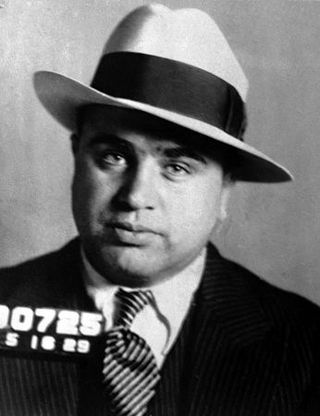
Al Capone didn't confess to racketeering.

Today Blawgletter takes up the Bernard L. Madoff scandal.  First we rhetorically bash the Securities and Exchange Commission; then we speculate on what made Mr. Madoff such a exquisitely good defrauder.

The SEC has an unerring sense for the capillary

We read yesterday, in the WSJ, that the SEC "may pursue charges against Mr. Madoff over what they believe were his lies to SEC officials during past examinations."

Huh?  Ponzi-boy Madoff will do time for . . . misleading SEC watchdogs?  The SEC plans to build its case not so much on a decades-spanning, lives-ruining, economy-tumulting $50 billion fraud . . . but on fibbing to regulators two or three years ago?

Al Capone went to the federal pen for lying about his true income to the Internal Revenue Service instead of for racketeering.  But at least he didn't confess to his underlying, far graver crimes; the feds got him on what they could get him on.  Scumdog Centimillionaire Madoff, by contrast, all but pleaded guilty.

So what would a piddling perjury conviction do that putting Madoff away on the actual racketeering he's admitted do?  Try to justify the SEC's incredible credulousness?

Anyways

Two days ago, we cracked open Malcolm Gladwell's latest book, Outliers:  The Story of Success (2008).  The best-seller says people succeed not just because of talent and ability in their field — athletics, science, whatnot.  No.  Other things matter far more.  Things like having rare opportunities fall their way, a whole lot of practice (at least 10,000 hours), reasonably good (but not necessarily great) intelligence, and "practical intelligence" about how to navigate in the world. 

Gladwell cites Robert Oppenheimer, the father of the A-bomb, as an example of why intelligence alone doesn't make someone great at something.  A genius and polymath, Oppenheimer also "possessed the kind of savvy that allowed him to get what he wanted from the world."

Ah.

At 22, in 1960, Bernie Madoff started an upstart brokerage firm that turned into one of the first to harness electronic trading — a serendipitous opportunity that made him rich, the chairman of Nasdaq, and a familiar of the SEC.  He loved to court investors and regulators (and scam them) and swiftly accumulated the requisite training time — lots more than the necessary 10,000 plus hours of practice.  He seems bright enough (having finished college and a year or so of law school).  And he displayed an astonishing gift for inducing people to give him their money and then misusing it – "the kind of savvy that allowed him to get what he wanted from the world."

An outlier, perhaps.  But also just another outliar.

Feed-icon-14x14 Our feed thinks the SEC needs to hire that "Lie to Me" guy on television.

Does section 3 of the federal Arbitration Act mandate a stay of litigation pending arbitration not only as to parties that entered into an arbitration agreement but also as to parties that didn't?

The Third Circuit said nosir — and noted its disagreement with the Fifth Circuit on that point.  Mendez v. Puerto Rican Int'l Cos., Inc., No. 07-4053 (3d Cir. Jan. 26, 2009).

The case involved claims by 41 individuals of discrimination and retaliation against their employers, including Plant Performance Services and Fluor Corporation.  The defendants asserted "on information and belief" that all of the workers had entered into arbitration agreements but managed to locate documentation for only eight of them.  The district court granted defendants' motion to compel and for a stay of the lawsuit as to the octet but denied it as to the 33 others.

The Third Circuit, affirming, discussed the Fifth Circuit's willingness to require a stay as to parties that didn't have an arbitration agreement on the ground that "proceeding with [the non-signatories' part of the] litigation will destroy the signatories' right to a meaningful arbitration."  Waste Mgmt., Inc. v. Residuos Industriales Multiquim, S.A. de C.V., 372 F.3d 339, 343 (5th Cir. 2004).  The panel felt that Fifth Circuit jurisprudence "find[s] more in Section 3 than its text will support".  Mendez, slip op. at 14.

Blawgletter concurs.  The Fifth Circuit rule puts so high a premium on giving signatories their day in arbitration that it overrides the non-signatories' right to their day in court.  Section 3 does mandate a stay "[i]n any suit or proceeding" that involves an arbitrable issue, 9 U.S.C. 3, but (as the Third Circuit held) that doesn't mean the whole suit or proceeding must stop in its tracks.

Feed-icon-14x14 Our feed has bells on its toes and rings on its fingers. 

StevenPinker 
This image appears on the first page of Steven Pinker's Harvard bio.

Steven Pinker wrote last week about why two of the country's smartest lawyers stumbled over the 36-word presidential oath of office.  Professor Pinker's explanation?  "[B]lowback from Chief Justice Roberts’s habit of grammatical niggling."

The Harvard don sets the scene thus:

On Tuesday, Chief Justice John Roberts joined the Flubber Hall of Fame when he administered the presidential oath of office apparently without notes. Instead of having Barack Obama “solemnly swear that I will faithfully execute the office of president of the United States,” Chief Justice Roberts had him “solemnly swear that I will execute the office of president to the United States faithfully.” When Mr. Obama paused after “execute,” the chief justice prompted him to continue with “faithfully the office of president of the United States.”

Pinker identifies the culprit as the Chief Justice's distaste for "split verbs".  This grammatical outrage puts "an adverb comes between an infinitive marker like 'to,' or an auxiliary like 'will,' and the main verb of the sentence."  The prof (who moonlights as the chairman of the usage panel of The American Heritage Dictionary) continues:

According to this superstition, Captain Kirk made a grammatical error when he declared that the five-year mission of the starship Enterprise was “to boldly go where no man has gone before”; it should have been “to go boldly.”  Likewise, Dolly Parton should not have declared that “I will always love you” but “I always will love you” or “I will love you always.”

Chief Justice Roberts just couldn't bear, Pinker suggests, to leave "faithfully" between "I will" and "execute the Office of the President of the United States".  First he stuck it at the end of the phrase, and when now-President Barack Obama in a state of inchoateness and mid-oath hesitated, the Chief jabbed "faithfully" right after "I will execute".  Both times, he solved the split verb problem that for 200-plus years has vexed Article II, Section 1 of the Constitution.

Chief Justice Roberts and President Obama tried again the following evening and nailed it this time.  Split verb and all.

Feed-icon-14x14 Our feed will always love you.

MindTheGap

After a six-month hiatus, Blawgetter's award-winning sister publication, Barnett's Notes on Commercial Litigation, has a new issue.  Behold its features:

In This Issue

1. A Primer on Credit Default Swaps.  The nature of CDSs, how they got a legislative push, and what legal rules apply to transactions involving them.

2. Did You Know?  Introducing three brand new SG partners.

3. Antitrust Division Grows Testy over Criticism.  Noting lackluster performance in cartel prosecutions.

4. Pushing Systemic Risk.  A perfect financial storm may have promoted manipulation.

5. We Went on Hiatus.  For Half a Year.  Sorry.   We'll do better in 2009.  Promise!

6.  Cartoon.  Presumption of innocence.

7.  Hot Lunch.  A fine column by the President of the Texas Bar.

8. Links & Info.

FeedIcon  Be a lert.

Have you ever wondered why a lawsuit that has turned uneconomic — i.e., the cumulative historical cost dwarfs any reasonable estimate of the possible gain — keeps motoring along?  Seventh Circuit Judge Richard Posner offered an answer in an opinion yesterday.  He said:

For 22 years these parties and their predecessors have been litigating, in numerous lawsuits in different courts, a dispute over a piece of property in Nashville.  We were told at argument without contradiction that the parties have expended $3 million in legal fees, a figure that exceeds any reasonable estimate of the amount in controversy.  Yet such behavior does not need be irrational or a product of spite or even of bad legal advice.  A rational litigant, having expended $X in unsuccessfuly efforts to prevail, yet having additional litigation options that he can pursue, will compare the cost of those options to the expected benefit, disregarding the $X he has spent already.  That is a sunk cost — a cost he cannot recover by anything he does and therefore a cost that will not influence his behavior (if he is rational).

Orlando Residence, Ltd. v. GP Credit Co., LLC, No. 07-4050, slip op. at 2 (7th Cir. Jan. 22, 2009).

Note the emphasis on rational.  A purely logical person would ignore his, her, or its "sunk costs" in deciding whether to expend more resources.  Shelling out an additional $100,000 to get $200,000, say, makes sense to this Spockian litigant.  Never mind that he, she, or it has already ponied up $300,000 in the so-far elusive quest for monetary justice.

Judge Posner adds the proviso that good sense to a litigant doesn't necessarily compute for the rest of us.  "Still, from an overall social standpoint, the money spent on this litigation — which we cannot quite end today, much as we would like to — is excessive."  Id.  Comfortingly, he adds, "[b]ut our decision will bring the end within sight."  Id.

Feed-icon-14x14  Our feed wishes you a Happy Friday and one terrific weekend.

BillGates 
Expect to see more CEOs (like Bill Gates here) having to answer monopolization charges.

Blawgletter has made no secret of our disappointment with antitrust law enforcement over the last eight years.  (Lookie here and here, for example.)  We've also guessed that an Obama administration would get tougher on monopolists and cartels.

Today, the rumor mill suggests that our speculation at least got the general direction of antitrust policy right.

The latest has Christine Varney as the probable new head of the Antitrust Division, a wing of the U.S. Department of Justice.

A Bloomberg report describes her as a "deal broker" who aggressively enforced antitrust law during a stint as a commissioner on the Federal Trade Commission in the Clinton administration.

Ms. Varney apparently hasn't litigated many (if any) antitrust cases.  A search on the CM-ECF site for her hometown federal court, the District of the District of Columbia, disclosed no cases of any kind in which she appeared as counsel.  So, she likely has far more experience in policy-making and advisory roles than in the litigation context.

Will that background mean an aversion to heading to court?  We hope not — and note with approval Ms. Varney's role, as counsel for Netscape, in encouraging the Department of Justice to prosecute Microsoft for monopolization of the Internet browser market.  PBS interview on Feb. 26, 1999, here.  She also, according to Bloomberg, "often joined 3-2 majorities [while an FTC commissioner] to press antitrust and consumer-protection complaints against companies."

UPDATE:  Reuters confirms the nomination of Ms. Varney as Assistant Attorney General in charge of the Antitrust Division.

We reproduce the text of Ms Varney's current bio on the website of Hogan & Hartson – Chief Justice John Roberts's old firm – for your information:

Christine Varney rejoined Hogan & Hartson in 1997, after five years in government service, to head the firm's Internet practice group. This practice provides full service assistance to companies doing business globally, including providing advice on antitrust, privacy, business planning and corporate governance, intellectual property, and general liability issues. Christine has provided antitrust, competition policy, and regulatory advice to a variety of companies, including eBay, Fox Interactive Media/MySpace, Orbitz Worldwide, Inc., DoubleClick, Ernst & Young, EMI, Intelius, Advertising.com, American Hospital Association, Washingtonpost.Newsweek Interactive, Dow Jones & Company, AOL, Synopsys, Compaq Computer, Gateway, Netscape, The Liberty Alliance, and Real Networks.

In addition, Christine has been instrumental in the founding of several industry self-regulation associations, including the Network Advertising Initiative and Online Privacy Alliance, working to create Internet best practices policies. She has received extensive media attention for the caliber of her work, including recognition in Chambers USA 2007, where she is considered “widely respected,” particularly on Internet and privacy issues.

During her U.S. government tenure, Christine served as a Federal Trade Commissioner from 1994 to 1997. At the Federal Trade Commission, she was a leading official on a wide variety of Internet issues. She also pioneered the application of innovation market theory analysis to transactions in both electronic high technology and biotechnology. She led the government's effort to examine privacy issues in the information age, resulting in congressional and agency hearings, proposed industry standards, and increased government enforcement of laws protecting privacy.

Prior to becoming a Federal Trade Commissioner, Christine was an Assistant to the President and Secretary to the Cabinet. She was the primary point of contact for the 20-member Cabinet. She was responsible for the overall coordination of several major issues and initiatives between the White House and various agencies.

Before joining the Clinton Administration, Christine practiced law with Hogan & Hartson. In addition, she served as Chief Counsel to the Clinton/Gore Campaign, General Counsel to the 1992 Presidential Inaugural Committee, and General Counsel to the Democratic National Committee from 1989 to 1992.

Christine lectures extensively, both in the United States and abroad, on various legal issues in American politics. She is also involved in an ongoing international dialogue on comparative political processes and competition policy with foreign government officials through the Organization for Economic Cooperation and Development (OECD). She regularly contributes to a variety of publications, including Newsweek, Antitrust Magazine, and Wired.

Representative Experience
Provided antitrust, regulatory, competition policy, and consumer protection advice to multinational content, technology, and commerce businesses, including eBay, DoubleClick, Washingtonpost.Newsweek Interactive, Dow Jones & Company, AOL, Synopsys, Compaq Computer, Gateway, Netscape, and Real Networks.
 
Provided antitrust and data protection advice to the Liberty Alliance, a consortium of more than 160 technology and consumer-facing organizations formed in September 2001 to establish an open standard for federated network identity.
 
Provided antitrust and data protection advice to the Online Privacy Alliance, a nonprofit organization of more than 30 global corporations and associations that have come together to introduce and promote business-wide actions that create an environment of trust and foster the protection of individuals' privacy online.
 
Provided antitrust and data protection advice to the Network Advertising Initiative, a group of network advertising companies that developed self-regulatory principles to govern their information collection practices.

Feed-icon-14x14  Shockingly, our feed has no aversion to heading to court.