Today a Superior Court in Rhode Island held the State of Rhode Island must reimburse almost $250,000 to the paint companies it sued for creating a public nuisance by selling lead paint years ago.  State of Rhode Island v. Lead Industries Ass'n, No. PB/99-5226 (R.I. Super. Jan. 22, 2009). 

News article here.

The expenses consisted of $218,270.64 that the defendants paid to "Co-Examiners" for studying implementation of an abatement remedy plus $15,554.75 in transcript fees and $8,295.82 in "conference call fees".  The court had required the defendants to advance those costs pending exhaustion of the defendants' post-trial motions and appeals.

The court concluded:

Here, where the Rhode Island Supreme Court has overturned the jury verdict against the Defendants and vacated the judgment of abatement, it would be inappropriate to continue holding the Defendants liable for any portion of the Co-Examiner expenses.

 State of Rhode Island v. Lead Industries Ass'n, slip op. at 21.

Possibly softening the blow to the State, the court observed, in a footnote, that the State's lawyers just might have to shoulder the expense burden:

According to the fee agreement between Motley Rice and the State, Motley Rice agreed to bear "all costs and expenses of prosecuting" this case.  (See Contingent Fee Agreement and Contingent Fee Addendum).  The costs incident to the co-examiners and remedy portion of this case imposed here under Rule 53 could potentially be covered under that agreement.  However, this is not a matter that the Court will address at the present time.  Thus, a determination by the Court that the State is obligated to pay the Co-Examiner fees and expenses in no way speaks to the issue of whether Motley Rice will ultimately bear responsibility for these expenses.

Id., slip op. at 21 n.10.

Yikes!  In 1999, when Motley Rice filed the case for the State, the firm no doubt didn't plan on spending 10 years litigating it, suffering a mistrial, and winning the retrial only to lose the favorable judgment in the Rhode Island Supreme Court.  This latest twist heaps hot coals on the firm's head.

Could Motley Rice have protected itself?  And, more important, can you?

Blawgletter can't say what Motley Rice could (or even should) have done to avoid potential liability for this unusual set of circumstances.  At the time the firm inked the contingent fee agreement with the State of Rhode Island, Motley Rice may have had no choice but to accept responsibility for "all costs and expenses of prosecuting", apparently without exception.

But the prudent contingent fee lawyer ought at least to think about what sorts of expenses he or she might have to advance and consider carve outs and limitations.  These could include:

  • Confining expense-advancement to "reasonable and necessary" costs or those those that the firm, in its reasonable judgment, approves;
  • Capping the firm's obligation at a specific dollar amount; and
  • Carving out particular kinds of fees and expenses, such as (a) awards of attorneys' fees; (b) bonds for injunctive and other extraordinary relief; (c) appeal bonds; (d) fees and costs of mediators, examiners, special masters, and other adjuncts to court proceedings; and (e) awards of sanctions against the client.

As you, dear reader, well know, litigation on a contingent fee basis has grown only riskier over the last decade or so.  That may go double for commercial litigation, whose cost in lawyer time and out-of-pocket expense leaps every time courts or legislatures add a layer of procedural complexity.  Think Twombly, Daubert, Celotex, Rule 23(f), and the Procrustean impulses of courts in class (especially securities and antitrust) actions.

Feed-icon-14x14 Adjust the risk!

BarackObama 
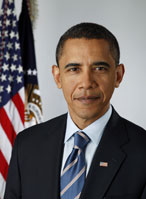
President Barack Obama has said he wants judges who are sympathetic to the vulnerable and powerless.

When will change come?

If you wonder how quickly the new Obama administration can rebalance the philosophical bent of the lower federal courts, consider some statistics.

In his eight years in office, President George W. Bush filled 67 of the 179 judgeships on the 13 courts of appeals — around 37.4 percent — and numerically and proportionally more in the district courts.

Looking ahead, as of January 21, 2009, existing and future vacancies on the courts of appeals total 15 of the judgeships and on the district court bench come to 50 (out of 674) — about 8.4 and 7.4 percent, respectively.  (For details, see below.)  And the Federal Judiciary proposes adding 11 new courts of appeals slots and 47 more district judgeships — which proposal, if Congress approves it, will give President Obama the ability in short order to seat 26 out of 190 circuit judges (13.7 percent) and 97 of 721 district judges (13.45 percent).

That looks like an opportunity for relatively swift change.  (Eight years at a 13+ percent replacement rate would swap out virtually all of the circuit and district judges.)  But how much change depends on who President Obama nominates and the Senate approves — and how long the process takes. 

Now for circuit-by-circui numbers.

The U.S. Courts website reports the following 65 current and pending vacancies as of January 21, 2009:

First Circuit

    Court of Appeals:    One

    District Courts:    One (D.R.I.)

Second Circuit

    Court of Appeals:    One

    District Courts:    Three (E.D.N.Y., S.D.N.Y., and W.D.N.Y.)

Third Circuit

    Court of Appeals:    Two

    District Courts:    Three (D. Del., M.D. Pa., and W.D. Pa.)

Fourth Circuit

    Court of Appeals:    Four

    District Courts:    Six (D. Md., E.D.N.C., M.D.N.C., E.D. Va., N.D. W. Va., and S.D. W. Va.)

Fifth Circuit

    Court of Appeals:    One

    District Courts:    Six (E.D. La., W.D. La., S.D. Miss., S.D. Tex., and W.D. Tex.(2))

Sixth Circuit

    Court of Appeals:    One

    District Courts:    Three (E.D. Mich., S.D. Ohio, and M.D. Tenn.)

Seventh Circuit

    Court of Appeals:    One

    District Courts:    Four (N.D. Ill., N.D. Ind., S.D. Ind., and W.D. Wisc.)

Eighth Circuit

    Court of Appeals:    None

    District Courts:    Three (E.D. Ark., W.D. Ark., and D.S.D.)

Ninth Circuit

    Court of Appeals:    One

    District Courts:    Eight (C.D. Cal. (3), E.D. Cal., N.D. Cal. (2), D. Or., and E.D. Wash.)

Tenth Circuit

    Court of Appeals:    None

    District Courts:    One (D. Wy.)

Eleventh Circuit

    Court of Appeals:    One

    District Courts:    Four (N.D. Fla., M.D. Ga., and N.D. Ga. (2))

District of Columbia Circuit

    Court of Appeals:    Two

    District Courts:    Three (D.D.C.)

Federal Circuit

    Court of Appeals:    None

    District Courts:    Not applicable

Feed-icon-14x14 Our feed suggests starting right away.

ObamaOath
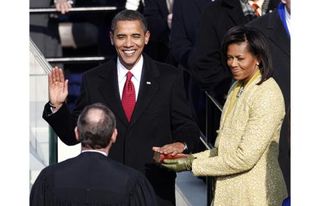
President Barack Obama taking the oath of office.  He and Chief Justice John Roberts repeat it — this time flawlessly — the next day. 

Blawgletter's journal of the 56th Inaugural continues:

  • Day 3:  We take Metro to — what else? — Metro Center station and a few blocks later score standing room inauguration ceremony tickets.  (Many thanks to our gracious donor!)  After a return to home base, we walk up Georgetown's M Street.  A festive mood animates the throng, whose members dart between bumper-to-bumper vehicles.  We check out the scary Exorcist staircase.  Later we head back to buy a pair of inaugural ceremony blue jeans and an inauguration-special six pack of Opus-Xs (for a friend).  Dinner time gives way to a post-prandial negotiation with a taxi driver for a one-way trip to the Texas Black Tie and Boots gala.  (Yes, he takes us for a ride.)  Friends, politicos, and lobbyists — a frightening number of the last — join us in attending.  Asleep at the Wheel plays "Choo Choo Ch'Boogie", "House of Blue Lights", and — among other favorites — "Cotton Eyed Joe".  The taxi odyssey to home base carries us, unnecessarily, through Old Town Alexandria.  But at least it costs less than the trip out.
  • Day 4, 6:30 a.m.:  The infernal alarm clock summons us to duty.
  • Day 4, 7:12 a.m. – 8:17 a.m.:  The first Metro train contains so many riders that we can see only smudges of faces kersplat against the car windows.  The next two feature are the same.  We backtrack two stations on an almost-empty outbound.  There we clamber on (barely) for our most intimate (also jarring) rail experience ever.  Our arms ache by the time we debark the Sardine Express at Federal Center SW.
  • Day 4, 8:24 a.m. – 11:39 a.m.:  The security check point stands about five blocks from the Metro station, and we make good time reaching it.  A sea of humanity stretches before us.  We join it, and for the next three hours shuffle every five minutes or so to advance about six inches towards the x-ray machinery and TSA personnel.  After we clear security, we walk-run to the standing room area.  A great many others have preceded us, but we find a spot that descries what looks like the focal point about halfway up the Capitol building.  Comparing our view with the images on the JumboTron (partially visible through leafless trees) confirms our squinting guess.
  • Day 4, 11:45 a.m. – 12:36 p.m.:  The ceremony begins!  Emcee Senator Dianne Feinstein looks from our vantage the size of a kitchen match.  The announcer acknowledges President George W. Bush to a rumble of boos.  Rick Warren offers a so-so prayer.  Aretha Franklin belts out My Country 'Tis of Thee.  Justice John Paul Stevens administers the oath to Vice President Joe Biden to applause.  A lovely musical interlude (featuring Yo Yo Ma and other virtuosos) plays.  Chief Justice John G. Roberts stumblingly swears in President Barack Obama.  (They repeat the oath, slowly and flawlessly, the next day.)  The crowd goes wild.  Then President Obama delivers his inaugural address.  "As for our common defense, we reject as false the choice between our safety and our ideals" gets big cheers.  The address ends with this:

So let us mark this day with remembrance, of who we are and how far we have traveled. In the year of America's birth, in the coldest of months, a small band of patriots huddled by dying campfires on the shores of an icy river. The capital was abandoned. The enemy was advancing. The snow was stained with blood. At a moment when the outcome of our revolution was most in doubt, the father of our nation ordered these words be read to the people:

"Let it be told to the future world … that in the depth of winter, when nothing but hope and virtue could survive…that the city and the country, alarmed at one common danger, came forth to meet (it)."

America, in the face of our common dangers, in this winter of our hardship, let us remember these timeless words. With hope and virtue, let us brave once more the icy currents, and endure what storms may come. Let it be said by our children's children that when we were tested we refused to let this journey end, that we did not turn back nor did we falter; and with eyes fixed on the horizon and God's grace upon us, we carried forth that great gift of freedom and delivered it safely to future generations.

Thank you. God bless you. And God bless the United States of America.

  • Day 4, 12:36 p.m. – 2:23 p.m.:  Our trek to home base takes us the length of the National Mall and then some.  Giddy people keep flooding the streets and the mall and in freezing cold.  We pause to pay our respects at the Vietnam Veterans Memorial, as do many others.  You always see someone in grief there, and you never leave without feeling sadness that mingles with gratitude.  We stumble into home base and go horizontal.  What a day!

Blawgletter heads home tomorrow.  Thank you for coming along for our first-inaugural-ever.

MLK 
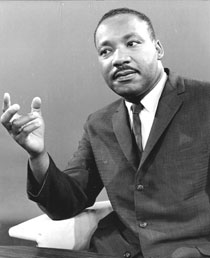
Martin Luther King, Jr. (1929-68).

I know you are asking today, "How long will it take?" Somebody’s asking, "How long will prejudice blind the visions of men, darken their understanding, and drive bright-eyed wisdom from her sacred throne?" Somebody’s asking, "When will wounded justice, lying prostrate on the streets of Selma and Birmingham and communities all over the South, be lifted from this dust of shame to reign supreme among the children of men?" Somebody’s asking, "When will the radiant star of hope be plunged against the nocturnal bosom of this lonely night, plucked from weary souls with chains of fear and the manacles of death? How long will justice be crucified, and truth bear it?"

I come to say to you this afternoon, however difficult the moment, however frustrating the hour, it will not be long, because "truth crushed to earth will rise again."

How long? Not long, because "no lie can live forever."

How long? Not long, because "you shall reap what you sow."

How long? Not long:

Truth forever on the scaffold,

Wrong forever on the throne,

Yet that scaffold sways the future,

And, behind the dim unknown,

Standeth God within the shadow,

Keeping watch above his own.

How long? Not long, because the arc of the moral universe is long, but it bends toward justice.

How long? Not long, because:

Mine eyes have seen the glory of the coming of the Lord;

He is trampling out the vintage where the grapes of wrath are stored;

He has loosed the fateful lightning of his terrible swift sword;

His truth is marching on.

He has sounded forth the trumpet that shall never call retreat;

He is sifting out the hearts of men before His judgment seat.

O, be swift, my soul, to answer Him! Be jubilant my feet!

Our God is marching on.

Glory, hallelujah! Glory, hallelujah!

Glory, hallelujah! Glory, hallelujah!

His truth is marching on.

Martin Luther King, Jr., March 25, 1965, Montgomery, Alabama.  Watch it here.

Blawgletter sits nine blocks from the White House at this moment.  We thought we'd share some reportage from our first-ever inauguration observation:

  • Day 1, 12:48 p.m.:  Corporate jets sprawl across the tarmac at Dulles.  Big ones.  Where did they come from?  Which malefactors of great wealth own them?  Why don't we have one?
  • Day 1, 3:17 p.m.:  Very cold, very cold on the National Mall.  Icicles form on our ears.  Why won't Obama respond to our text messages?

  • Day 1, 5:48 p.m.:  Huge crowd at Trader Joe's.  HUGE!  The checkout line looks longer than the National Mall.  We retreat to the convenience store across the street.  We buy cheese, Wheat Thins, and beer.  Still no word from Barack.

  • Day 1, 9:59 p.m.:  We conclude that the ads for Beverly Hills Chihuahua looked a lot funnier than the movie itself.  We start to wonder if Hollywood deserves its reputation for uniformly high-quality cinema.

  • Day 2, 6:14 a.m.:  The sun rises.  Or so the newspaper says; we didn't actually see it.

  • Day 2, 10:02 a.m.:  We begin reading the newspaper that had the information about the sunrise.  Coffee tastes good.

  • Day 2, 11:08 a.m.:  Taxi ride to the Convention Center!  We stand in the line for inaugural ball tickets.  We get them and then buy inauguration lapel pins and an inauguration train engine.  Fuddruckers burgers give us our first taste of fine cuisine.  Why hasn't Obama texted us back?

  • Day 2, 1:15 p.m.:  Our walk takes us again to the National Mall.  Gobs of people accompany us towards the Lincoln Memorial.  We don't know why.  They do seem friendly.

  • Day 2, 2:01 p.m.:  Oh.  We forgot about the free concert.

  • Day 2, 3:22 p.m.:  Beyonce!  The Boss!  Jamie Foxx!  Tiger Woods!  James Taylor!  On CNN!

  • Day 2, 7:00-9:24 p.m.:  Dinner in honor of Houston Mayor Bill White's plunge into candidacy for U.S. Senate.  We see old friends.  None can explain Obama's texting reticence.

Feed-icon-14x14 867-5309.

Did you know that inducing, taking, or publishing nekkid pictures of frolicking spring breakers could land the images-purveyor in a federal lawsuit for damages?  If you didn't, now you do. 

The Eleventh Circuit — which, yes, does include Daytona Beach, Florida — ruled yesterday that one such frolicker didn't have a claim despite video of her, er, involvement "in two wet T-shirt contests, which were observed by a crowd of 300 to 400 people, many of whom had video cameras."  Tilton v. Playboy Entertainment Group, Inc., No. 07-15447, slip op. at 3 (11th Cir. Jan. 15, 2009).  Just shy of 18 at the time, Ms. Tilton also "participated" in contests that required simulation of sex.  Id.  She lost the case because, the court held, the fakeness was apparent.

Speaking of apparents, Blawgletter wonders where they were — if not during the festivities, at least when their daughter chose to file a lawsuit that further publicized her youthful indiscretions?

FeedIcon Let' all try to make good decisions, shall we?

CypherStent 
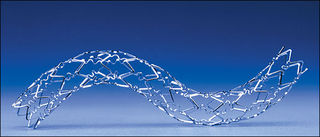
Boston Scientific sued Cordis for making Cyper stents like this one.

Recall that KSR Int'l Co. v. Teleflex, Inc., 127 S. Ct. 1727 (2007) (see post), eased the test for patent-invalidating "obviousness" – whether a practitioner in the relevant art would have found the invention obvious in light of existing art.  Pre-KSR decisions by the Federal Circuit had complexified the obviousness question.  KSR simplified matters, directing courts to give obviousness its ordinary, common-sense meaning.

The Federal Circuit has gradually caught onto KSR, having at first pretended that it hadn't really obliterated a line of Federal Circuit cases that added factors like "motivation".  Yesterday the court showed that it knows from obvious.

The lawsuit related to Boston Scientific's patent on a drug-eluting stent.  Boston Scientific accused Johnson & Johnson and Cordis of infringing the patent and won a jury verdict and judgment.  The Federal Circuit affirmed the district court's construction of language in the patent but held the invention of the patent obvious in light of an earlier patent that disclosed — surprise! — a drug-eluting stent.  Boston Scientific Scimed, Inc. v. Cordis Corp., No. 08-1073 (Fed. Cir. Jan. 15, 2009).

Descriptions of patent lawsuits involving Boston Scientific covers pages 20-29 of its latest Form 10-Q report.

FeedIcon And they spend, oh, about $334 million a year in legal fees.

SmartCard 
This smart card uses radio frequency identification to expedite transactions.

The European Commission raided smart chip makers' premises last October.  Smart chips go into smart cards, which can store and process data, and SIM cards, which identify the subscriber in cell phones and other telephony devices. 

The press release of January 7, 2009, said:

Antitrust: Commission confirms inspections in the smart card chip sector

The European Commission can confirm that on 21 October 2008 Commission officials carried out unannounced inspections at the premises of several smart card chips producers in several Member States. These chips are used for the production of smart cards, such as telephone SIM cards, bank cards and identity cards. The Commission has reason to believe that the companies concerned may have violated EC Treaty rules prohibiting practices such as price fixing, customer allocation and the exchange of commercially sensitive information (Article 81).

The Commission officials were accompanied by their counterparts from the national competition authorities.

Surprise inspections are a preliminary step in investigations into suspected cartels. The fact that the Commission carries out such inspections does not mean that the companies are guilty of anti-competitive behaviour; nor does it prejudge the outcome of the investigation itself. The Commission respects the rights of defence, in particular the right of companies to be heard in antitrust proceedings.

There is no strict deadline to complete cartel inquiries. Their duration depends on a number of factors, including the complexity of each case, the extent to which the undertakings concerned co-operate and the exercise of the rights of defence.

Reuters reported that the raidees included Infineon Technologies, STMicroelectronics, Renasas Technology, and NXP Semiconductors.

FeedIcon  Meanwhile, crickets from the U.S. Department of Justice.

Catch your breath before going to the latest Deliberations post, which looks at a 1936 article by Clarence Darrow on "How to Pick a Jury". 

Anne Reed there expresses proper horror at Darrow's categorizations, including our favorite, the Presbyterian, whom Darrow deems "as cold as the grave". 

Baptists?  Worse.  Much worse.

FeedIcon  Quod erat demonstradum?