The Tenth Circuit came out today with an opinion that affirms the jury's role as final arbiter of damages awards.  The decision also ventured into questions of whether patent law preempts state trade secrets claims and the availability of prejudgment interest for the period between verdict and entry of judgment.  Russo v. Ballard Medical Products, No. 07-4090 (10th Cir. Dec. 18, 2008).

The plaintiff in the case, an inventive fellow by the name of Ronald D. Russo, disclosed trade secrets to Ballard Medical Products, which made catheters, under a Confidential Disclosure Agreement.  Without Russo's permission, Ballard later used the trade secrets, which involved removing debris from endotracheal ventilator tubes, to develop a longer-lasting product.

The jury awarded the plaintiff $17 million on the trade secrets claim (in the nature of unjust enrichment damages) plus $3 million for breach of the CDA. The company challenged the damages award on appeal, and the plaintiff cross-appealed because the district judge refused to award him pre-judgment interest for the time (about four months) between the verdict and the court's entry of judgment.

Ballard's first point on appeal — that the Federal Circuit had exclusive appellate jurisdiction due to the intersection of Russo's state law claims with patent law — foundered on the fact that the claims didn't require decision of any question of patent law.  Yes, Russo's complaint did mention that Ballard used his trade secrets to take out patents.  But "the fact that patents may be used as evidence in aid of a trade secret claim is not the same thing as raising a substantial (or really, any) question of federal patent law."  Russo, slip op. at 10.

Ballard's attempt to parlay patent law into a preemption defense against Russo's substantive claims and his award of damages met a similar fate.  Ballard argued (1) that patent law preempts all state law claims if, as Ballard had done, the trade secret misappropriator discloses the invention by taking out a patent on it and (2) that it precludes an award of damages that equals the entire value of the invention itself.  The court rejected both arguments, holding that Ballard's improper disclosure of Russo's trade secrets to the U.S. Patent and Trademark office didn't put the trade secrets into the public domain such that only patent law could protect the erstwhile trade secrets and that the jury awarded only damages that Ballard's wrongful conduct caused, not the whole value of the invention itself.

As for damages, the court concluded that sufficient evidence supported the jury's $20 million award.  Expert testimony put damages for misappropriation of trade secrets at up to $32 million, which the jury cut to $17 million.  "When the damages awarded by the jury fall within the range permitted by the evidence admitted at trial (and whose admission is unchallenged on appeal), we may not second guess the award."  Russo, slip op. at 29.  And, although Russo's expert pegged damages for breach of the CDA at $2.751 million, the expert also said that small adjustments to his "conservative" assumptions would yield a higher number.  That sufficed, the court held, to sustain the $3 million award.

The final issue — about prejudgment interest — posited that the district court erred in declining to compensate Russo for the four months that intervened between rendition of the verdict and the district court's entry of judgment.  The panel harkened to Utah law.  Finding it less than pellucid on the question but probably against Russo's position, the court accordingly affirmed.

Feed-icon-14x14 The catheter and the damage done.

ChristopherCox 
Securities and Exchange Commission Chairman Christopher Cox in 2006, when Bernard Madoff's Ponzi scheme still had a couple years to run, despite warnings to the SEC.

The real lesson is that financial enforcement nearly always fails to protect investors, and this Ponzi scheme is merely typical.

To Catch a Thief, The Wall Street Journal, Dec. 18, 2008.

FeedIcon Our feed blames the New Deal.

According to the current Recent Orders page of the Judicial Panel on Multidistrict Litigation website, transfer motions that it heard in Charleston, South Carolina, on November 20, 2008, ought to go to many different judges in lots of places around the country.

The first order, per the website, bears a date of November 26.  The last one, so far — again according to the website — issued on December 12.

The Panel denied motions to centralize two of the matters it considered at the November 20 session:  In re Cardinal Health, Inc. Contract Litig., MDL No. 1991, and In re U.S.A. Exterminators, Inc. Fair Labor Standards Act (FLSA) Litig., MDL No. 2000.

Blawgletter has attended, and argued at, several JPML hearings.  Our principal take-away?  That you can't reliably predict where the Panel will send any MDL matter.

Some say the decision depends on the number of parties that support a particular venue.  Many also posit that the transfer turns on the willingness and reputation of the particular judge who inherits the cases involving the same subject matter, according to local case assignment protocols.

But in addition we all acknowledge that imponderables weigh in the balance as well.  Does a Panel member want personally to get the MDL?  Does a particular district deserve an MDL assignment due to its historical lack of MDL cases?  Or its access to air transportation?  And does the Panel believe that the general reputation of a district as having expertise in a subject matter warrant sending an MDL matter there?  (We think here especially of the S.D.N.Y., which boasts of aplomb with complex commercial disputes.)

We from experience suspect that advocacy counts least.  Lawyers get mere minutes — sometimes one or two — to explain why the venue they favor ought to prevail over all other possible choices.  And not infrequently at least one of the arguing lawyers makes jokes about the process and suggests that things like the presence of fine restaurants in a possible transferee city ought to make a difference.

And yet we applaud the system.  The Panel makes wise decisions in almost all cases.  We just wish it kept its website up to date.

Feed-icon-14x14 Our feed wishes the Panel would send all MDL cases to Dallas.  By which we mean the good ones.

AnimalHouse 
The cast of Animal House (1978) toasts something other than the passage of the Class Action Fairness Act of 2005.  Road trip, perhaps?

The Fourth Circuit held today that a counterclaim defendant, which stood on the receiving end of a class counterclaim for cheating consumers, doesn't have the right to remove a case from state to federal court under old law or even the Class Action Fairness Act of 2005 (CAFA).  The 2-1 decision upheld a West Virginia district court's order remanding the lawsuit to the Circuit Court of Brooke County, West Virginia.  Palisades Collections LLC v. Shorts, No. 08-2188 (4th Cir. Dec. 16, 2008).

(The counterclaim alleged that AT&T Mobility, as successor to Cingular Wireless, violated state consumer protection law by charging Ms. Short an early termination fee.)

The majority and dissenting opinions cite old cases — including one from 1850, another from 1900, and an additional one from 1941 — in support of their conflicting interpretations of The Law.  But the issue, as we perceive it, boils down to whether CAFA, by allowing "any" defendant to remove a case, extended the removal right to a defendant that joins a case as a result of a defendant's act of adding it as a counterclaim defendant.

Respectfully, Blawgletter highly doubts that Congress's use of "any defendant" in CAFA means "any defendant and any counterclaim-defendant".

Our partners Jonathan Bridges and Bill Merrill represented Ms. Shorts, by the way.  Good on them, we say.

Feed-icon-14x14  Our feed never charges early termination fees.  On account of it doesn't charge any fees at-all.

Plavix 
Plavix patent prevails in court — but at what literary cost?

Do you like dull writing?  Do you relish lifeless prose?

If so, you've come to the right place.

No, seriously.  Blawgletter imagines you tolerate tedious verbiage when it drips from the pen of a federal appellate court, whether one of the 13 intermediate ones or the inerrant-because-final one that sits at One First Street, NE, in Washington, DC.

A decision last week by the Federal Circuit illustrates for us the deadness of so much judicial word-smithing.  Sanofi-Synthelabo v. Apotex, Inc., No. 07-1438 (Fed. Cir. Dec. 12, 2008).

We focus — perhaps unfairly — on the writing judge's repetitive use of a single word and variations on it.  The unanimous opinion deploys "state", "states", "stated", "statement", and "statements" no less, on average, than once in each of the 26 pages.

Does the active verb to state so despair of equivalents and cousins?  We can think, off hand, of several — aver, allege, argue, assert, articulate, asseverate, avouch, avow, cite, claim, clamor, complain, contend, contest, declaim, declare, demand, dictate, insist, maintain, mention, posit, present, propose, say, suggest, and — our favorite — yammer.

Liven it up, we say.  Let not power beget literary poverty.  A splash of color embiggens the smallest opinion.

Feed-icon-14x14 The RSS icon at left invites you to subscribe to our stately feed.

SarbanesOxley

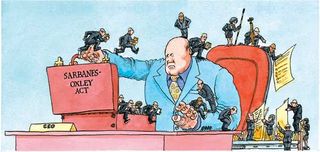
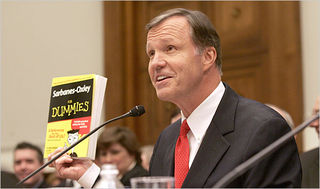
Corporate types complain a lot about the burdens of the Sarbanes-Oxley Act.  A decision yesterday by the Ninth Circuit may give them a wee lift.

George Diaz, a shareholder of Digimarc Corporation, a supplier of "secure personal identification systems", sued several of the company's officers and directors for breaching fiduciary duties and violating section 304 of Sarbanes-Oxley.  The misdeeds centered around Digimarc's restatement of income because of $2.7 million worth of accounting errors. 

The district court dismissed the federal claim on the ground that section 304 doesn't create a private cause of action.  The statute provides in relevant part that "an accounting restatement due to material noncompliance of the issue" requires the CEO and CFO of the issuer to reimburse the company for "any bonus or other incentive-based or equity based compensation" they received plus any profits from their trading in company stock during a 12-month period.  15 U.S.C. 7243(a).

The Ninth Circuit agreed.  Noting that the Act lacks an explicit authorization of private suits, the court also found in the statute nothing that implied congressional intent to create a private claim for violation of section 304.  Diaz v. Davis (In re Digimarc Corp. Deriv. Litig.), No. 06-35838 (9th Cir. Dec. 11, 2008).

FeedIcon Happy Friday, y'all.

RenoirGuino 
The Washerwoman (1917) by Renoir and Guino.

Between 1913 and 1917, Pierre-Auguste Renoir and an assistant, Richard Guino, collaborated in the creation of 11 sculptures.  Guino later obtained the exclusive right to produce and reproduce the objects from the original plaster casts.  In 1984, Guino's successor, a trust, registered copyright in the sculptures with the U.S. Copyright Office.  In 2003, a great-grandson of Renoir sold some of the sculptures and castings of them in Arizona.  The Guino trust sued for copyright infringement.  The district court granted summary judgment to them on liability, and a jury later awarded $125,000 in damages.

The Ninth Circuit affirmed.  Societe Civile Succession Richard Guino v. Renoir, No. 07-15582 (9th Cir. Dec. 10, 2008).

Blawgletter discovered a couple of things from the opinion.  First, that copyright law protects sculptures.  (Okay, we kinda knew that already.)  And, second, that 17 U.S.C. 303(a) of the Copyright Act of 1976 extends the protection to works someone created before January 1, 1978 but that previously had neither fallen into the public domain nor been copyrighted. 

Section 303(a) confers that protection for 70 years after the death of the last surviving author.  Because Guino died in 1973, the copyright will last until 2043.

FeedIcon Who doesn't wash clothes in the nude?

Wittgenstein 
Ludwig Wittgenstein (1889-1951) thought deep ratiocinations about language.

The Seventh Circuit today tossed a summary judgment that denied commissions to a sales representative.  AA Sales & Assocs., Inc. v. Coni-Seal, Inc., No. 07-2694 (7th Cir. Dec. 9, 2008).

The defendant, Coni-Seal, a maker of automotive parts, entered into a one-page contract that entitled the plaintiff, AA Sales, to a six percent commission "on all products sold to the approved accounts".  The approved accounts referred to potential customers "approved by Coni-Seal prior to solicitation by AA Sales."

AA Sales, with Coni-Seal's approval, over a period of years solicited AutoZone, a big auto parts retailer, to buy parts from Coni-Seal.  But AutoZone demurred.  Later, due to Coni-Seal's introduction of a new line of products but no thanks to efforts by AA Sales, AutoZone came around.  AA Sales claimed that its contract entitled it to commissions even though it didn't procure any sales to AutoZone.

The district court held, on Coni-Seal's motion for summary judgment, that AA Sales couldn't recover because it didn't cause the AutoZone sales.

The Seventh Circuit reversed, saying:

It is a fundamental principal [sic] both of our canons of interpretation and indeed of philosophy of language that particular bits of contract language must be interpreted in their own context.  Compare Shi Liang Lin v. U.S. Dep't of Justice, 494 F.3d 296, 316 (2d Cir. 2007) (Katzmann, J., concurring with en banc judgment) ("Text without context can lead to confusion and misunderstanding."), with, e.g., LUDWIG WITTGENSTEIN § 3.3 TRACTATUS LOGICO-PHILISOPHICUS (C.K. Ogden, trans. 1992) ("only in the context of a proposition has a name meaning.").  During the life of the contract, AA Sales was entitled to commissions based on "all products sold to the approved accounts."  (emphasis added).  This language does not require AA Sales to prove that it actually effectuated sales in order to be entitled to a commission.  On the contrary, we think the contract means what it says:  while the contract remains in effect, AA Sales will be entitled to commission based on all sales to approved accounts . . . .

AA Sales, slip op. at 8 (emphasis in original).

Blawgletter finds nothing remarkable in the opinion except the reference to Wittgenstein.  We imagine that the court had in mind the meaning of "approved accounts" — the "name" that required "the context of a proposition" before we could know what it signifies.  But, seriously, do we need to go all philosophical to say Coni-Seal didn't do right?  That contract says Coni-Seal will pay for sales to "approved accounts".  Coni-Seal's approval of the account triggers the right of AA Sales to collect commissions on any sales to the account.

We don't mind the court's display of erudition.  But we would appreciate more explanation.  We would learn more . . . and feel grateful for the lesson.

FeedIcon Our feed expects snow tonight.

The Seventh Circuit upheld summary judgment for a class of Cingular wireless customers against a debt-collecting firm, AFNI, Inc.  The customers' contracts with Cingular permitted recovery of "collection agency" fees "incurred by CINGULAR" or that "we incur".  But AFNI didn't act as a collection agency; it instead bought the customers' debts from Cingular outright.  Neither the contracts nor Wisconsin law therefore authorized AFNI to charge a collection fee.  By charging a fee it had no legal right to collect, the court held, AFNI violated the Fair Debt Collection Practices Act as a matter of law.  Seeger v. AFNI, Inc., No. 07-4083 (7th Cir. Dec. 8, 2008).

The court also concluded that AFNI's ignorance of the law didn't count as a "bona fide error" that might've absolved it from liability.

FeedIcon "The time has come for someone to put his foot down. And that foot is me."

Muddypiggy 
We don't know what it means either.

Blawgletter's trial in October and November allowed us to question potential jurors.  The judge's protocol for voir dire — we say vore die-er in Texas — gave us all of 30 minutes.  What to ask?

A half hour goes by in a flash.  So, yeah, we had to prioritize.  A bunch.

One thing we didn't try to do:  convince jurors that our side should win.  We saw our top job not as persuading but as finding the stinkers.  And stinkers, as a rule, will clam up on you if you start arguing your case; they'll hide because they want on the jury to vote against you.

We also smiled, gave thank yous (especially for answers we didn't like), and generally tried to project knowledge, enthusiasm, and credibility.

The night before voir dire, our jury consultant made a list of questions.  He also told me he really likes "the bumper sticker question".  The BSQ = what bumper stickers do you have on your car?

The suggestion made Blawgletter roll our eyes.  Also cringe.  The BSQ seems so . . . goofy.

But we feel less skeptical now.  We got through our other questions briskly and so had time for the BSQ.  And what did we learn?

One guy said he had three stickers on his vehicle — including "Nobama" and "Read My Lipstick".

Another's advertised his interest in mountain-climbing.

A third said his bumper stickers refer to his involvement in iron-man type athletic events.

You could say that only the first venireperson's bumper stickers gave us useful information (and in fact we struck him with a peremptory challenge after the judge denied our challenge for cause). 

But people who slap any bumper sticker on their car, regardless of what it says, tend more toward aggressiveness and narcissism.  (Hat tip to How We Drive.)  Can you say candidate for foreperson?

FeedIcon Pick me!  Pick me!