Defendants went four-for-four with the Texas Supremes today. Blawgletter can't bear to review what happened. See for yourself here.

Quote of the Day: James H. Fowler and Nicholas A. Christakis

Does others' happiness make us happier? (Try not to smile.)
People who are surrounded by many happy people and those who are central in the network are more likely to become happy in the future.
James H. Fowler & Nicholas A. Christakis, Dynamic spread of happiness in a large social network: longitudinal analysis over 20 years in the Framingham Heart Study, Dec. 4, 2008, bmj.com.

Second Circuit Dings Investment Adviser as Rep for Securities Buyers
Blawgletter summons from our law school days a recollection about the relative prestige and reputation of the U.S. courts of appeals (now 13, then 11). The Second Circuit stood high on the list. It still does. And we think it deserves its standing.
The court's opinion yesterday in W. R. Huff Mgmt. Co., LLC v. Deloitte & Touche, LLP , No. 06-1664-cv (2d Cir. Dec. 3, 2008), illustrates why. It follows the Second Circuit's unique protocol for opinion-writing. Which protocol entails:
- Identifying the "term" in which the court docketed the appeal;
- Stating the dates on which the court heard argument and decided the appeal, respectively;
- Naming the judges on the panel;
- Pithily capturing, usually in a single paragraph, the name of the trial court judge, the procedural posture of the case, the lower court's ruling, the principal issues on appeal, and the court's holding;
- Listing the names of counsel and their respective clients; and
- In the body of the opinion, making a compelling case for the panel's decision.
Judge for yourself the helpfulness of the court's summary of the appeal and its outcome:
Defendants-appellants filed this interlocutory appeal from two orders of the United States Distrct Court for the Southern District of New York (Lawrence M. McKenna, Judge), denying their motion to dismiss the plaintiff-appellee's complaint for lack of standing, and adhering to that decision upon reconsideration. We reverse on the ground that plaintiff, an investment advisor that has (a) the discretionary authority to make investment decisions on its clients' behalf, and (b) the power of attorey to file suit on its clients' behalf, but does not have ownership or title of the claim itself, lacks constitutional standing to bring a securites action in a representative capacity on behalf of its clients.
W. R. Huff, slip op. at 1-2. We couldn't have said it better ourselves.

Universities Win School Colors Fight
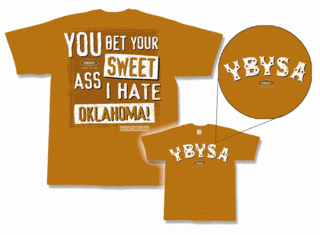
Smack Apparel apparently likes to confuse people.
The Fifth Circuit held last week that a t-shirt maker infringed trademarks of four big-time sports schools in their color schemes.
Smack Apparel slapped sporting garb with the colors of Louisiana State University (purple and gold), the University of Oklahoma (crimson and creme), Ohio State University (scarlet and gray) and the University of Southern California (cardinal and gold). And — fatal mistake — Smack added identifying touches, including "BOUrbon Street or Bust" (Oklahoma) and "2003 College Football National Champions" (LSU).
The district court determined on summary judgment that the universities proved their Lanham Act claims as a matter of law. The Fifth Circuit affirmed. Bd. Supervisors for La. State Univ. Ag. & Mech. College v. Smack Apparel Co., No. 07-30580 (5th Cir. Nov. 25, 2008).

Hiding Patents = Waiver, Federal Circuit Tells Qualcomm
You'd think Qualcomm must've known something bad would happen.
It sued rival semiconductor maker Broadcom for using video compression technology that Qualcomm claimed as its own. But Qualcomm had hornswaggled Broadcom.
It had induced the industry (and hence Broadcom) to adopt the (Qualcomm) technology by pretending that it (Qualcomm) didn't own (hadn't patented) the (Qualcomm) technology. In fact it held two patents relating to what, thanks to its non-disclosure, had become the new industry standard.
Qualcomm made the something bad worse by pretending that it hadn't influenced the standard-setting process. The truth eventually came out (during testimony of Qualcomm's final trial witness), and the hammer fell. Wham! The district court concluded that Qualcomm waived its right to enforce the patents, declared them unenforceable as against all the world, and awarded fees and costs to Broadcom.
The Federal Circuit today agreed but limited the unenforceability decree to products that use the industry standard. Qualcomm Inc. v. Broadcom Corp., No. 07-1545 (Fed. Cir. Dec. 1, 2008).
 Let's please not even talk about the option back-dating unpleasantness.
Quote of the Day: Raymond Wolfinger
Inductive reasoning may produce false conclusions.
The plural of anecdote is data.
Raymond Wolfinger, Political Science professor at UC-Berkeley, responding to one student's criticism of another student's use of an example as reasoning by anecdote.

Annals of Conflict of Laws: Texas Supremes Go for Clever Over Cogent

Cudd and its insurer hope to avoid Cudd's promise to indemnify for an oilfield accident.
A Master Service Agreement between Sonat Exploration and Cudd Pressure Control contemplated that Cudd would provide oilfield services to Sonat in several states, including Louisiana, New Mexico, and Texas. Th MSA required Cudd to indemnify Sonat for claims that Cudd employees might bring against Sonat (and vice versa). But it didn't specify a choice of law to govern the entire contract or the indemnity provisions.
In October 1998, one of Sonat's wells in Louisiana blew out and killed seven workers, including four Cudd employees, whose survivors sued Sonat in Texas state courts. Sonat paid around $28 million to settle the claims against it and tapped Cudd for indemnity. Cudd refused. The trial court applied Texas law and held Cudd's indemnity obligation to Sonat valid. (The relevant Texas statute generally allows mutual oilfield indemnities but limits them to the amount of insurance coverage.) The court awarded Sonat about $21 million on its indemnity claim.
The court of appeals concluded that Louisiana law controlled and therefore reversed and remanded. (Louisiana law generally bars oilfield indemnities if the underlying claim arises from the indemnitees' negligence or strict liability.) The Supreme Court of Texas agreed. It pointed to a paragraph in an exhibit to the MSA, which paragraph required Cudd to name Sonat and its affiliates as "additional insureds" under Cudd's existing policies with respect to operations in and offshore Louisiana. "Because contracts should be governed by the law the parties had in mind when the contract was made, we hold in these circumstances that Louisiana law applies." Sonat Exploration Co. v. Cudd Pressure Control, Inc., No. 06-0979, slip op. at 11 (Tex. Nov. 21, 2008) (footnote omitted).
Blawgletter finds the way Their Unanimous Honors arrived at the result too clever by half. Their rationale boiled down to the notion that the parties' effort to wire around possible invalidity of the indemnity under Louisiana law necessarily means they expected Louisiana law to govern the validity question, presumably regardless of the state in which an indemnity-triggering accident occurred. That strikes us as bizarre.
Perhaps the court intended a more modest pronouncement — that the parties expected Louisiana law would govern indemnity only for claims that arose from operations in Louisiana. But, even so, does the bare fact that the MSA includes protection against the possibility that Louisiana law might apply really signify an expectation that it would apply? And does the law that governs the indemnity really vary according to where an accident happens?
The court of appeals decided the case with a holistic view of all the circumstances, including the fact that the indemnity-triggering event arose out of work that the MSA contemplated would take place in Louisiana. That approach seems to us a lot more sensible than seizing on a couple of paragraphs in an exhibit to the main contract to infer as a matter of law that the parties expected what they manifestly wanted to avoid.
Why does the question of what law applies matter? Because Texas law would require Cudd (and its insurer) to make good on the indemnity, but Louisiana law probably would not. The decision thus goes a long way towards letting the insurer off the hook.
Imagine our surprise.

Quote of the (Thanksgiving) Day: Abraham Lincoln
Even calamity ought not divert us from counting and giving thanks for our blessings, President Lincoln reminded Americans on October 3, 1863, in the midst of the War Between the States:
The year that is drawing toward its close has been filled with the blessings of fruitful years and healthful skies. To these bounties, which are so constantly enjoyed that we are prone to forget the Source from which they come, others have been added which are of so extraordinary a nature that they can not fail to penetrate and soften even the heart which is habitually insensible to the ever-watchful providence of Almighty God.
In the midst of a civil war of unequaled magnitude and severity, which has sometimes seemed to foreign states to invite and to provoke their aggression, peace has been preserved with all nations, order has been maintained, the laws have been respected and obeyed, and harmony has prevailed everywhere, except in the theater of military conflict, while that theater has been greatly contracted by the advancing armies and navies of the Union.
Needful diversions of wealth and of strength from the field of peaceful industry to the national defense have not arrested the plow, the shuttle, or the ship; the ax has enlarged the borders of our settlements, and the mines, as well of iron and coal as of the precious metals, have yielded even more abundantly than theretofore. Population has steadily increased notwithstanding the waste that has been made in the camp, the siege, and the battlefield, and the country, rejoicing in the consciousness of augmented strength and vigor, is permitted to expect continuance of years with large increase of freedom.
No human counsel hath devised nor hath any mortal hand worked out these great things. They are the gracious gifts of the Most High God, who, while dealing with us in anger for our sins, hath nevertheless remembered mercy.
It has seemed to me fit and proper that they should be solemnly, reverently, and gratefully acknowledged, as with one heart and one voice, by the whole American people. I do therefore invite my fellow-citizens in every part of the United States, and also those who are at sea and those who are sojourning in foreign lands, to set apart and observe the last Thursday of November next as a day of thanksgiving and praise to our beneficent Father who dwelleth in the heavens. And I recommend to them that while offering up the ascriptions justly due to Him for such singular deliverances and blessings they do also, with humble penitence for our national perverseness and disobedience, commend to His tender care all those who have become widows, orphans, mourners, or sufferers in the lamentable civil strife in which we are unavoidably engaged, and fervently implore the interposition of the Almighty Hand to heal the wounds of the nation and to restore it, as soon as may be consistent with the Divine purposes, to the full enjoyment of peace, harmony, tranquility, and union.
In testimony wherof I have hereunto set my hand and caused the seal of the United States to be affixed.
The 1863 Thanksgiving fell on November 26 — exactly a week after President Lincoln delivered the Gettysburg Address.

No Subpoenas for 3d-Party Documents in Arbitration, Second Circuit Rules
The Second Circuit held today that arbitrators can't force non-parties to produce documents under the federal Arbitration Act:
This appeal places squarely before us a question that has divided the circuits: Does section 7 of the Federal Arbitration Act ("FAA"), 9 U.S.C. § 7, authorize arbitrators to compel pre-hearing document discovery from entities not parties to the arbitration proceeding? The Eighth Circuit has held that it does, see In re Arbitration Between Sec. Life Ins. Co. of Am., 228 F.3d 865, 870-71 (8th Cir. 2000); the Third Circuit has determined that it does not, see Hay Group, Inc. v. E.B.S. Acquisition Corp., 360 F.3d 404, 407 (3d Cir. 2004); and the Fourth Circuit has concluded that it may — where there is a special need for the documents, see Comsat Corp. v. Nat'l Sci. Found., 190 F.3d 269, 275 (4th Cir. 1999). Like the Third Circuit, we hold that section 7 does not enable arbitrators to issue pre-hearing document subpoenas to entities not parties to the arbitration proceeding, and therefore reverse the order of the United States District Court for the Southern District of New York (Owen, J.).
Life Receivables Trust v. Syndicate 102 at Lloyd's of London, No. 07-1197-cv, slip op. at 2 (2d Cir. Nov. 25, 2008).

Bank Says “Without Delay” Means Three Days Later; Fifth Circuit Begs to Differ
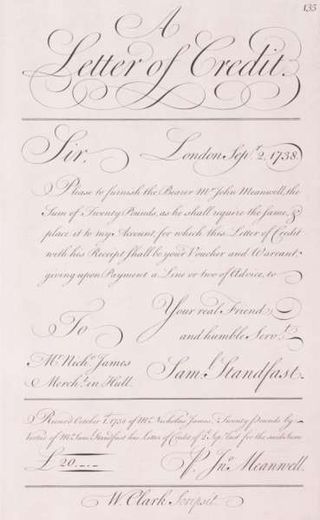
An old-timey letter of credit. Does it really say "Sam Standfast"?
A letter of credit guarantees that the "issuer" will pay to the "beneficiary" a debt on which the "applicant" stiffs the beneficiary.
A Fifth Circuit decision yesterday suggests that Blawgletter should've put "guarantees" in quotes, too.
A Louisiana steel pipe buyer, PVF, ordered steel pipe from LaBarge, a Missouri outfit. LaBarge insisted that PVF get a letter of credit to back up its promise to come forth with cash upon delivery of the tubular goods.
First Bank got the letter of credit gig and faxed the instrument to LaBarge. To everyone's chargrin, soon after taking delivery of LaBarge's pipe, PVF descended into chapter 11. LaBarge timely demanded that First Bank make with the money by sending a facsimile copy of the letter of credit — the only version LaBarge had. But the document called for presentment of the "original Irrevocable Letter of Credit . . . so that drawings can be endorsed on the reverse thereof." First Bank rejected the presentment on the ground that a fax doesn't count as the "original". The district court deemed the defect fatal.
The Fifth Circuit agreed. LaBarge Pipe & Steel Co. v. First Bank, No. 07-30441 (5th Cir. Nov. 24, 2008)
But then the court rumbled on to our favorite part, in which the bank loses the case. The panel pointed out, in way too many pages, that First Bankers decided to welch on February 17, 2003, but didn't get around to telling LaBarge until February 20. (And then only because of LaBarge's pestering phone messages.) But the letter of credit incorporated the Uniform Customs and Practice for Documentary Credits (1983 Revision) International Chamber of Commerce Brochure No. 400, which in relevant part provides that, upon deciding to dishonor a presentment, a letter of credit issuer "must give notice to that effect without delay by telecommunication or, if that is not possible, by other expeditious means . . . to the beneficiary."
The court held, as a matter of law, that First Bank's sitting on bad news for three days before returning LaBarge's phone calls to deliver said bad news didn't qualify as giving notice of said bad news "without delay".
What happened to the "original" of the letter of credit? First Bank never could find it.
The opinion runs 33 pages and features 22 footnotes.
We did not make this up.
