The Washington Post reports today that questions from Supreme Court justices during oral argument in Wyeth v. Levine, No. 06-1249 (U.S.), suggest a narrow ruling on a broad question of federal preemption.

The case presents the sweeping issue of whether the Food and Drug Administration's "prescription drug labeling judgments" preempt state law claims for injuries that result from inadequate warnings of medical risks. 

The plaintiff, Diana Levine, lost her right arm after receiving an "IV-push" injection of Phenergan, an anti-nausea medication.  The inadvertently arterial administration of the drug resulted in gangrene and led to amputation of the guitarist's arm.  Ms. Levine alleged that Wyeth should've given a stronger warning about the danger of using the IV-push method.  A Vermont jury awarded her $6.7 million in damages; the Supreme Court of Vermont declined to overturn the verdict.

The Post story notes that "the justices seemed more likely on Monday to be headed toward a narrow ruling that might be confined to the facts of Levine's case."  It elaborates:

"How could the FDA have concluded that IV push was safe and effective," Alito asked, given that Phenergan is not a lifesaving drug and gangrene can result from improper administration?

Justice Ruth Bader Ginsburg chimed in, "How could the benefit outweigh the substantial risk?"

The questions imply doubt that FDA approval of a label precludes inquiry into the quality of the agency's review — and the integrity of drug-makers' disclosures.

Kurt R. Karst, who attended the argument, has more in this post on FDA Law Blog.  He observes:

[G]iven the tenor of the Court’s questions, which dealt specifically with what FDA knew and what the submissions were, we believe that: (1) an outcome either way is likely to be narrowly focused; and (2) that a narrow outcome could result in additional litigation as to whether preemption is available in any specific set of facts (i.e., a sweeping proclamation of preemption involving all drug labeling is unlikely).

Feed-icon-14x14 A beautiful day in KCK.

RobertsCourt 
Who will stay, and who will go?

The next president will appoint dozens of federal appellate judges during his four-year term – plus dozens more should he win re-election in 2012.  What does that portend for the federal judiciary?  Does it matter?

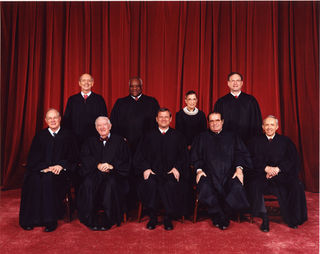
Let's start with the numbers.  Not since 1971 have Democratic appointees formed a majority on the Court.  On the current Roberts Court, Republican appointees hold seven seats (Roberts, Scalia, Thomas, Souter, Stevens, Alito, Kennedy) while picks of Democratic presidents occupy two (Breyer and Ginsburg).

Since Ronald Reagan's second term, each president has named two justices to the Supreme Court.  That seems about right for 2008-12.

The composition of the 13 U.S. courts of appeals has shown more movement.  In 1980, the appointees of Democratic presidents outnumbered their Republican colleagues by 86 to 50.  The ratio dwindled to 76-66 by 1984 and reversed to 62-96 four years later.  Since then, the Democratic-Republican split shifted to 62-96 in 1988, 42-119 in 1992, 54-105 in 1996, 78-76 in 2000, 69-94 in 2004, and 66-101 in 2008.  Republican appointees account for 60 percent of all circuit judges today.

On a circuit-by-circuit basis, Republican appointees currently hold 82 percent of the seats on the Eighth Circuit, 76 percent on the Fifth Circuit, 70 percent on the Seventh and D.C. Circuits, 67 percent on the Tenth and Federal Circuits, 60 percent on the First and Sixth, 58 percent on the Eleventh, 54 percent on the Fourth, 50 percent on the Second and Third, and 41 percent on the Ninth.

Appointments of circuit judges clustered in the 25-40 range during each presidential term since President Reagan's first term.  (President Carter elevated 59 in his 1976-80 term.)  The next president's appointments look likely to tend towards the higher end of the historical range.

Do the numbers matter?  A 2006 study showed that appointees of Republican presidents since Reagan voted for the "conservative" outcome in cases 62 percent of the time.  The book, Are Judges Political?:  An Empirical Analysis of the Federal Judiciary, also found:

  • "In ideologically contested cases, involving the most controversial issues of the day, a judge's ideological tendency can be predicted by the part of the appointing president:  Republican appointees vote very differently from Democratic appointees."
  • "A judge's ideological tendency is likely to be dampened if she is sitting with two judges of a different political party."
  • "A judge's ideological tendency, in ideologically contested cases, is likely to be amplified if she is sitting with two judges from the same political party."

(That accords, btw, with Blawgletter's unscientific look at the effect of party balance and party dominance at the Supreme Court of Texas.)

So what would the courts of appeals look like in 2012?  An article in Politico.com notes:

Russell Wheeler, a Brookings expert on the courts, calculates that the new president will immediately have 15 appellate vacancies to fill, and would likely get another 14 in the probable event that Congress expands the courts soon to accommodate rising caseloads. Retirements from among the 164 appeals court justices now sitting.

“A reasonable estimate,” Wheeler wrote in a recent study, “is that a President McCain would increase the total proportion of Republican appointees from 56% to 74% and reduce the proportion of Democratic appointees from 36% to 26%.

“That would make for the second most lopsided appellate judiciary in modern history, after 1953, following 20 years of Roosevelt and Truman appointees,” Wheeler said in his study. “A President Obama, by contrast, would reduce the proportion of Republican appointees [from 56%] to 42% and increase the proportion of Democratic appointees from 36 to 58%,” he wrote.

A presidential candidate once told Blawgletter that the vast majority of American voters could not care less about judicial appointments.  Perhaps.

But we suspect that people sense when things get out of kilter.  The federal judiciary hasn't reached a truly scary level of imbalance.  Yet.

FeedIcon Our feed predicts the centre will hold. 


Who'd want to patent this?

The Federal Circuit today upheld the affirmance by the Board of Patent Appeals and Interferences of a patent examiner's rejection of an application to patent a method of hedging risk in the field of commodities trading.  In re Bilski, No. 07-1130 (Fed. Cir. Oct. 30, 2008) (en banc).

Got that?

Neither does Blawgletter, but as best we can piece together the decision is to a Big Deal.  The four-page list of counsel — including a Great Many amici curiae — gave us a hint.  Then, on the very next page, we saw that the court heard the appeal en banc.  And the 12 judges issued five opinions — a 9-3 majority, one concurrence, and three dissents.  Did we mention the 132-page length of all that ink-spilling?

The kerfuffle centered on what Congress meant when, in 1952, it added "process" as patent-eligible subject matter under section 101 of the patent statute.  The court grappled with whether the Bilski patent application recited a "fundamental principle" of the universe and therefore couldn't qualify as patentable.  Because, you see, one can't pre-empt others' use of fundamental principles.

The court resolved the question by using a limiting "machine-or-transformation" test, which it illustrated thus:

A claimed process involving a fundamental principle that uses a particular machine or apparatus would not pre-empt uses of the principle that do not also use the specified machine or apparatus in the manner claimed.  And a claimed process that transforms a particular article to a specified different state or thing by applying a fundamental principle would not pre-empt the use of the principle to transform any other article, to transform the same article but in a manner not covered by the claim, or to do anything other than transform the specified article.

Bilski, slip op. at 11.  The court held that the Bilski application failed the machine-or-transformation test.

We think Bilski will bring joy to those who — like Michael Crichton — feared that the U.S. Patent and Trademark Office would start letting people win a government monopoly on basic scientific discoveries and the like.

Feed-icon-14x14 Steady, Michael. 


KenmoreDryer 
Do you get more with a Kenmore?

Today the Seventh Circuit — with Judge Richard Posner tickling the keyboard — instructed a district judge to decertify a class action that challenged the audacity of Sears, Roebuck and Company in labelling a Kenmore-brand clothes dryer as sporting a "stainless steel drum" when in fact part of the raiment-tumbler consisted of "mild steel" with a ceramic coating. 

The class representative alleged that his garments got rusty when the non-stainless part, er, oxidized.

Judge Posner first praised the class mechanism as "an ingenious device for economizing on the expense of litigation and enabling small claims to be litigated."  Thorogood v. Sears, Roebuck and Co., No. 08-1590, slip op. at 3 (7th Cir. Oct. 28, 2008).  So far so good.  But then the opinion turns less kindly:  Class cases raise potential conflicts between lawyers and class members, encourage sell-out settlements, enhance the risk of wrong decisions, and — wait for it — threatens federalism.  Id. at 3-8.

None of those things doomed class certification.  No.  What did?  The court's view that no one (or hardly anyone) would share Mr. Thorogood's belief that slapping a "stainless steel drum" label on a dryer signifies 100 percent stainless steel or warrants against rusty duds.  The trouble with determining actual damages and applying 29 different states' deceptive practices statutes compounded the inadvisability of class treatment, the court held.

Judge Posner did put in a good word for computing damages, in appropriate cases, on a class-wide basis:  "'Aggregate class proof of monetary relief may . . . be based on sampling techniques or other reasonable estimates, under accepted rules of evidence.'  3 Herbert B. Newberg & Alba Conte, Newberg on Class Actions § 10.3, p. 480 (4th ed. 2002)."  Id. at 12 (citing Stewart v. General Motors Corp., 542 F.2d 445, 452-53 (7th Cir. 1976); United States v. City of Miami, 195 F.3d 1292, 1299-1300 (11th Cir. 1999); Pettway v. Am. Cast Iron Pipe Co., 494 F.2d 211, 259-63 (5th Cir. 1974)).

Feed-icon-14x14 Mild steel lacks chromium, you know.

RoyalFurgeson 
Judge Furgeson testifies at a House hearing.

The Judicial Panel on Multidistrict Litigation will hear a new slew of transfer motions on November 20 in Charleston, South Carolina.  Notice of Hearing Session and Hearing Session Order here.

Blawgletter notes that the Panel has a new member — W. Royal Furgeson, Jr., who sits in the Western District of Texas (San Antonio).  He joined the JPML a month or so ago.

Comments on His Honor at The Robing Room include:

I was impressed by the fact that he looks exactly how you would picture Wyatt Earp in your mind's eye.

Runs an extremely "lawyer-friendly" courtroom. Very courteous to lawyers on both sides of the docket.

One of the finest judges I know. He spends more time trying to do the right thing, and how often does one say that about a federal judge?

An excellent judge, intent on seeing that justice is done, even encouraging settlement. A gentleman's gentleman. Very well respected. I have been in front of him a number of times, and each time was a good experience.

Has an incredible respect for justice and the lawyers before the court.

A gentleman and a scholar. He is courteous and fair and his cheerful demeanor makes practicing before him a pleasure even when he rules against you. If only all judges were like him.

Intelligent, hard-working and a gentleman with a cheerful disposition.

A terrific addition, we say.

Feed-icon-14x14 Our feed adores its world-wide audience.

Ahmad Chalabi — who some say played a crucial role in prompting the U.S. invasion of Iraq — today lost a legal battle against another Middle Eastern state, the Hashemite Kingdom of Jordan.

Chalabi alleged that Jordan committed torts and violated the Racketeer-Influence and Corrupt Organizations Act when in 1989 the kingdom seized Petra Bank, which Chalabi founded a dozen years earlier.  The district court sidestepped a gnarly question about jurisdiction under the Foreign Sovereign Immunities Act and granted a motion to dismiss on the ground that the applicable statutes of limitations expired years before Chalibi filed suit in 2004.  The D.C. Circuit affirmed, holding that the district court properly put the limitations issue before the jurisdictional one and rejecting Chalabi's "continuing tort" riposte to the you-sued-too-late defense.  Chalabi v. Hashemite Kingdom of Jordan, No. 07-7141 (D.C. Cir. Oct. 27, 2008).

Feed-icon-14x14 Curveball.

Recovering lawyer and editor Dahlia Lithwick — currently of Slate and Newsweek — today explores the surging role of lawyers in keeping elections honest (or at least trying to):  

Election litigation is a boom industry, even in a crumbling economy. [Loyola election law professor Richard L.] Hasen recently published a study indicating that the number of lawsuits filed over elections rose from an average of 94 in the four years before the 2000 election to an average of 230 in the six years after. Paradoxically, the best way to inoculate America against the growing pandemic of "vote fraud" allegations from the political right, and the anxiety over widespread voter intimidation and suppression from the left, may be by throwing more lawyers at it. That's why the single most important role for the armies of attorneys working the 2008 election may ultimately just be to be there: to avert the biggest conflicts and bear witness to the small ones. Send in enough lawyers, and you may just ensure that a watched polling place never boils.

A 2006 Harris poll found that only 18 percent of Americans trust attorneys completely. That's a sad and unfair reflection on the contempt we feel for the profession in this day and age. One can't help but wonder what it says about public confidence in our voting systems, then, that despite our almost complete lack of faith in them, we will rely almost exclusively on lawyers to protect the integrity of this election.

Blawgletter shares Ms. Lithwick's ironic sense.  The public relies on our profession to uphold the rule of law — in elections as elsewhere — while doubting our integrity in doing it.  That stings.

Has it been ever thus?  We dimly recall that the Puritans disliked the legal profession — because it doesn't produce tangible stuff? — but avidly employed it in litigation and plucked from it many leaders (including John Winthrop). 

Also consider Tocqueville's view of the American lawyer as bridge between the (economic and political) aristocracy and common folk:

The more we reflect upon all that occurs in the United States the more we shall be persuaded that the lawyers, as a body, form the most powerful, if not the only, counterpoise to the democratic element. In that country we easily perceive how the legal profession is qualified by its attributes, and even by its faults, to neutralize the vices inherent in popular government. When the American people are intoxicated by passion or carried away by the impetuosity of their ideas, they are checked and stopped by the almost invisible influence of their legal counselors. These secretly oppose their aristocratic propensities to the nation's democratic instincts, their superstitious attachment to what is old to its love of novelty, their narrow views to its immense designs, and their habitual procrastination to its ardent impatience.

What has changed?  We suspect that the invisibility has disappeared. 

For good or ill.

FeedIcon Probably for good. 

Australia 
One is reminded of a terrier.

Something about a class of overseas people suing an Australian bank about securities fraud that emanated from the world's smallest continent.  They lost on subject matter grounds.  Seems the U.S. Securities Exchange Act doesn't reach so far.  Morrison v. National Australia Bank Ltd., No. 07-0583-cv (2d Cir. Oct. 23, 2008).

Kinda like Empagran.

Last month, the Second Circuit clarified its precedents on when a non-signatory to a contract that includes an arbitration clause may compel a signatory to arbitrate their dispute.  Today, the court followed its decision in Sokol Holdings, Inc. v. BMB Munai, Inc., No. 07-2871 (2d Cir. Sept. 18, 2008), to turn back another non-signatory's effort to force a signatory into arbitration.  Ross v. American Express Co., No. 06-4598-cv(L) (2d Cir. Oct. 21, 2008).

The plaintiffs sued American Express, MasterCard, VISA, Diners Club, and several card-issuing banks for conspiring to fix prices for currency exchange fees.  None of the plaintiffs had American Express cards; they consisted entirely of MasterCard, VISA, and Diners Club cardholders.  Amex nonetheless cited arbitration provisions in the cardholder agreements between plaintiffs and banks that issued MasterCard and VISA plastic rectangles.  The district court held that Amex had a shot at bootstrapping the arbitration clauses as against the plaintiffs and set a trial to determine whether the facts supported such a maneuver.  The Second Circuit disagreed, concluding that the "intertwining" doctrine didn't extend to a situation — as in Sokol Holdings — where the plaintiffs don't make allegations that treat the non-signatory defendant as if it were a party to the underlying agreement.

But it got weird before that — specifically in the court's brief discussion of why it had appellate jurisdiction.  Although the federal Arbitration Act allows interlocutory appeals from refusals to enforce a "written" arbitration agreement between parties to the case, the panel provided hardly any analysis of whether jurisdiction existed where the party seeking to compel arbitration doesn't have an actual "written" agreement with a signatory and instead relies on equitable estoppel principles to take advantage of an agreement between others.  The judicial trio instead dropped a footnote in which it mentioned that "a substantial split among the Circuit has now developed over this jurisdictional question."  Ross, slip op. at 7 n.2 (citing Sourcing Unlimited, Inc. v. Asimco Int'l, Inc., 526 F.3d 38, 44 n.6 (1st Cir. 2008)).

The court then concluded that the "intertwined" nature of Amex's appeal (from denial of arbitration) and plaintiffs' separate appeal (from ordering trial of the estoppel question) gave it "pendent appellate jurisdiction".  Id. at 8.

Feed-icon-14x14 Our feed keeps its pants up with a piece of intertwine.