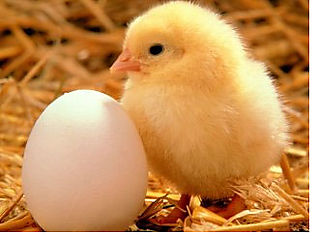
Mama?
Legal actions that commenced this week may help answer which came first — the chicken or the egg.
Probably not.
On September 24, the Humane Society of the United States aimed its public interest talons at a trade association. The Society’s press release starts thus:
Agribusiness Cartel Provides Lowest Possible Care for Birds, Extracts Highest Possible Profits from Consumers
WASHINGTON — Legal Petitions filed with the Federal Trade Commission and the United States Department of Justice today accuse the egg industry of engaging in a massive price-fixing scheme that has inflated egg company profits to historic highs.
The Humane Society of the United States (HSUS) filed the Petitions seeking civil and criminal penalties against the United Egg Producers (UEP)—the nation’s largest egg trade association—and a dozen major egg factory-farming corporations.
The price-fixing conspiracy centers on a bogus animal welfare certification program that dooms hundreds of millions of egg-laying hens to suffer in tiny cages, while producers reap record profits. As a result of this scheme, between August 2007 and March 2008, egg prices nationwide skyrocketed by as much as 45 percent and at the fastest rates in 30 years—all at the expense of U.S. consumers.
The day after the Humane Society’s announcement, an egg buyer filed T. K. Ribbing’s Family Restaurant v. United Egg Producers, Inc., No. 08-cv-4653-GP (E.D. Pa. Sept. 25, 2008). The Class Action Complaint spans a larger period but likewise accuses United Egg and several of its biggest ovum-producing members of manipulating pullet and hen supply to raise prices for their output.
U.S. District Judge Gene E. K. Pratter drew the assignment. Her Honor ascended to the federal bench in 2004. Her former partners at Duane Morris consider her a good egg.
The defendants will likely invoke the Capper-Volstead Act of 1922, section 291 of which provides in relevant part:
Persons engaged in the production of agricultural products as farmers, planters, ranchmen, dairymen, nut or fruit growers may act together in associations, corporate or otherwise, with or without capital stock, in collectively processing, preparing for market, handling, and marketing in interstate and foreign commerce, such products of persons so engaged. Such associations may have marketing agencies in common; and such associations and their members may make the necessary contracts and agreements to effect such purposes[.]
7 U.S.C. 291. The defense appears to have cracks. Because, among other things:
The Capper-Volstead Act removed from the proscription of the antitrust laws cooperatives formed by certain agricultural producers that otherwise would be directly competing with each other in efforts to bring their goods to market. But if the cooperative includes among its members those not so privileged under the statute to act collectively, it is not entitled to the protection of the Act.
Nat’l Broiler Marketing Ass’n v. United States, 436 U.S 816, 822 (1978) (holding that association including "even one" non-"farmer" disqualified it from Capper-Volstead protection).
In any event, the industry appears to have its product on its face. See also Humpty Dumpty.
The Humane Society’s petitions and the restaurant’s complaint make much of the plan to reduce flocks, cut layings, and hence induce soaring prices through artificial scarcity. The theory implies a chicken-before-egg solution to the causality dilemma. Yet Blawgletter doubts that mere litigation will resolve the question.