Stolttanker
A lovely sea-going parcel tanker.

Parcel tanker shipping giant Stolt-Nielsen pitched a fit when the Antitrust Division in the U.S. Department of Justice revoked — or tried to revoke — an amnesty agreement between them.  Under the Division’s corporate leniency program, the first-in bona fide seeker of amnesy gets, well, leniency; and Stolt-Nielsen still wanted it. 

Revocation loosed litigation.  Then Stolt-Nielsen asked, under the Freedom of Information Act, for a copy of all of the 100 or so amnesty agreements that the Antitrust Division had entered into since the program started in 1993.  When the Division balked, claiming exemptions, more litigation ensued.  The district court bought all of the government’s arguments and told Stolt-Nielsen to suck eggs.

The D.C. Circuit reversed, finding only two exemptions arguably applicable.  Both related to revealing confidential and identifying information from and regarding amnesty recipients.  The court said the Antitrust Division needn’t turn over documents that would breach confidence with program participants but rejected the government’s argument (and the district court’s ruling) that redacting the agreements wouldn’t solve the problem.  The court remanded to the district court for determination of whether redactions would make non-secret portions "reasonably segregable" from the secret stuff.  Stolt-Nielsen Transportation Group, Ltd. v. United States, No. 07-5191 (D.C. Cir. July 25, 2008).

Blawgletter has a different question.  What relevance do amnesty agreements with other companies have to the question of whether Stolt-Nielsen violated its amnesty agreement?  Will Stolt-Nielsen try to show that the Division let violations of other agreements with different companies slide but for no good reason got real huffy with a Hollandic parcel tanker shipper?  Selective persecution?

By the way, Stolt-Nielsen won the fight over revocation of the amnesty agreement.  So far.

Feedicon Do they still wear wooden shoes?

Can you dismiss a complaint simply by filing a notice even after the court has granted a motion to dismiss?  Yes, the Third Circuit held today — at least where the defendants haven’t answered, the plaintiffs haven’t dismissed a similar case before, and the district court’s order granting dismissal also allowed the plaintiffs a chance to replead and didn’t convert a motion to dismiss to a motion for summary judgment.  The court explained that in those circumstances Rule 41(a)(1)(A)(i) operates to effect dismissal automatically upon the filing of a notice.  In re Bath and Kitchen Fixtures Antitrust Litig., No. 07-1520 (3d Cir. July 28, 2008).

Feedicon14x14 Happy Monday!

Anightincasablanca
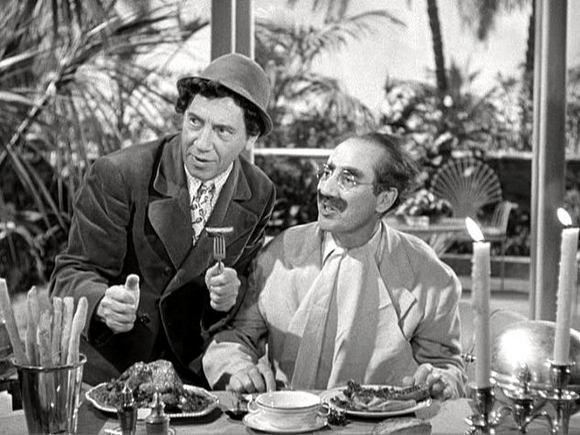
Chico and Groucho Marx in A Night in Casablanca.

As visions of Sea Smoke start dancing in Blawgletter’s head — for tonight Oxford promises to uncork some — the time seems right to close out Groucho Marx’s epistolary feud with Warner Brothers over the then-impending release of A Night in Casablanca (1946). 

We’ve seen Mr. Marx’s first two letters, in which he responds to missives from the Warner legal department.  His opening salvo questions whether the studio owned the name "Casablanca" and from there ponders intellectual property rights in other monikers, including "Brothers", "Burbank", and "Jack".  The next, which answers a second Warner letter asking for a summary of A Night in Casablanca‘s plot, has Mr. Marx as a doctor of divinity who hawks can openers and pea coats.

The final instalment follows:

Dear Brothers:

Since I last wrote you, I regret to say there have been some changes in the plot of our new picture, "A Night in Casablanca."  In the new version I play Bordello, the sweetheart of Humphrey Bogart.  Harpo and Chico are itinerant rug peddlers who are weary of laying rugs and enter a monastery just for a lark.  This is a good joke on them, as there hasn’t been a lark in the place for fifteen years.

Across from this monastery, hard by a jetty, is a waterfront hotel, chockfull of apple-cheeked damsels, most of whom have been barred by the Hays Office for soliciting.  In the fifth reel, Gladstone makes a speech that sets the House of Commons in an uproar and the King promptly asks for his resignation.  Harpo marries a hotel detective; Chico operates an ostrich farm.  Humphrey Bogart’s girl, Bordello, spends her last years in a Bacall house.

This, as you can see, is a very skimpy outline.  The only thing that can save us from extinction is a continuation of the film shortage.

Fondly,

Groucho Marx

And so it ended.  Warner Brothers never responded, and the world today can watch A Night in Casablanca to our heart’s content.

Feedicon14x14 Umm, Sea Smoke.

Grouchomarx
Groucho Marx (1890-1977) as Rufus T. Firefly.

Yesterday, Blawgletter quoted at full length a combative letter from Groucho Marx to Warner Brothers.  The dispute centered on the studio’s belief that an impending Marx Brothers movie, A Night in Casablanca (1946), would impinge on the intellectual property that Warner Brothers embodied four years earlier in Casablanca (1942).

Mr. Marx’s letter, we learned, produced a sequel.  It responded to a letter in which the Warner organization asked for a thumbnail of the plot.  The reply went like this:

Dear Warners:

There isn’t much I can tell you about the story.  In it I play a Doctor of Divinity who ministers to the natives and, as a sideline, hawks can openers and pea jackets to the savages along the Gold Coast of Africa.

When I first meet Chico, he is working in a saloon, selling sponges to the barflies who are unable to carry their liquor.  Harpo is an Arabian caddie who lives in a small Grecian urn on the outskirts of the city.

As the picture opens, Porridge, a mealy-mouthed native girl, is sharpening some arrows for the hunt.  Paul Hangover, our hero, is constantly lighting two cigarettes simultaneously.  He apparently is unaware of the cigarette shortage.

There are many scenes of splendor and fierce antagonisms, and Color, an Abyssinian messenger boy, runs Riot.  Riot, in case you have never been there, is a small night club on the edge of town.

There’s a lot more I could tell you, but I don’t want to spoil it for you.  All this has been okayed by the Hays Office, Good Housekeeping and the survivors of the Haymarket Riots; and if the times are ripe, this picture can be the opening in a new worldwide disaster.

Cordially,

Groucho Marx

Feedicon14x14_3 To be continued.

Today a unanimous panel of the Federal Circuit upheld a summary judgment of non-infringement in a case that prompted the district court to describe the behavior of lawyers as less professional than "vipers slithering around on hot coals."  The suit accused several dozen companies of infringing a patent regarding "Character Pattern Recognition and Communications Apparatus".  The summary judgment hinged on whether the claim term "syllabic element" meant "a one-syllable letter group" or, more broadly, "a word or a part of a word" with no limit on the number of syllables comprising it.  The district court accepted the narrower construction.  The Federal Circuit agreed.  Board of Regents of the University of Texas System v. BENQ Am. Corp., No. 07-1388 (Fed. Cir. July 23, 2008).

Feedicon14x14_2 Our feed wonders how the regents feel.

Agripoolbag_4
An Agripool catcher bag.

The Bankruptcy Appellate Panel of the Sixth Circuit today upheld a bankruptcy judge’s failure to infer that missing emails would have hurt a creditor’s "ordinary course of business" defense.  The trustee of the debtor, a lawn mower maker, sought to recover a "preference" payment that the debtor made to a catcher bag manufacturer within 90 days before the debtor filed for bankruptcy protection.  The bag supplier, an Italian company, Agripool, invoked the ordinary course of business defense, contending that it made no unusual efforts to collect from the debtor during the 90-day preference period.  The trustee, in turn, asked the bankruptcy judge to infer the opposite as a result of the vendor’s failure to produce emails from the relevant time period.  The bankruptcy judge didn’t draw the inference and concluded that Agripool established its defense.  The Sixth Circuit’s Bankruptcy Appellate Panel held that the court didn’t abuse its discretion in that respect.  Kaye v. Agripool, SRL (In re Murray, Inc.), No. 07-8064 (6th Cir. B.A.P. July 23, 2008).

The Panel nonetheless reversed, concluding that Agripool’s expert relied on, um, unreliable information in opining that the payments to Agripool fell within ordinary commercial terms for the relevant industry.

Feedicon Catcher of the Rye?

Groucho
Groucho Marx (1890-1977).

In 1942, Groucho Marx sent this letter after a studio threatened legal action over the impending release of A Night in Casablanca (1946):

Dear Warner Brothers,

Apparently there is more than one way of conquering a city and holding it as your own. For example, up to the time that we contemplated making this picture, I had no idea that the city of Casablanca belonged exclusively to Warner Brothers. However, it was only a few days after our announcement appeared that we received your long, ominous legal document warning us not to use the name Casablanca.

It seems that in 1471, Ferdinand Balboa Warner, your great-great-grandfather, while looking for a shortcut to the city of Burbank, had stumbled on the shores of Africa and, raising his alpenstock (which he later turned in for a hundred shares of common), named it Casablanca.

I just don’t understand your attitude. Even if you plan on releasing your picture, I am sure that the average movie fan could learn in time to distinguish between Ingrid Bergman and Harpo. I don’t know whether I could, but I certainly would like to try.

You claim that you own Casablanca and that no one else can use that name without permission. What about “Warner Brothers”? Do you own that too? You probably have the right to use the name Warner, but what about the name Brothers? Professionally, we were brothers long before you were. We were touring the sticks as the Marx Brothers when Vitaphone was still a gleam in the inventor’s eye, and even before there had been other brothers—the Smith Brothers; the Brothers Karamazov; Dan Brothers, an outfielder with Detroit; and “Brother, Can You Spare a Dime?” (This was originally “Brothers, Can You Spare a Dime?” but this was spreading a dime pretty thin, so they threw out one brother, gave all the money to the other one, and whittled it down to “Brother, Can You Spare a Dime?”)

Now Jack, how about you? Do you maintain that yours is an original name? Well it’s not. It was used long before you were born. Offhand, I can think of two Jacks—Jack of “Jack and the Beanstalk,” and Jack the Ripper, who cut quite a figure in his day.

As for you, Harry, you probably sign your checks sure in the belief that you are the first Harry of all time and that all other Harrys are impostors. I can think of two Harrys that preceded you. There was Lighthouse Harry of Revolutionary fame and a Harry Appelbaum who lived on the corner of 93rd Street and Lexington Avenue. Unfortunately, Appelbaum wasn’t too well-known. The last I heard of him, he was selling neckties at Weber and Heilbroner.

Now about the Burbank studio. I believe this is what you brothers call your place. Old man Burbank is gone. Perhaps you remember him. He was a great man in a garden. His wife often said Luther had ten green thumbs. What a witty woman she must have been! Burbank was the wizard who crossed all those fruits and vegetables until he had the poor plants in such confused and jittery condition that they could never decide whether to enter the dining room on the meat platter or the dessert dish.

This is pure conjecture, of course, but who knows—perhaps Burbank’s survivors aren’t too happy with the fact that a plant that grinds out pictures on a quota settled in their town, appropriated Burbank’s name and uses it as a front for their films. It is even possible that the Burbank family is prouder of the potato produced by the old man than they are of the fact that your studio emerged “Casablanca” or even “Gold Diggers of 1931.”

This all seems to add up to a pretty bitter tirade, but I assure you it’s not meant to. I love Warners. Some of my best friends are Warner Brothers. It is even possible that I am doing you an injustice and that you, yourselves, know nothing about this dog-in-the-Wanger attitude. It wouldn’t surprise me at all to discover that the heads of your legal department are unaware of this absurd dispute, for I am acquainted with many of them and they are fine fellows with curly black hair, double-breasted suits and a love of their fellow man that out-Saroyans Saroyan.

I have a hunch that his attempt to prevent us from using the title is the brainchild of some ferret-faced shyster, serving a brief apprenticeship in your legal department. I know the type well—hot out of law school, hungry for success, and too ambitious to follow the natural laws of promotion. This bar sinister probably needled your attorneys, most of whom are fine fellows with curly black hair, double-breasted suits, etc., into attempting to enjoin us. Well, he won’t get away with it! We’ll fight him to the highest court! No pasty-faced legal adventurer is going to cause bad blood between the Warners and the Marxes. We are all brothers under the skin, and we’ll remain friends till the last reel of “A Night in Casablanca” goes tumbling over the spool.

Sincerely,

Groucho Marx

Feedicon One day I shot an elephant in my pajamas.  How he got in my pajamas, I don’t know.   Monkey Business (1931).

Calistotanzi
The company Calisto Tanzi founded collapsed in 2003 when people learned its $5.4 billion bank account balance didn’t exist.

A 2-1 panel of the Second Circuit today upheld an order that allowed American-style securities fraud litigation to move forward despite the Italian bankruptcy of the principal defendant, Parmalat.  The court held that 11 U.S.C. 304 — a part of the old U.S. Bankruptcy Code, which went the way of the dinosaurs in 2005 — didn’t require the district court to enjoin proceedings against the successor to Parmalat.  The court cited, among other reasons, the fact that the Italian court needn’t accept a U.S. judgment but that liquidating U.S. securities claims in the U.S. will advance resolution of the great big sprawling litigation whether by settlement or judgment.  Bondi v. Capital & Finance Asset Mgmt. S.A., No. 07-2949-cv (2d Cir. July 22, 2008).

Feedicon14x14 Our feed has a song in its heart.