Whiterabbit
The White Rabbit was always late for a very important date.

As all the world knows, a settlement class member who wants to opt out must timely tell the court of opt-outer’s desire for exclusion.  But what happens if the settlement notice that the class member receives doesn’t specify the opt-out deadline but the member could’ve figured it out anyway?  Should the court allow more time for opting out?

The Fifth Circuit said no this week to several Canadian companies (which we’ll call "Silvercreek") that tardily tried to exclude themselves from a $69 million settlement with Bank of America in a piece of the sprawling Enron securities litigation.  Silvercreek admitted getting a copy of the district court’s order that preliminarily approved the settlement and directed the sending of notice to class members.  The order established March 28, 2005 as the deadline for filing "objections" to the settlement and April 11 as the date for the "[f]inal approval hearing".  But it left a blank in the space for the opt-out deadline.  The court nevertheless directed the claims administrator to identify March 28 as the end date for opting out in the electronic and paper notices it would post on a litigation website and mail to class members. 

Silvercreek said nothing about objecting to the settlement or opting out until April 27 — 16 days after the final approval hearing — when it requested more time.  The district court demurred.  The Fifth Circuit affirmed, holding that Silvercreek failed to justify its tardiness with a showing of "excusable neglect".  Even if Silvercreek never got a notice specifying an opt-out deadline, the court concluded, it could and should have learned of the March 28 cut-off with a little investigation.  And anybody with a lick of sense, the court suggested, ought to have figured that the deadline must precede the April 11 final approval hearing.  A request for opt out more than two weeks after the hearing thus came too late. Silvercreek Mgmt. Inc. v. Banc of America Securities LLC, No. 06-20026 (5th Cir. July 7, 2008).


Feedicon Tempus fugit.

Carterglass
Senator Carter Glass (1858-1946) disliked the New Deal but the banking excesses that preceded the Great Depression even more.

Blawgletter learned in law school about a pillar of the New Deal — the Glass-Steagall Act of 1933.  Little did we know that, 66 years after Franklin D. Roosevelt signed it into law, Glass-Steagall would met its end with William J. Clinton’s inking of Gramm-Leach-Bliley.

Who cares, right?  You do, we think.  Because Glass-Steagall likely would’ve prevented the credit crisis from which we all now suffer.

The 1933 legislation barred commercial banks, which take deposits and make business and other loans, from mating with investment banks, which float securities and invest for their own accounts.  In the less than a decade since Gramm-Leach-Bliley repealed the separation of financial church and state, the conjugal bliss between commercial and investment banking has produced horrific excesses.

Take mortgage lending.  Under the same profit-seeking roof, the commercial banking arm of one financial conglomerate lent billions to your Countrywides and Ameriquests so they could fund risky — gently to put the matter — real estate loans while the investment bankers down the hall packaged the loans into securitizations and sold them to pension funds and other investors.  The banks also sliced and diced the underlying loan instruments into ever-finer pieces, producing tranches of collateralized debt obligations, interest rate swaps, and even auction rate securities.  At every step, the bankers collected rich fees for moving the merchandise.

Would that have happened under Glass-Steagall?  Nary a chance, we say.  The event that produced Glass-Steagall — the Great Depression — resulted from reckless lending and nutty speculation, to both of which the combination of commercial and investment banking in one enterprises mightily contributed.  History repeats itself, you know.

Let’s hope that, this time, the excesses resulting from the 1999 repeal of the Act cause nothing more than depressing than a recession.

As the credit crisis crests ever higher, the Seventh Circuit’s affirmance of summary judgment against a guarantor today strikes Blawgletter as a harbinger of decisions to come.

The ruling turned on whether a guarantor of a Uruguayan tiremaker’s debt presented evidence to support its defense that the lender "impaired" the collateral for the loan.  Impairing security for a debt increases the likelihood that the guarantor, through no fault of its own, will have to make up any shortfall between the amount owing and the proceeds from selling the collateral.  Impairment may thus get the guarantor off the hook.

The problem for the guarantor stemmed from the fact that its lawyers missed a deadline for designating experts.  As a result of the tardy disclosure, the district court struck the experts and refused to consider their opinions.  On appeal from summary judgment for the holder of the debt in the full amount of the guaranty ($1 million), the guarantor tried to avoid the late designation by casting the opinion of its valuation expert as a "lay" opinion to which the disclosure deadline didn’t apply.  But the Seventh Circuit tubed the argument, holding that the opinion resulted not from the witness’s personal knowledge of the specific collateral (as the owner of the business would presumably have) but from his general experience with similar assets.  Compania Administradora de Recuperacion de Activos Administradora de Fondos de Inversion Sociedad Anonima v. Titan Int’l, Inc., No. 07-1996 (7th Cir. July 10, 2008).

Feedicon14x14 Our feed wonders if the plaintiff could’ve made its name any longer.

The Second Circuit today joined the Third, Sixth, and Seventh Circuits in holding that a "cash balance" pension plan doesn’t violate the Employee Retirement and Income Security Act of 1974 despite the fact that older employees (sort of) get less bang for their buck.

A cash balance plan creates a phantom account for each plan participant.  The employer never contributes anything to the accounts but keeps records as if it does.  The employer thus pretends to put, say, five percent of a participant’s salary each year into the fake account and then periodically adds non-existent earnings on the fantasy balance.  The make-believe account grows over time.  And the plans at issue in the case incurred an obligation to buy an annuity with the balance when the participant retires at age 65.

But the cash balance methodology disfavors participants who are closer to retirement.  Not because their accounts get lower hypothetical contributions.  No.  The discrimination occurs because the contributions-plus-earnings for older participants are less when they hit 65 than for younger ones.

Does that violate the prohibition in ERISA section 204 against reducing "the rate of an employee’s benefit accrual . . . because of the attainment of any age"?  No, the Second Circuit concluded.  The rate of "benefit accrual" doesn’t fall as a participant ages; he or she gets the same fake contribution regardless of how old the person is.  Yes, an older participant’s account balance won’t, when he or she turns 65, amount to as much as the balance of a younger participant’s account will when he or she reaches 65.  But that outcome results from the fact that a 60-year-old has less time for the account balance to earn compound interest before age 65 than a 30-year-old does.  A $10,000 balance will earn less in five years than it would in 35.  Simple as that.  Hirt v. The Equitable Retirement Plan for Employees, Managers and Agents, No. 06-4757-cv (2d Cir. July 9, 2008).

Blawgletter frankly doesn’t understand the plaintiffs’ theory either.  It looks like a "gotcha" to us.  So there you have it.   

Surefootboot
The boot that launched a suit.

The Tenth Circuit today reversed itself on a question of Article III jurisdiction:  whether a trademark user that doesn’t reasonably fear an imminent infringement suit may nonetheless sue the trademark owner for a declaratory judgment. 

The declaratory judgment plaintiff, Surefoot, made ski boots.  Sure Foot, the defendant and owner of the "SUREFOOT" trademark, manufactured shoe "traction" products and shoelaces.  Sure Foot wrote Surefoot with accusations that it infringed the mark and created a likelihood that its use of "Surefoot" would confuse customers about the origin of Surefoot’s products.  Surefoot disagreed.  Six years passed.  Surefoot registered "SUREFOOT" for certain of its products.  Sure Foot asked the Trademark Trial and Appeal Board (a part of the U.S. Patent and Trademark Office) to cancel the registration.  Then and only then Surefoot sued Sure Foot for a declaration that it didn’t infringe Sure Foot’s SUREFOOT mark.  The district court dismissed for lack of a justiciable controversy under Article III of the Constitution.

The panel held that MedImmune, Inc. v. Genentech, Inc., 127 S. Ct. 764 (2007), supplanted the "reasonable apprehension of imminent suit" test from Cardtoons, L.C. v. Major League Baseball Players Ass’n, 95 F.3d 959 (10th Cir. 1996), with a looser standard, one that asks whether an ongoing legal dispute exists.  Because Sure Foot and Surefoot did in fact disagree about use of SUREFOOT, the court held, an Article III "case or controversy" existed.  It remanded so the district court could decide whether it should exercise its discretion to entertain the declaratory judgment action.  Surefoot LC v. Sure Foot Corp., No. 06-4294 (10th Cir. July 8, 2008).

Pollyanna
Pollyanna relentlessly looked for the good in people.

The new President of the State Bar of Texas, Harper Estes, just wrote the best "My Opinion" column (in the Texas Bar Journal) that Blawgletter has ever had the privilege to read.  We challenge you to start reading it and then try to stop.  Betcha can’t do it.

What makes it compelling?  For starters, it opens with a humanizing title — "Call Me Pollyanna".  Which has at least one parallel in literature.  Remember that long whale story?  The one with Captain Ahab — he of the peg leg and textbook manifestations of obsessive-compulsive disorder? 

Right.  Herman Melville’s Moby-Dick (1851).  The novel opens with the main character in first-person narrator mode.  He says, immortally, "Call me Ishmael."

Call me Pollyanna grabs you in a similar way.  It draws you in.  You quickly see that the writer has a self-deprecating sense of humor.  You also infer that he has read a lot, relating themes and quotes not only from Pollyanna (the 1960 movie) but also from the likes of Abraham Lincoln, Winston Churchill, Sigmund Freud, and even Rabbi Tarfon.

President Estes also addresses a Serious Subject — that of making a difference to our profession and our communities.  He gently exhorts the 83,000 members of the Texas Bar to work together "to educate the public about the rule of law and its importance, not only to our democracy, but to the everyday lives of all Texans."

We urge you to begin reading President Estes’s column.  You won’t want to stop.  And it just might turn you into a Pollyanna too.

The Ninth Circuit today upheld summary judgment for a debtor against a debt collection agency under the Fair Debt Collection Practices Act.  The agency had purported to verify to the debtor that he owed, in addition to an amount due under a residential lease, a $225 fee for the landlord’s cost of having a lawyer write a demand letter.  But the lease allowed recovery of such a fee only if the landlord sued.  Oops.

The debt collector invoked the bona fide error defense under section 1692k(c) of the FDCPA.  It asserted, in a declaration, that the landlord had always given it accurate information in the past and that it therefore reasonably relied on the false information about the landlord’s entitlement to tack on the fee. 

The Ninth Circuit rejected the defense.  It noted that the statute requires proof that "the violation was not intentional and resulted from a bona fide error notwithstanding the maintenance of procedures reasonably adapted to avoid any such error."  Reliance on a creditor to get the numbers right doesn’t raise a fact issue that the agency maintained "procedures reasonably adapted to avoid" a mistake in the creditor’s representations.  "The procedures themselves must be explained, along with the manner in which they were adapted to avoid the error."  Reichert v. Nat’l Credit Systems, Inc., No. 06-15503, slip op. at 8 (9th Cir. July 7, 2008).

Thurgoodmarshall
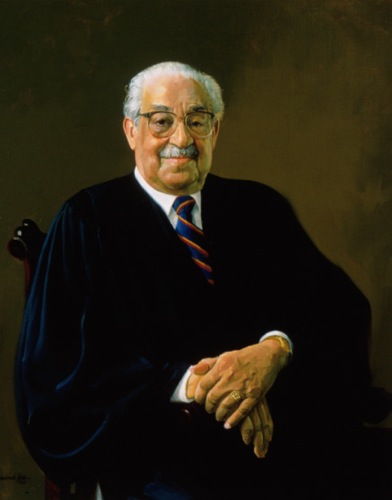
Supreme Court Portrait of Thurgood Marshall (1908-93).

Blawgletter’s mom celebrated her birthday on July 2 (the 69th such occasion for her).  Little did we know, until today, that she shares the date with another great American — Thurgood Marshall.

Congress celebrated the 100th anniversary of the former Justice’s naissance with this Concurrent Resolution:

Honoring and recognizing the dedication and achievements of Thurgood Marshall on the 100th anniversary of his birth.

Whereas Thurgood Marshall was born in Baltimore, Maryland, on July 2, 1908, the grandson of a slave;

Whereas Thurgood Marshall developed an interest in the Constitution and the rule of law in his youth;

Whereas Thurgood Marshall graduated from Lincoln University in Pennsylvania with honors in 1930, but was denied acceptance at the all-white University of Maryland Law School because he was African-American;

Whereas Thurgood Marshall attended law school at Howard University, the country’s most prominent black university, and graduated first in his class in 1933;

Whereas Thurgood Marshall served as the legal director of the National Association for the Advancement of Colored People (NAACP) from 1940 to 1961;

Whereas Thurgood Marshall argued 32 cases before the Supreme Court of the United States, beginning with the case of Chambers v. Florida in 1940, and won 29 of them, earning more victories in the Supreme Court than any other individual;

Whereas, as Chief Counsel of the NAACP, Thurgood Marshall fought to abolish segregation in schools and challenged laws that discriminated against African-Americans;

Whereas Thurgood Marshall argued Brown v. Board of Education before the Supreme Court in 1954, which resulted in the famous decision declaring racial segregation in public schools unconstitutional, overturning the 1896 decision in Plessy v. Ferguson;

Whereas Thurgood Marshall was nominated to the United States Court of Appeals for the Second Circuit by President John F. Kennedy in 1961, and was confirmed by the United States Senate in spite of heavy opposition from many Southern Senators;

Whereas Thurgood Marshall served on the United States Court of Appeals for the Second Circuit from 1961 to 1965, during which time he wrote 112 opinions, none of which were overturned on appeal;

Whereas Thurgood Marshall was nominated as Solicitor General of the United States by President Lyndon Johnson, and served as the first African-American Solicitor General from 1965 to 1967;

Whereas Thurgood Marshall was nominated as an Associate Justice of the Supreme Court by President Johnson in 1967, and served as the first African-American member of the Supreme Court;

Whereas Thurgood Marshall sought to protect the rights of all Americans during his 24 years as a justice on the Supreme Court;

Whereas Thurgood Marshall was honored with the Liberty Medal in 1992, in recognition of his long history of protecting the rights of women, children, prisoners, and the homeless; and

Whereas Thurgood Marshall died on January 24, 1993, at the age of 84: Now, therefore, be it

    Resolved by the House of Representatives (the Senate concurring), That Congress–

    (1) honors the dedication and achievements of Thurgood Marshall;

    (2) recognizes the contributions of Thurgood Marshall to the struggle for equal rights and justice in the United States; and

    (3) celebrates the lifetime achievements of Thurgood Marshall on the 100th anniversary of his birth.

Feedicon14x14 A true patriot.

Bleakhouse
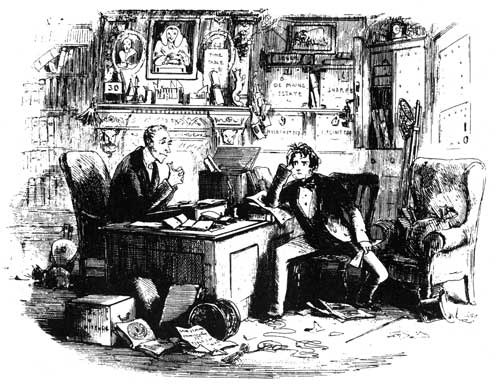
In Bleak House (1852-53), the cost of litigation exhausted the Jarndyce estate.

In The Washington Post today, business columnist Steven Pearlstein offers a contrarian take on the capping of punitive damages as a matter of federal common law in Exxon Shipping Co. v. Baker, No. 07-219 (U.S. June 25, 2008).  (Blawgletter post here.)  In "Altering the Economics of Civil Litigation", Mr. Pearlstein opines that "the problem with court’s decision in the Exxon case is not that it went too far in trying to reform the civil justice system, but that it didn’t go far enough."

He explains that the Court did a good thing in Exxon Shipping but that the Justices should also rein in defense-side abuses:

[I]t ought to be equally offensive to our sense of justice that corporate defendants are routinely allowed to manipulate the judicial process with an endless stream of motions, depositions and appeals, many as frivolous as anything served up by the plaintiff’s bar. For years, federal and state judges have turned a blind eye to this obvious and rampant abuse of process, which rivals anything conjured up by Charles Dickens in his famous novel, "Bleak House." Symbolically, the case of Exxon Shipping Co. v. Baker is to 21st-century jurisprudence what Dickens’ Jarndyce v. Jarndyce was to the 19th century.

By limiting abusive punitive damage awards without limiting the abusive tactics of the corporate defense bar, Justice Souter and his colleagues have fundamentally altered the economics of civil litigation and slammed the courthouse door on average citizens with legitimate claims against big and negligent corporations.

To which Blawgletter says, on this Independence Day, amen.