Johnashcroft
Will Twombly rescue John Ashcroft from paying damages?

The U.S. Supreme Court yesterday granted the government’s petition for writ of certiorari in Ashcroft v. Iqbal, No. 07-1015 (U.S. June 16, 2008), to consider (Blawgletter thinks) both of the questions that the petition posed:

QUESTIONS PRESENTED

1. Whether a conclusory allegation that a cabinet- level officer or other high-ranking official knew of, condoned, or agreed to subject a plaintiff to allegedly unconstitutional acts purportedly committed by subordinate officials is sufficient to state individual-capacity claims against those officials under Bivens.

2. Whether a cabinet-level officer or other high-ranking official may be held personally liable for the allegedly unconstitutional acts of subordinate officials on the ground that, as high-level supervisors, they had constructive notice of the discrimination allegedly carried out by such subordinate officials.

News reports on the grant played up the second question — the one having to do with whether former Attorney General John Ashcroft and other high officials may constitutionally suffer civil judgment for subordinates’ heinous conduct. 

That issue interests us, too, but something else caught our eye back when the Second Circuit upheld the claims in June 2007.  As we said then:

Second Circuit Ponders Twombly Aftermath in 9/11 Aftermath Case

Yesterday, the Second Circuit became the first U.S. court of appeals to expound on how the decision in Bell Atlantic Corp. v. Twombly, 127 S. Ct. 1955 (2007), has changed pleading requirements.  The court summarized:

After careful consideration of the Court’s opinion [in Twombly] and the conflicting signals from it that we have identified, we believe the Court is not requiring a universal standard of heightened fact pleading, but is instead requiring a flexible "plausibility standard," which obliges a pleader to amplify a claim with some factual allegations in those contexts where such amplification is needed to render the claim plausible.

Iqbal v. Hasty, No. 05-5768, slip op. at 33 (2d Cir. June 14, 2007) (emphasis in original).  Circuit Judge Jon O. Newman wrote the court’s opinion, which Blagletter highly recommends for its style and clarity.  Circuit Judge Cabranes wrote a concurring opinion.

The decision in Iqbal v. Hasty concerned civil claims against federal officials high and low for harsh confinement conditions that the government imposed on persons "of high interest" after 9/11.  The plaintiff, a Muslim Pakistani, alleged constitutional and statutory violations arising from savage beatings, frequent cavity searches (not in his teeth), solitary confinement, and other brutal treatment during his detention in a Brooklyn federal prison.  The Second Circuit largely sustained his claims despite the officials’ immunity defenses.

A glance at the government’s cert. petition confirms the importance of Twombly to the case.  It says that "the result reached by the court of appeals is inconsistent with a proper understanding of this Court’s decision[]" in Twombly.

So perhaps in the 2008 Term we will get some elaboration on the True Meaning of Twombly.  Not to mention more clarity on accountability — or not — for harsh treatment of detainees in the post-9/11 world.

Feedicon14x14 Feel our feed’s raw power.

Patent law allows recovery of attorneys’ fees only if (1) your side wins and (2) the case qualifies as "exceptional".  35 U.S.C. 285.  A decision today by the Federal Circuit illustrates the difficulty of satisfying the second requirement.

In Innovation Technologies, Inc. v. Splash! Medical Devices, LLC, No. 07-1424 (Fed. Cir. June 16, 2008), Innovation sued Splash! for infringing a patent on irrigating wounds.  The case proceeded, but before the Markman hearing Innovation signed a covenant not to sue Splash! again for infringing the patent and moved the district court to dismiss the case with prejudice.  After dismissal, Splash! asked for fees and costs under section 285.  The district court concluded:

Splash has shown by clear and convincing evidence that Innovation knew, or, on reasonable investigation, should have known, that its claims of infringement were baseless.  It appears to me that the lawsuit was filed solely for the purpose of harassing a small competitor.

The Federal Circuit held the district court’s analysis insufficient, vacated the $144,000 award, and remanded the case for findings on the adequacy of Innovation’s pre-suit investigation, Innovation’s reasons for filing the suit, whether Innovation committed "improprieties" during litigation, the meaning of claims terms that the parties disputed, and why Innovation abandoned the case.

Feedicon14x14_2 Our feed likes exceptional cases.

Blawgletter likes to gripe about judicial opinions that sacrifice coherence on the altar of (attempts at) judicial cleverness.  Our preference runs to introductory paragraphs that give the reader a quick roadmap to the issues and holdings. 

Today the Second Circuit made us happy.  It summarized a complex 60-page decision thus:

In August 1994, CBI Holding Company, Inc. and all but one of its subsidiaries (collectively, “CBI”) filed voluntary petitions for relief under Chapter 11 of the Bankruptcy Code. Ernst & Young and Ernst & Young LLP (together, “E&Y”), the pre-bankruptcy accountants for CBI and Defendants-Appellees in this action, filed a Proof of Claim against CBI in those proceedings for allegedly unpaid auditing and consulting services. On August 23, 1995, the United States Bankruptcy Court for the Southern District of New York (Lifland, J.) confirmed a Plan of Reorganization (“the Plan”) and appointed Bankruptcy Services, Inc. (“BSI”), the Plaintiff-Appellant in this action, the disbursing agent of the Plan. On October 16, 1996, BSI filed a complaint in the bankruptcy court, followed by an amended report on October 26 25, 1996, pressing seven claims against E&Y concerning the professional services E&Y rendered to CBI from 1992 to 1994. BSI brought each of the seven claims as the successor to the claims of CBI under the Plan (collectively, “the CBI claims”). Pursuant to a settlement contained in the Plan, BSI also brought four of these claims as the assignee of the claims that Trust Company of the West (“TCW”) acquired as a pre-bankruptcy creditor of CBI (collectively, “the TCW claims”). Finally, BSI also brought one claim – for expungement of E&Y’s Proof of Claim – as the assignee of an objection to E&Y’s Proof of Claim filed by the Official Unsecured Creditors’ Committee (“Creditors’ Committee”). On April 5, 2000, the bankruptcy court granted judgment for BSI on six of its seven claims, see Bankr. Servs., Inc. v. Ernst & Young (In re CBI Holding Co.), (“CBI I” or “Bankruptcy Opinion”), 247 B.R. 341 (Bankr. S.D.N.Y. 2000), and later awarded BSI approximately $70 million in damages. In two orders entered on June 30, 2004, see Ernst & Young v. Bankr. Servs., Inc. (In re CBI Holding Co.) (“CBI II” or “June Order”), 311 B.R. 350 (S.D.N.Y. 2004), and October 25, 2004, see Ernst & Young v. Bankr. Servs., Inc. (In re 10 CBI Holding Co.) (“CBI III” or “October Order”), 318 B.R. 761 (S.D.N.Y. 2004), the District Court for the Southern District of New York (Wood, J.)1 vacated the judgment of the bankruptcy court, and directed judgment in E&Y’s favor, on the grounds that: (1) the fraudulent acts of CBI’s management must be imputed to the company itself, thereby depriving BSI of standing to press the CBI claims; and (2) BSI lacks standing to assert the TCW claims under Barnes v. Schatzkin, 215 A.D. 10 (1st Dep’t 1925). BSI appeals from each of these grounds. We agree and reverse.

We hold that BSI has standing to assert the CBI claims under the so-called “adverse interest” exception to the normal rule that a claim against a third party for defrauding a corporation with the cooperation of its management accrues to creditors rather than to the guilty corporation. The bankruptcy court’s finding that CBI’s management “was acting for its own interest and not that of CBI” is not clearly erroneous and constitutes the “total abandonment” of a corporation’s interests necessary to satisfy the adverse interest exception. We also hold that BSI has standing to assert the TCW claims because revisions to the bankruptcy laws have undermined the rationale of Barnes for the reasons set forth in Semi-Tech Litigation, L.L.C. v. Ting, 13 A.D.3d 185 (1st Dep’t 2004).

Because we reverse, we must reach the two arguments that E&Y raises in its cross-appeal: (1) BSI’s claims are not “core proceedings” that may be adjudicated by a bankruptcy judge; and (2) E&Y is entitled to a jury trial on all of BSI’s claims. We reject both argumentsWe hold that all of the claims pressed by BSI – both the CBI claims and the TCW claims – are “core proceedings,” because they are covered by the language of 28 U.S.C. § 157(b) and are integrally related to the Proof of Claim that E&Y voluntarily submitted against the estate. Similarly, we hold that while both parties now agree that E&Y is entitled to a jury trial on the TCW claims, E&Y waived its right to a jury trial on the CBI claims when it submitted its Proof of Claim against the estate and subjected itself to the equitable powers of the bankruptcy court.  Moreover, under the rule announced by the Supreme Court in Katchen v. Landy, 382 U.S. 323 (1966), there is no need to vacate the portions of the bankruptcy court’s judgment which relate to the CBI claims merely because the portions of the judgment which relate to the TCW claims have been vacated to allow for a jury trial.

Bankruptcy Services, Inc. v. Ernst & Young (In re CBI Holding Co., Inc.), Nos. 04-5972-bk(L) & 04-6300-bk(XAP) (2d Cir. June 16, 2008).

Feedicon14x14 Our feed wishes you a productive week.

Nigh on 50 years ago, the constitutional scholar Alexander Bickel wrote that "[t]he least dangerous branch of the American government is the most extraordinarily powerful court of law the world has ever known." The Least Dangerous Branch:  The Supreme Court at the Bar of Politics 1 (1962).  The Supreme Court’s 5-4 decision this week in Boumediene v. Bush, No. 06-1195 (U.S. June 12, 2008), proves, if nothing else, Professor Bickel’s insightfulness on that point.

Today, Linda Greenhouse, the chief legal reporter-analyzer (for awhile longer) of The New York Times, examines the short-term political implications of Boumediene.  Article here.

On Friday, the WSJ editorial page shied from overtly political analysis, writing instead of the majority opinion’s "dissembl[ing]" and "plainly dishonest" analysis.  "In a stroke," it says, Justice Anthony Kennedy "and four other unelected Justices have declared their war-making supremacy over both Congress and the White House."  The editorial’s title?  "President Kennedy".

That view echoes the dissenting justices.  Chief Justice John Roberts observes, for example, that "[o]ne cannot help but think . . . that this decision is not really about the detainees at all, but about control of federal policy regarding enemy combatants."  Justice Scalia sounds the same theme, only with more vehemence:

What competence does the Court have to second-guess the judgment of Congress and the President on such a point?  None whatever.  But the Court blunders in nonetheless.  Henceforth, as today’s opinion makes unnervingly clear, how to handle enemy prisoners in this war will ultimately like with the branch that knows least about the national security concerns that the subject entails.

The decision, Justice Scalia warns, "will almost certainly cause more Americans to be killed."

Will Boumediene affect the November elections?  Ms. Greenhouse doubts it will sway many.  Yet she sees in Boumediene a summing-up:

Habeas corpus, as such, is an unlikely crowd-mover. But the decision clearly tapped into deep feelings about the entire course of the Bush administration’s plan for the fight against terrorism. The debate among the justices was ostensibly over the fine points of constitutional history and interpretation. But what it revealed was a court as divided as the rest of the country, on the eve of a historic and perhaps close election, over the very nature of the post-Sept. 11 world.

Feedicon Can the falcon hear the falconer?

Supremecourtbldg

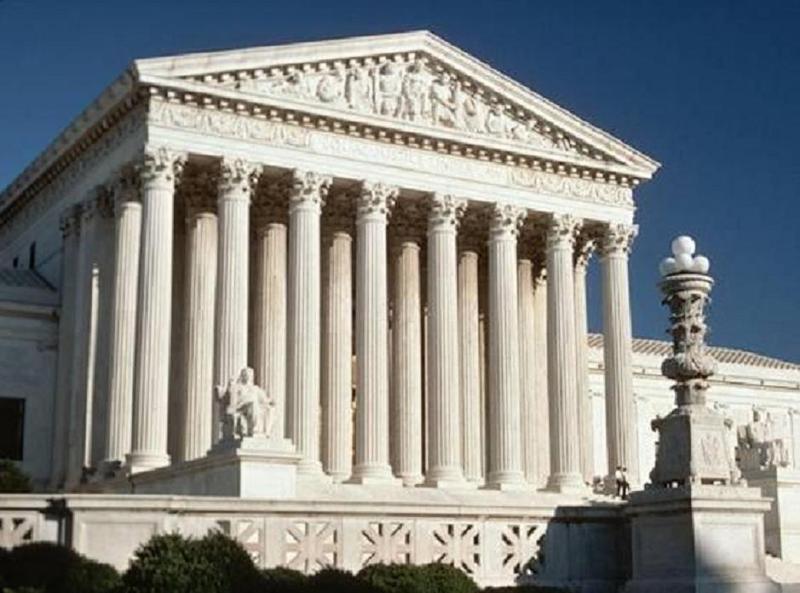
Today the Supreme Court ruled five-to-four that "enemy combatants" in lock-up at Guantanamo Bay may challenge the lawfulness of their detentions by way of seeking the writ of habeas corpus.  Justice Kennedy, writing for the majority, gave an overview of his 70-page opinion thus:

Petitioners present a question not resolved by our earlier cases relating to the detention of aliens at Guantanamo:  whether they have the constitutional privilege of habeas corpus, a privilege not to be withdrawn except in conformance with the Suspension Clause, Art. I, § 9, cl. 2. We hold these petitioners do have the habeas corpus privilege. Congress has enacted a statute, the Detainee Treatment Act of 2005 (DTA), 119 Stat. 2739, that provides certain procedures for review of the detainees’ status. We hold that those procedures are not an adequate and effective substitute for habeas corpus. Therefore § 7 of the Military Commissions Act of 2006 (MCA), 28 U.S.C.A. § 2241(e) (Supp. 2007), operates as an unconstitutional suspension of the writ. We do not address whether the President has authority to detain these petitioners nor do we hold that the writ must issue. These and other questions regarding the legality of the detention are to be resolved in the first instance by the District Court.

Boumediene v. Bush, No. 06-1195, slip op. at 1-2 (U.S. June 12, 2008). 

Justices Breyer, Ginsburg, Souter, and Stevens joined in the majority opinion. 

Chief Justice Robert and Justices Alito, Scalia, and Thomas dissented. 

Washington Post story here; NYT here; WSJ here; Bloomberg here.

Feedicon14x14_2 Take our feed for a test drive.

Animalfarm
The court rejected an argument it considered hogwash.

The Seventh Circuit today declined an invitation to correct, judicially, a glaring mistake by Congress.

The appeal involved an attempt to undo a remand of a class action to state court.  The defendant, Vertrue, removed it under the Class Action Fairness Act, but the district court remanded it on the ground that it didn’t satisfy the more than $5 million amount in controversy requirement.  Vertrue petitioned the Seventh Circuit for leave to appeal under CAFA section 1453(c)(1). 

But its lawyer waited to file until April 18, the seventh day (excluding the weekend) after the April 8 entry of the remand order.  Why does that matter?  Well, Blawgletter will tell you.

Section 1453(c)(1) says that "a court of appeals may accept an appeal from an order of a district court granting or denying a motion to remand a class action to the State court from which it was removed if application is made to the court of appeals not less than 7 days after entry of the order."  Note the "not less than 7 days" part.

Spivey asked the court to dismiss the petition on the ground that Vertrue missed the deadline.  But, as the court pointed out, "April 18 is ‘not less than 7 days’ — in other words, is more than 6 days — after April 8."  Spivey v. Vertrue, Inc., No. 08-8009, slip op. at 2 (7th Cir. June 11, 2008).  And yet Spivey persisted, citing a bunch of sister circuit decisions holding that "not less than" really means "not more than".  Chief Judge Easterbrook would have none of it:

Spivey’s argument rests not on the statutory text but on the proposition that the law cannot mean what it says. . . . That Congress has written a deadline imprecisely, or even perversely, is not a sufficient reason to disregard the enacted language. . . . Turning ‘less’ into ‘more’ would be a feat more closely associated with mutating commandments on the barn’s wall in Animal Farm than with sincere interpretation.

Id. at 4.  And so the court accepted the appeal.  Reversed.  Ordered remand to the state court because Spivey didn’t rebut Verture’s affidavit putting the amount in controversy at $7 million.

Feedicon14x14 Some statutes are more equal than others.

Marketingdollarsign
When marketing leads to price-fixing.

Blawgletter recently got an email about lawyer marketing.  It included an article that promised help on getting "’top dollar’ for your work", avoiding "under pricing yourself", and overcoming the fear of "rais[ing] your fees".

Hmmm.  But as we skimmed down the html page, alarm bells started going off.  For under the rubric of "The Market Method of Pricing", the author offered these suggestions (with emphasis ours):

[The market method] is a good way of determining pricing. Get your assistant to support you in this task and spend time discovering what the range of pricing is in the community.

Have your assistant do a "mystery shopper" study by calling around as if he/she were a potential client. Find out what your competitors say on the phone around pricing. Your assistant may need to call from his/her home phone to avoid caller ID. As another option, you could have him/her call other legal assistants or paralegals at your competitors’ firms and offer to exchange your fees for their fees — or you could do that yourself with other lawyers in your market.

If you really want to get into it and have maximum data, write to a few dozen competitors in your marketplace and say you are doing a fee survey. Explain that if they would send you their fee list, you will create a composite list that does not identify those responding and send them a copy of the results. To keep it simple for them, include a stamped, self-addressed envelope with a list of the most common services offered in your practice area.

Now you will see what people are charging for services similar to those you offer. You should be able to come up with a range of fees. Use this range to set fees for your own services. My recommendation in law firm marketing planning is to charge at the 75% level of the list. So you should be at or in the top 25% of the fees.

Remember that in general it is not a good practice strategy to compete on price. Most potential clients will see pricing that is too low as a signal that there is something missing either from the service, the provider, or the firm. And people who are looking for a low price will follow that low price wherever they can find it rather than becoming long-term clients. So be sure that your price covers your costs and a reasonable profit margin.

We doubt the marketing guru intended anything untoward.  And unless the surveying activity results in an agreement among competitors to fix, maintain, or stabilize prices, nothing illegal may have happened.  But systematically collecting and sharing competitors’ pricing data can lead to just such a thing.

Which section 1 of the Sherman Act forbids.

Feedicon And we wouldn’t want that.