My Symphony

To live content with small means;
to seek elegance,
rather than luxury,
and refinement,
rather than fashion;
to be worthy, not respectable,
and wealthy, not rich;
to study hard, think quietly,
talk gently, act frankly;
to listen to stars and birds,
to babes and sages,
with an open heart;
to bear all cheerfully,
do all bravely,
await occasions, hurry never.
In a word, to let the spiritual,
unbidden, and unconscious
grow up through the commonplace.

This is to be my symphony.

An old friend sent me this, and I pass it along to you, friends old and new.  Happy holidays.

The American Tort Reform Association published its Judicial Hellholes 2007, er, report. Imagine Blawgletter’s excitement.

Adam Liptak, in his Sidebar column at the NYT, points out a few shortcomings in the, ah, report — including that "[i]t has no apparent methodology."

[Meanwhile, the folks at Addicting Games have a series of HellHoles episodes, which apparently have nothing to do with judges or courts. See the first one here.]

We note that you’d better not compose your own list of judicial hellholes. That little "(R)" in Judicial Hellholes(R) means ATRA registered it with the Patent and Trademark Office — presumably so they can sue your pants off for tradmark infringement if you use "hellhole" to describe a court where, say, defendants win all the time. Even if you have a methodology.

Barry Barnett

Feedicon_2 Our feed uses only the most reliable methodologies.

Beyonce
Beyonce Giselle Knowles.

The Fifth Circuit yesterday affirmed a summary judgment in favor of singer-songwriter-movie star Beyonce Knowles, whom Jennifer Armour accused of copying the "hook" in her "Got a Little Bit of Love for You".  The hook, according to the complaint, found its way into Ms. Knowles’s "Baby Boy".  The court affirmed the summary judgment because Ms. Armour didn’t produce evidence that Ms. Knowles had "access" to "Little Bit of Love" at the time she created "Baby Boy".  (Note:  You can’t "copy" something you didn’t have access to.)  Armour v. Knowles, No. 06-20934 (5th Cir. Dec. 21, 2007).

Blawgletter would normally end there, but the case exhibits a few points we’d like to share. 

First, an admission by Ms. Armour — that she didn’t send a demo tape to Ms. Knowles’s business associates until after the crucial date of creation — prevented a finding that anyone sufficiently close to Ms. Knowles had "access" at the relevant time.  The admission trumped a contrary affidavit.

Second, a "mysterious", "unidentified", and "elusive" man — who went by "T-Bone" — might have gotten a demo tape in time, but Ms. Armour didn’t present enough evidence to justify a reasonable jury in finding that T-Bone actually gave the tape to Ms. Knowles.  That Ms. Armour’s manager honestly believed T-Bone was a good friend of Ms. Knowles didn’t prove that they were good friends.

Third, we bet somebody had fun writing this:

The lyrics [from "Little Bit of Love" and "Baby Boy"] differ in word and substance:  Armour’s evidence somewhat less love for her "ba-by" — "a l’il bit" — and somewhat more control over such love, which she can "stop" or "make grow;" Beyonce’s suggest a deeper and more stubborn love, which pervades her thoughts, dreams, and "fan-ta-sies."

Finally, and unfortunately, the opinion doesn’t disclose its author, using the per curiam designator instead.  We can’t tell which of the three panel members — Circuit Judges Higginbotham, Smith, and Owen — wielded the pen. 

Too bad; it’s a strong, readable, and lively opinion; and we’d like to give credit where it is due.

Barry Barnett

Feedicon14x14 We value good opinions.

NERA Economic Consulting released a study of trends in "shareholder class actions".  It concludes that, after a sharp decline in 2006, filings have returned to 2005 levels.  Most of the credit goes to cases against subprime lenders and their enablers, NERA reports.

Should you bother to read the consulting firm’s conclusions?  No. 

For one thing, Blawgletter can’t tell whether NERA’s definition of "shareholder class actions" includes (harder to win) derivative cases.  We think it should, but the study doesn’t say — at least as far as we can tell. 

For another, the researchers don’t sort out (or try to sort out) possible explanations for the dip-and-recovery of filing numbers.  Might the indictment of the leading securities class action firm Milberg Weiss in May 2006 have depressed filings?  Um, yes, we bet it did. 

Could the spurt in attention to options backdating cases have accounted for the increase in cases during 2007?  Yeppur.  And, as even NERA points out, the 2007 flood of lawsuits relating to subprime lending explains a lot of the growth in shareholder class actions.

We suspect a publicity stunt.  For which we fell.  But at least now you know not to do likewise.

Barry Barnett

Feedicon14x14_2 Also humbug!  Plus — God bless us, every one!

Heraclescerberus
Heracles holding Cerberus.

For those of you whose taste inclines to the intersection of ancient myth with modern law, Chancellor Chandler’s summary judgment opinion will thrill:

In classical mythology, it took a demigod to subdue Cerberus, the beastly three-headed dog that guarded the gates of the underworld.  In his twelfth and final labor, Heracles journed to Hades to battle, tame, and capture the monstrous creature.  In this case, plaintiff United Rentals, Inc. journeyed to Delaware to conquer a more modern obstacle that, rather than guards the gates to the afterlife, stands in the way of the consummation of a merger.  Nevertheless, like the three heads of the mythological Cerberus, the private equity firm of the same name presents three substantial challenges to plaintiff’s case:  (1) the language of the Merger Agreement, (2) evidence of the negotiations between the parties, and (3) a doctrine of contract interpretation known as the forthright negotiator principle.  In this tale the three heads prove too much to overcome.

United Rentals, Inc. v. RAM Holdings, Inc., No. 3360-CC, slip op. at 1 (Del. Ch. Dec. 21, 2007) (footnotes omitted).

Nobody will mistake the opinion for epic poetry — thank the gods — but His Honor does get to the right outcome.  The at best ambiguous language of the merger agreement — particularly in sections 8.2(e) and 9.10 — precluded a favorable summary judgment on URI’s claim for specific performance.  Mainly because section 8.2(e) plainly entitles the acquirer to walk the deal by paying a $100 million break-up fee and section 9.10 makes specific performance rights explicitly "subject to" section 8.2(e).

The tri-nogginous hound of hell wins.  As he should have.  This time.

Barry Barnett

Feedicon14x14 Our feed wishes it had three noggins.

The Globe and Mail (Toronto) describes affidavits that Canadian antitrust enforcers used to get chocolate search warrants last month.  The Competition Bureau filed the 24-page and 57-page affidavits with the Ottawa Superior Court of Justice.  The WSJ has a similar article.

The affidavits tell of a price-fixing conspiracy lasting from 2002 until a few weeks ago.  The scheme involved the big chocolatiers — Hershey, Cadbury Schweppes, Mars, and Nestle — as well as ITWAL, which describes itself as a "national distribution network of wholesale distributor members."  The conspirators agreed to coordinate price increases and may even have forced retailers not to discount.

The reports don’t name the affiants other than to say that they want immunity.  Here’s a clue:  The Competition Bureau didn’t ask for a Cadbury Schweppes search warrant.  Hmmm.

Blawgletter read about the Canadian probe last month and learned yesterday that our Antitrust Division now has its own inquiry going.

To get a flavor for how the chocolate bidness operates in the U.S., we took a look at a few reports.  We found an April 4, 2007, press release in which Hershey announced "[a]n increase of approximately 4-5 percent on the Company’s standard bar, king-size bar, 6-pack and vending lines . . . effective immediately."  We also saw this April 5, 2007, report:  "Prudential analyst John M. McMillin . . . noted that . . . British competitor Cadbury recently raised prices and privately held competitor Masterfoods, which makes M&Ms and Mars candy bars like Snickers and 3 Musketeers, ‘is also taking pricing up, so Hershey is not out there alone, we think, in this chocolate price increase.’"  And, on April 23, 2007, Nestle mentioned the positive impact in the Americas of customer "buying ahead of price increases, notably in dairy-related categories."

Coincidence doesn’t prove coordination of course.  But what do they say about smoke and fire?

Barry Barnett

Feedicon Does price-fixing make chocolate sweeter?

Colbertstewart

We would like to return to work with our writers. If we cannot, we would like to express our ambivalence, but without our writers we are unable to express something as nuanced as ambivalence.

Joint Statement, Dec. 20, 2007, explaining that the two will recommence production of The Colbert Report and The Daily Show despite the ongoing strike of the Writers Guild of America.

Barry Barnett

Feedicon Our feed feels ambivalent about doing nuance.

The WSJ reports that the Delaware chancery court rejected United Rental Inc.’s bid to force Cerberus to consummate a $4 billion buy-out.

Blawgletter doesn’t have the details, but we imagine that Chancellor William Chandler shared our doubts about URI’s case.  We "wonder[ed] whether [URI’s] lawyers read section 8.2(e) of the Agreement and Plan of Merger before suing the fictional canine’s namesake [Cerberus] in Delaware."  Terminating a Merger, Doggie Style.

Apparently His Honor read section 8.2(e) and wondered too.

Barry Barnett

Feedicon14x14 Happy Holidays!

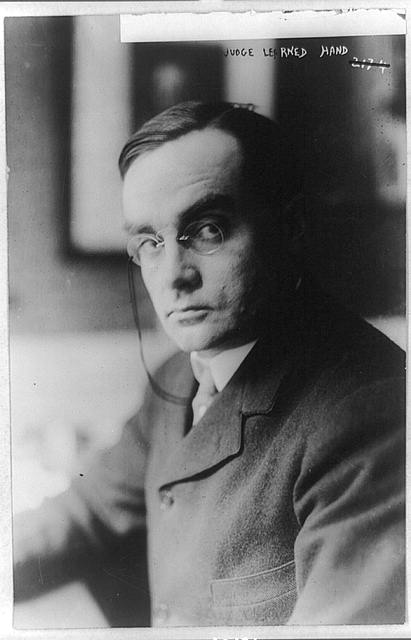
Learnedhand
The greatest judge since Solomon?

"I beseech ye in the bowels of Christ, think that ye may be mistaken." I should like to have that written over the portals of every church, every school, and every courthouse, and, may I say, of every legislative body in the United States.  I should like to have every court begin, "I beseech ye in the bowels of Christ, I think we may be mistaken."

Morals in Public Life (1951).

Barry Barnett

Feedicon_2 Happy Friday, y’all.

The NYT reports that the first-ever quarterly loss at Bear Stearns foretokens more agony on Wall Street.  The article doesn’t explain why.

Blawgletter has heard that the subprime fallout won’t end until investors learn where the risk of subprime borrower defaults ended up.  Apparently the subprime industry did such a terrific job of shifting risk that we can’t tell who now bears it.

Does the uncertainty matter?  And, if it does, why?

We suspect that where the risk went matters a lot to owners of entities (or funds or securities) that concentrated on financial instruments whose collateral consists largely if not entirely of unwise mortgages.

The Bear Stearns announcement suggests that even the bullet-proof aren’t.  And that, until we get a true accounting of the dumb decisions Wall Street made, for itself and its gullible investors, we should expect more shocks, less investment, and additional lawsuits.

Bottom line:  nobody wants to buy a share in a company, a mutual fund, or any of the abundant exotic mortgage-backed securities nowadays without a fine understanding of the true risk.  Which means, we think, that few if any shares will be bought.

Barry Barnett

Feedicon Bear or Stearns? — you decide.