Fruittart_2
We sometimes say "tart" when we mean "tort" in Texas.  But at least we know the difference.

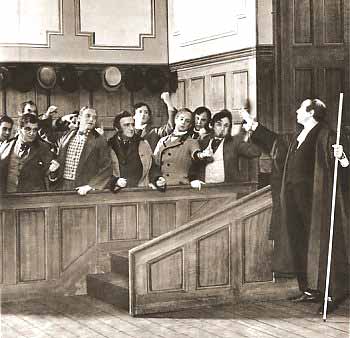
Say you obey the jury summons and show up with the 40 or so other potential triers-of-fact in the pews of the downtown, big city U.S. district court.  Your heart rejoices that now, at last, you can participate in our system of civil justice!  You can almost taste the chocolate-chip cookies that one or more of the panel members will bake for the group before verdict time.

And why shouldn’t you feel joy?  You’ve served more than a dozen years as president — and founder! –of the local Citizens Against Lawsuit Abuse club.  You’ve attended national "tort reform" conventions (except you don’t put it in quotes) and rubbed elbows with general counsel from the world’s most successful insurance, petrochemical, investment banking, accounting, and manufacturing concerns, among others.  You’ve educated your fellow citizens that lawsuits sap America’s economic supremacy, that civil plaintiffs seek the jackpot kind of justice, and that people claiming pain and suffering should, well, get over it.

During voir dire, which the nice judge conducts personally, you learn the plaintiff claims that a tire-splitting machine mangled his hand.  Your excitement rises.  You hear the judge ask whether any venireperson (including you) holds "any beliefs — philosophical, moral, religious or otherwise — that would make it difficult for you to sit in judgment in this case."  Her Honor also inquires whether everyone "could be impartial to both sides". 

You think, without a quiver of conscience, that you’ll have no difficulty sitting in judgment.  Of course you won’t!  But the impartiality thing makes you slightly uncomfortable.  Still, you keep your hand down and — who’d’a thunk it — wind up serving as foreperson on the jury that finds for the defense in all respects.

The judge in an actual personal injury case that involved the mangling of a hand by a tire-splitter asked about difficulty of sitting in judgment and impartialness but refused questions regarding opinions about personal injury lawsuits, advocacy of tort reform, and attitudes about pain and suffering.  The plaintiff lost.  Yet the Seventh Circuit held today that the district judge did not err, holding that her inquiries "more than adequately allowed the parties to exercise their challenges [to potential jurors] intelligently."  Alcala v. Emhart Industries, Inc., No. 06-3153 (7th Cir. July 25, 2007).

Blawgletter has no way of knowing whether a tort reformer made his way onto the jury by denying, silently to himself, that he couldn’t judge the case impartially.  But neither could anyone else in the courtroom.  And who can explain why a history of opposing plaintiffs’ lawsuits doesn’t deserve at least some exploration in a civil case?  Or how the questions "more than adequately" asked about bias?

Barry Barnett

Feedicon14x14_2 Our feed speaks the truth.  Tries to, anyway.

The Irish author and socialist wrote:

There is nothing so bad or so good that you will not find Englishmen doing it; but you will never find an Englishman in the wrong.  He does everything on principle.  He fights you on patriotic principles; he robs you on business principles; he enslaves you on imperial principles.

The Man of Destiny (1898).

Sounds kind of bitter — but also kind of timely.

Barry Barnett

Feedicon_2 Our feed tastes great.

Pete Rock recorded a bunch of songs.  He signed a recording contract authorizing release of an album to feature at least 10 of the Rock tunes.  The contract also required venue in England for any "legal proceedings" arising out of it.

Mr. Rock sued in New York for breach of the contract (failure to make a payment) and for copyright infringement and state law violations relating to release of a second album of songs without his permission.  The district court dismissed the whole case under the forum selection clause for litigation in Albion

The Second Circuit affirmed dismissal of the contract claim but reversed as to copyright and state law claims, holding that the former did but the latter did not arise out of the contract.  The court regretted splitting the case between New York and England but not enough to allow dismissal of the whole thing in favor of proceedings in BlightyPhillips v. Audio Active Ltd., No. 05-7017-cv (2d Cir. July 24, 2007).

Barry Barnett

Feedicon14x14 Our feed’s rocking equals or exceeds its rolling.

Fans of Bill Murray’s star turn as Tripper in Meatballs (1979) will recall that "CIT" stands for counselor-in-training. 

Not so at the Federal Circuit.  The acronym there signifies the U.S. Court of International Trade.  Except that the circuit court doesn’t use the acronym in its opinions.  Go figure.

Today, the court did issue two opinions regarding the work of the CIT.  One concerned "safeguard duties" on imports of certain steel products.  Wheatland Tube Co. v. United States, Nos. 06-1524 & 05-1525 (Fed. Cir. July 25, 2007).  The other dealt with antidumping and countervailing duties on "grain-oriented silicon electrical steel".  Nippon Steel Corp. v. United States Int’l Trade Comm’n, No. 06-1502 (Fed. Cir. July 25, 2007).

Tripper might say that it just doesn’t matter.  We know better, don’t we?

Barry Barnett

Feedicon Our feed wants to meet you.

Attorney General Alberto Gonzales’s testimony before a Senate committee today included a vow that he "will not tolerate any improper politicization of this department."

Considering the care with which Mr. Gonzales must choose his words these days, Blawgletter notes with interest his inclusion of "improper" before "politicization".  Does that mean he will tolerate proper politicization?  And what does he consider proper?

Barry Barnett

Feedicon_2 Duh.

Do federal judges bristle at news stories that identify the president who appointed them?  Blawgletter has heard that some do.  And we can see why.  Matching judges’ decisions with presidents (and therefore political parties) suggests that politics plays a role in the outcomes. 

The implication often does the judges an injustice.  Chief Justice John Roberts, for example, doesn’t vote for a conservative or Republican outcome in hopes of furthering his own career; he already has the best job in the legal world.

But decisions that run counter to prior party affiliation enhance confidence in results.  Good.

And let’s not go too far in connecting who-appointed-me with political overtones.  Most people, we imagine, take the identity of the appointing president as a proxy for judicial philosophy — liberal, conservative, activist, law-and-order, and the like.  Fine.

The difficulty comes in cases that inject judges into the political process.  One might in good faith wonder, for instance, whether any of the justices who decided Bush v. Gore pondered the impact that his or her vote might have on the Court’s balance and therefore his or her influence in future decisions.

Nor can we ignore the linkage that politicians make in their campaigns between electing them and the judicial appointments they would make.   

Practicing lawyers, including Blawgletter, want to know judges’ pre-appointment political affiliation.  We just do.  And we find their bristling at reports of that affiliation reassuring. 

Those who disagree might consider doing what our 12-year-old son suggests:  Cry me a river, build a bridge, and get over it.

Barry Barnett

Feedicon Our feed knows how to swim.

Blawgletter has never hidden our enchantment with patent law.  Just today, the Federal Circuit made our heart beat faster yet again.  It held, 2-1, a patent invalid but possibly enforceable.  What joy!

Phrases like "obviousness-type double patenting" and "unenforceable based on inequitable conduct" may prompt a scratching-of-the-head in others, but they have no such affect on Blawgletter.  Not that we can penetrate their meaning.  We just love the way they sound.

So, anyways, the court affirmed a summary judgment of invalidity with respect to one patent (for a drug that treats angina, hypertension, and congestive heart failure) but reversed a summary judgment of unenforceability as to that patent and one other.  In re Metoprolol Succinate Patent Litig. (AstraZeneca AB v. KV Pharmaceutical Co.), No. 06-1254 (Fed. Cir. July 23, 2007).

Barry Barnett

Feedicon14x14_2 Succinate this!

Okay, get this.  You buy stock in a company for $10 a share.  You sell it months later for $6 a share.  Have you suffered a loss?  Yep.  If somebody induced you to purchase by lying about the company’s financial condition, can you get your money back from him?  It depends.

Why does it depend?  You had a $4 per share loss.  Right.  But so far you’ve proved only "transaction causation" — that you bought in reliance on misrepresentations.  You haven’t yet shown, as you must, that the fraud also caused the stock’s price to go down — by, for example, reducing the market price when the truth comes out.

The Third Circuit spilled 49 pages of ink on the differences between transaction causation and loss causation and the necessity of proving both. 

If securities law really makes your heart sing and shout, Blawgletter urges you to read the opinion cover to cover.  The rest of us may prefer to start on page 42.  McCabe v. Ernst & Young, LLP, No. 06-1318 (3d Cir. July 23, 2007).

Barry Barnett

Feedicon14x14 Our feed sings for its supper.

Kangkodos
Kang and Kodos hitchhiking.

Do you like to make people laugh?  Do you enjoy early Woody Allen movies, especially Sleeper?  Have you often heard people praising your wit?  And do you like everything about practicing law except for the clients, the judges, and your colleagues, particularly that partner who never fails to give you the creeps?

If so, welcome to Blawg Review #118.  Blawgletter has the honor to host Blawg Review this week.  We will cover many topics but will strive to throw in something funny every now and then.  Blawgletter:  Business trial law with a sense of humor.

Banishing Jury Trial

Jury

Anne Reed covers juries and jury trials on her terrific Deliberations blawg.  This week, she asks Is the Jury System Dying?  But she warns against going overboard with laments about the rarity of civil trial by jury.  As she notes in Clients, Choices, and the Jury System, "our first responsibility is to the client, not to the jury, and that often means we choose another path."

Scott Greenfield takes up the vanishing jury trial in Simple Justice.  Speaking from a criminal defense lawyer’s perspective, Scott wonders Trials; Where Have You Gone?  He offers a thought-provoking answer — that "the disease [of declining jury trials] was a conservative shift in political sentiment, elevating the desire for personal security over the promise of individual freedom."

Earlier this year, Blawgletter wrote about the Lone Star State’s 55 percent drop-off in civil jury trials since 1996.  We supposed that growing hostility to civil lawsuits in the Texas legislature, governor’s office, and judiciary helps explain the drop.  And we chuckle when we hear Supreme Court justices blaming everyone but themselves.

Should we care about marginalization of our most democratic institution, weakening of the strongest bulwark against arbitrary government action, silencing our greatest teacher of civic values?  Eh, we guess.

Michael "Voldemort" Vick

Lordvoldemort

Have you already read Harry Potter and the Deathly Hallows, which came out this Saturday?  If not, you needn’t bother.  Atlanta Falcons quarterback Michael Vick delivers just as much evil in far fewer than 759 pages.  Or so federal prosecutors would have you believe.

Sports Law Blog describes the criminal charges against Mr. Vick (a/k/a "Ookie") and three buddies (including "P-Funk") for horrific treatment of fighting dogs.  The post includes links to other sources and the indictment itself.

Professor Stephen Bainbridge supplies a scholarly explanation of the Vick case, pointing out that the libertarian Edmund Burke would consider dog fighting way past his limit on government’s proper role.

Speaking of Pets

We also have videos — one of West Virginina Senator Robert Byrd rhapsodizing on canine critters (thanks to Althouse) and another of Will Ferrell advertising his dog-suing law practice (hat tip to Seth at QuizLaw).

Professor Glenn Reynolds of Instapundit warns that "IT’S A BAD IDEA TO BURGLARIZE a place marked ‘K-9 Training Facility.’"  Res ipsa loquitur.

Plus J.D. Hull balances things a bit with an appreciation of cats.  Mr. Hull composes What About Clients? even during his vacation.  Yo, dawg, get some R&R.

Leash_sound

Finally, What the Funny . . . Patents describes a patent on one of those "invisible pet" leashes (above).  This variety issues "a plurality of animal sounds" from a speaker on the collar.

Roundup

The Disassociate, a column in NLJ.com and a blog, writes:

I cannot believe we are returning to formal business attire. I was sure that armpit-yellowed golf shirts and high-water seersucker pants were totally acceptable. Boy did I misread those second looks.

Mad Kane’s Humor Blog includes an ode about bloggers’ obsession with Google page-ranking.  We’ve never checked our page rank before, but we now we can’t wait to!

Professor Eric Goldman discusses our firm’s contingent fee agreement in patent cases — or at least Steve Susman’s description of it — on his Technology & Marketing Law Blog.  Reacting to Steve’s statement that he’d file suit before starting peace talks in order to avoid a bad forum, Professor Goldman suggests that limits on venue choices in new patent legislation could encourage pre-litigation settlement discussions.  (Go here for our view on how recent court decisions force plaintiffs to sue before talking settlement.)

The Invent Blog, per Stephen Nipper, gives a Miller High Life-like tribute to "Mr. et al." in this post.

Walter Olson provides an obit for a lawsuit against "Extreme Makeover" in Overlawyered; Evan Schaeffer’s Legal Underground offers links to classic (and scary) posts by The Machiavellian Lawyer; and Charon QC describes a striking instance of judicial disdain.

What About Clients expresses lack of sympathy for those who pulled an all-nighter last week on debate about Iraq:

In olden days (circa 96th and 97th Cong.), when WAC? worked for Congress during those pointless posturing all-nighters, we (a) stayed up for 4 or 5 nights in a row with no cots, (b) ate nothing but the cheapest pharmaceutical "Crank", and (c) drank only coffee, whiskey, Tune Inn beer and Jolt cola, all out of dirty Mason jars. Spartan. Tireless. And just as lame.

Over at Balkinization, Sandy Levinson — who taught Blawgletter a thing or two about writing — lays out constitutional amendments that he’d like to see.  One would limit presidential veto power, and others would relate to the office that John Nance Garner described as "not worth a bucket of warm" bodily excretion.

Wired GC fusses about the costs versus benefits of the patent system.  The post cites an article, in The New York Times, about a law professor’s study, which concludes that costs outweigh benefits because patent litigation expenses — presumably including defense costs — exceed profits from patents.  But we wonder.  Doesn’t having profits mean that you got more revenue than you paid to get it?

Queensjurors
Jurorial love birds.  Homicide brought
them together.

And who can resist the tale of two Queens jury venire members who married after the groom voted to convict a murderer?  Not Peter Lattman, who writes The Wall Street Journal’s marvelous Law Blog.

Above the Law points out that the three people who sat for the Guam bar examination failed.  A fourth didn’t show up.

Scott Felsenthal and Jonathan Louis May, at The Legal Scoop, give us top 10 negotiation skills for a lawyer, answer should I go to law school, and demystify working in-house.

Our Funnier Posts

Please indulge us for a moment.

Quote of the Day: Stinking Badges

Supremes Kill Dr. Miles, Dance on His Grave

Pearl Goes Abu Ghraib on Will Ferrell

Climate Change Litigation — and Retirement Grease

Annals of Antitrust Enforcement: Don’t Blame Us

I Played for Vince Lombardi

Blawg Review has information about next week’s host and instructions how to get your blawg posts reviewed in coming issues.

Cheers!

Barry Barnett

Feedicon All hail Blawg Review!

A U.S. District Judge yesterday approved a plea bargain in which a drug company and its principal principals agreed to pay $634.5 million for lying about the addictiveness of a pain-killer, OxyContin.  The company apparently owes $600 million and the individuals the rest.

Blawgletter marvels that nobody got prison time to think, penitently, about the horrific human cost of encouraging pharmacoligical nirvana.  Plus the individuals have to pay but a small fraction of the fine — a fraction that may, for all we know, come from insurance.

So what did the Justice Department achieve?  We can’t tell.  Let’s hope that we learn more in the days to come.

Barry Barnett

Feedicon Feed?  Acquire our stinkin’ feed here.