Medusa
Gazing on the gorgon Medusa’s snaky
visage
ossified onlookers.

The Securities Litigation Uniform Standards Act of 1998 pre-empts state law class and mass actions that allege fraud in connection with the purchase or sale of a "covered security".  SLUSA thus tries to stop collective lawsuits that seek to avoid the limitations of the Private Securities Litigation Reform Act of 1995 by asserting only state law claims.

The Ninth Circuit today applied SLUSA pre-emption to a class action whose claims merely "coincided" with allegations of securities fraud.  The case involved people who made real estate loans through a public company, U.S. Mortgage, Inc., and lost money because, they alleged, of a scheme to defraud buyers of U.S. Mortgage stock.  The plaintiffs didn’t themselves acquire or part with the stock, but the court held that that didn’t matter under SLUSA.  Applying the Supreme Court’s "expansive view of SLUSA’s preemptive scope" in Merrill Lynch, Pierce, Fenner & Smith, Inc. v. Dabit, 126 S. Ct. 1503 (2006), the court affirmed dismissal on the ground that the complaint alleged fraud that "concided" with the purchase or sale of securities.  U.S. Mortgage, Inc. v. Saxton, No. 04-17494 (9th Cir. July 13, 2007).

Blawgletter notes that Saxton and Dabit don’t apply in several situations, including where the fraud didn’t relate to buying and selling securities that trade on a stock exchange or don’t require federal registration.  So plaintiffs have that going for them.

Barry Barnett

Feedicon_2 Happy Friday the 13th!

The Seventh Circuit today declined to review remand orders despite their inconsistency with another district judge’s refusal to remand a similar case.  Citing Powerex Corp. v. Reliant Energy Services, Inc., 127 S. Ct. 2411 (2007), the court held that 28 U.S.C. 1447(d) "blocks appellate inquiry into whether the district judge [who ordered remand] is mistaken" in deciding to remand to state court and dismissed the appeal for want of jurisdiction.  In re Mutual Fund Market-Timing Litig., No. 07-1695 (7th Cir. July 13, 2007).

Will Powerex prompt other appeals courts to dismiss remand appeals promptly?  Blawgletter hopes so.  Interlocutory review makes trial court resolution of cases on the merits almost impossible.  It should therefore happen rarely.  Decisions like In re Mutual Fund will help, however modestly.

Barry Barnett

Feedicon Help yourself to our feed.

Applying equitable estoppel principles, the Eleventh Circuit today compelled arbitration by a plaintiff-investor despite her failure to sign any of the securities investment advisor and broker agreements requiring arbitration.  The court also allowed non-signatory defendants to compel arbitration of certain of her claims against them.  Both rulings applied only to the extent the claims that made the terms of the agreement an element — as where the plaintiff alleged that a defendant broke a promise in the agreement.  Becker v. Davis, No. 06-12654 (11th Cir. July 11, 2007).

The court distinguished claims that did not depend on the agreements and deemed them outside the ambit of the arbitration provisions.  The agreements did not contemplate a horse farm, the court cited as an example, but instead focused on securities investments.  The horse farm and other like claims will stay in court as arbitration of others proceeds.

Blawgletter sees no inconsistency between arbitrating some claims and litigating others — with the proviso that the arbitration moves ahead to resolution promptly.  And we wouldn’t worry too much about coordinating arbitration with court proceedings — although we imagine that the arbitration hearing will usually happen well before a court trial and that the court case might should await the outcome, depending of course on the circumstances.

Barry Barnett

Feedicon14x14 Under no circumstances should you deny yourself the Blawgletter feed.

The Ninth Circuit held yesterday that some state law claims challenging rates for telecommunications services could proceed despite the "filed rate" doctrine.  The doctrine relates to the terms and conditions that service providers file, with a government regulatory agency, such as the Federal Communications Commission.  It bars claims that effectively seek damages equal to the difference between the "filed rate" and some lower rate.  The court also affirmed dismissal of claims that did call for recovery of overcharges.  In re NOS Communications (Fisher v. NOS Communications), No. 04-17040 (9th Cir. July 10, 2007).

Barry Barnett

The Federal Circuit yesterday reversed a district court’s refusal to grant judgment as a matter of law on a counterclaim of invalidity for obviousness.  Relying principally on its own 1988 precedent, the court held that prior art made the patents obvious under KSR Int’l Co. v. Teleflex Inc., 127 S. Ct. 1727 (2007).  The court also affirmed judgment of non-infringement as a matter of law, upholding the district court’s overruling of the jury’s contrary verdict.  PharmaStem Therapeutics Inc. v. ViaCell Inc. , No. 05-1490 (Fed. Cir. July 9, 2007).

The decision represents the third time, by Blawlgetter’s count, that the Federal Circuit has held a patent invalid for obviousness post-KSR without conceding that KSR made a difference in the outcome.

Barry Barnett

Feedicon14x14_3 Join our feed community.

Ex-Milberg Weiss managing partner David J. Bershad admitted involvement in paying kickbacks to individuals who agreed in return to serve as class representatives. Mr. Bershad will forfeit $7.75 million and pay a $250,000 fine.  He will also cooperate with the government’s ongoing case against others. 

See the NYT story here.

Will Mr. Bershad’s guilty plea pressure others to do likewise? Does it signal an impending deal with the firm or other Milberg lawyers? Why does Blawgletter ask so many questions?

Barry Barnett

Feedicon14x14 Our feed exceeds expectations.

Gadaffi_2
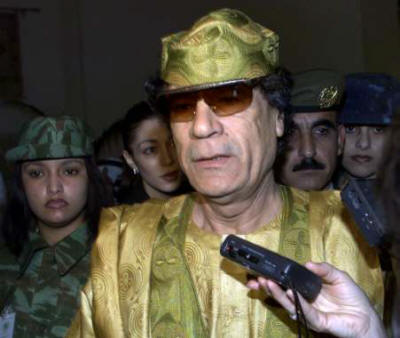
Muammar Gaddafi has run Libya — and granted
clemency pleas — since 1969.

Call Blawgletter crazy, but we wonder why President George W. Bush commuted I. Lewis "Scooter" Libby, Jr.’s entire 30-month prison sentence instead of taking a more modest step — such as using his clemency powers to keep Mr. Libby out of prison during appeals of his conviction and sentence.

Pre-empting the Courts

Mr. Bush said many times that he’d let the legal process run its course before deciding whether to intervene.  But, for reasons he hasn’t explained, he didn’t wait — declaring his respect for the jury’s guilty verdict but deeming the prison term "excessive". 

The turnabout strikes us as odd if only because Mr. Libby’s appeal would have determined the excessiveness, or not, of his sentence.  If the legal process ran its course — perhaps resulting in an acquittal or a lessening of his punishment — commutation may have proved unnecessary.

So Mr. Bush could have waited.  And he could have kept Mr. Libby free until his appeals ran out.  Article II, section 2 of the Constitution gives the president power to order "Reprieves and Pardons" (except in cases of "impeachment"), a sweeping authority and unreviewable discretion that comprehend everything from a mild expression of regret to a full pardon.  Why, then, did Mr. Bush opt to act early?

Jury Waiver by Libby; Bush’s Lone Star Record

Before grappling with that question, let’s recall that Mr. Libby waived his constitutional right to have a jury determine the facts relevant to the sentencing decision — such as whether he conspired with others in the administration to leak the undercover identity of Valerie Plame.  Mr. Libby chose instead to let the judge find the facts and pronounce sentence.  We can thus think of no reason why Judge Walton’s ruling deserves Mr. Bush’s respect less than the jury’s verdict finding Mr. Libby guilt.

Let us also reflect on Mr. Bush’s clemency record.  As Adam Liptak’s article today in the NYT observes, Texas Governor Bush commuted sentences in fewer cases than any predecessor since the 1940s.  As president, he commuted three sentences and granted 113 pardons while denying more than 1,000 applications.  And, in those instances where he used his authority, we imagine that he waited to act until after exhaustion of all direct appeals.

Potential Explanations

Blawgletter can imagine only two reasons that Mr. Bush short-circuited the legal process in Mr. Libby’s case — one merely unseemly, the other much worse. 

The understandable one involves politics.  Mr. Libby’s supporters argued that the prosecution should never have happened in the first place, contending that the special counsel held too much power and abused it by criminalizing a political dispute over the Iraq war.  They demanded nothing less than a complete pardon.  Political opponents, on the other hand, would have depicted a pardon as an abuse of the clemency power.  They call the commutation by the same name anyway, but commuting the sentence while leaving the finding of guilt at least comes across as less extreme.

The other possible explanation gives us the willies plus the heebie jeebies.  Special counsel Fitzgerald made no secret of his willingness to make a deal in return for Mr. Libby’s cooperation.  The help would doubtless require Mr. Libby to disclose White House secrets — including information about efforts to discredit Joseph Wilson, who denounced Mr. Bush’s claim that Saddam Hussein tried to buy radioactive "yellowcake" in Africa.  Leaving Mr. Libby under threat of a long prison sentence might not have gone far enough to buy his silence.  A desire to keep him quiet, under this possibility, thus may have rushed Mr. Bush into pre-empting the legal process.

Wherefore?

We may never know why Mr. Bush reneged on letting the law take its course, why he hurried, and why he commuted Mr. Libby’s prison sentence instead of paroling him during the appellate process.  Mere politics, rather than fear of the truth coming out, may explain Mr. Bush’s speediness.  If not, or if the truth comes out anyway, history may remember Mr. Bush as the first president who used his clemency power to save himself. 

Call him the Libbyan president, for short.

Barry Barnett

Feedicon14x14 Put our feed to work for you.

Six years ago, in Festo Corp. v. Shoketsu Kinzoku Kogyo Kabashiki Co., 535 U.S. 722 (2001), the Supreme Court considered how changing a patent application during its prosecution limits later claims of infringement under the doctrine of equivalents.  The Court held that amendment of the Festo application didn’t necessarily preclude infringement by Shoketsu’s device and remanded for further proceedings. 

More proceedings ensued and resulted, after a bench trial, in a judgment of non-infringement because, the district court found, a person of ordinary skill in the art would have foreseen the Shoketsu equivalent at the time of the amendment.  The Federal Circuit affirmed, holding that an amendment precludes a claim of infringement by an equivalent device that "is known in the prior art at the time of the amendment."  Festo Corp. v. Shoketsu Kinzoku Kogyo Kabushiki Co., Ltd., No. 05-1492 (Fed. Cir. July 7, 2007).

Barry Barnett

Feedicon14x14 Our feed has no equivalent.

Ralph Waldo Emerson liked philosophical flexibility. So he, famously, equated “a foolish consistency” with “the hobgoblin of little minds”.

This week, President Bush proved his kinship with Emerson by commuting the 30-month sentence of I. Lewis “Scooter” Libby, Jr., for perjury and justice obstruction.. How so, you say? By using his own special clemency-granting process., one that swept away every precedent and principle other than Mr. Bush’s druthers.

He — for example — disregarded his Attorney General’s position on sentencing white collar perjurers and justice-obstructers (long prison terms regardless of public service and other mitigating circumstances); ignored the protocol he used to assess every other clemency plea (filtering, applicant interviews, and recommendations by a “pardon” section of the Justice Department); explicitly reserved a possible expansion of the amnesty (into a full pardon)j and broke a promise (to let the legal process run its course before considering intervention) . The president even refused to watch coverage of Mr. Libby’s trial, preferring, we surmise, to assess the defendant’s blameworthiness on a cold record.

Don’t get Blawgletter wrong. We would fain contest the decider’s constitutional power to bestow mercy on whomsoever, howsoever, and whensoever he wishes. But we do propose that the Libby commutation captures Mr. Bush’s reflexively ad hoc, supra-legal, extra-constitutional approach to issues.

Think of, among other things, Guantanamo, Abu Ghraib, signing statements, extraordinary renditions, domestic wiretaps, rejection of congressional oversight, waterboarding, firing of U.S. Attorneys, secret prisons, denial of habeas corpus rights, military commissions, lax enforcement of laws protecting investors and consumers, nomination of ideological judges, hostility towards class actions, and retention of an incompetent or dishonest Attorney General.

The rule of law — in contrast to the rule of men — depends on faithful application of rules, procedures, and precedents. It does not bend to obey any single person’s will. And a chief executive who habitually tries to mold the law to his own preferences resembles, we think, a hobgoblin far more destructive and scary than the one Emerson had in mind.

Barry Barnett

The Seventh Circuit held yesterday that it lacked jurisdiction to review an order remanding a case to state court — despite the plaintiff’s failure to join and serve an in-state defendant at the time of removal. The court deemed the order unreviewable because it constituted a remand for lack of jurisdiction within 28 U.S.C. 1447(c). Holmstrom v. Peterson , No. 05-3670 (7th Cir. July 3, 2007) (citing Powerex Corp. v. Reliant Energy Svcs.., No. 05-85 (June 18, 2007) (available at http://www.ca7.uscourts.gov/tmp/4I0JEX1B.pdf)).

Barry Barnett