When "happenstance" — rather than the parties’ actions — moots a case during an appeal, should the appeals court vacate the district court’s opinion?  Yes, the Ninth Circuit held today.  The court distinguished between mootness that occurs as a result of settlement, on the one hand, and mootness that happens by, well, happenstance, on the other.  The first kind doesn’t usually justify vacatur, but the second type does.  NASD Dispute Resolution, Inc. v. Judicial Council of the State of Calif., No. 02-17413 (9th Cir. May 30, 2007).

The appellees in the case wanted to hold onto a decision that declared their immunity from suit.  The Ninth Circuit sympathized but pointed out that vacatur wouldn’t rip the opinion from the pages of the Federal Supplement 3d and wouldn’t eliminate its preclusive effect on parties and their privies.

Barry Barnett

Feedicon14x14 Rip our feed.

Terminal disclaimer, in patent law lingo, means a statement that disclaims some of a patent’s duration.  The disclaimer has the effect of making the patent coterminous, time-wise, with an earlier patent — one that covers substantially the same invention.  It serves to avoid the sin of double-patenting the invention.

Got that?  Great.

One other thing.  Blawgletter learned yesterday that a terminal disclaimer "simply is not an admission that a later-filed invention is obvious."  Motionless Keyboard Co. v. Microsoft Corp. , No. 05-1497 (Fed. Cir. May 29, 2007).  We suppose that one could assume, as the district court in Motionless Keyboard did, that a patent holder wouldn’t file a terminal disclaimer unless its later patent duplicated the earlier one, making it obvious.  But we can also see why the Federal Circuit wouldn’t want to make admission of obviousness the price of filing a terminal disclaimer.  That would encourage unnecessary disputes about double-patenting.

Barry Barnett

Feedicon Subscribe to your own Blawgletter feed.

Today, the Sixth Circuit resolved a federal/state conflict over enforceability of a "floating" forum selection clause as the basis for personal jurisdiction over an out-of-state defendant.  Such a clause "floats" when the choice of forum varies according to the location of any possible assignee of the clause-containing contract.

The Sixth Circuit and the Supreme Court of Ohio reached opposite conclusions about enforceability, the latter deeming the clause unenforceable if at the time of signing the contract the beneficiary of the clause intended "almost immediately" to assign the contract but didn’t disclose that intention.  The Sixth Circuit held that the law of the forum state, Ohio, controlled the question and that the district court did not err in refusing to enforce the floating forum selection clause.  Preferred Capital, Inc. v. Sarasota Kennel Club, Inc., No. 06-3063 (6th Cir. May 29, 2007).

Barry Barnett

Feedicon14x14_2 Get our feed in your home forum.

Title VII of the Civil Rights Act of 1964 prohibits discrimination in employment decisions, including decisions to underpay women.  It also specifies a 180-day statute of limitations. 

Today, the U.S. Supreme Court applied the limitations (or "charging") period to restrict the "back pay" that victims of unlawful employment bias may recover.  Title VI, the 5-4 Court held, allows recovery of back pay only to the extent the employee suffers from actionable discrimination that occurs during the charging period.  The Court "reject[ed] the suggestion that an employment practice committed with no improper purpose and no discriminatory intent is rendered unlawful nonetheless because it gives some effect to an intentional discriminatory act that occurred outside the [180-day] charging period."  Ledbetter v. Goodyear Tire & Rubber Co., Inc., No. 05-1074 (U.S. May 29, 2007).

The ruling bars liability for low pay that a plaintiff receives during the charging period but that results from earlier acts of discrimination.  If an employer — for discriminatory reasons — starts underpaying an employee before the charging period and — for non-discriminatory reasons — continues underpaying her during the charging period, the plaintiff may not recover for the present consequences of the old bias.

Barry Barnett

Feedicon14x14 Subscription to our feed available here.

Bob Murphey, a tobacco-chewing lawyer and volunteer fire chief in Nacogdoches, Texas, told stories, many on himself.  Blawgletter remembers hearing him on the radio, telling tales as if a group of coffee-drinkers and idlers sat with him around a table at a drug store fountain.  One story we recall:

People don’t know this, but I played for Vince Lombardi. 

I went out for football at Nacogdoches High School.  In those days, the practice field sat alongside a creek, so that particular location added high humidity to intense East Texas August heat.

The coach stood off to the side while the boys ran around on the field, throwing and catching and blocking and tackling.  After watching me for awhile, coach called me over.  He asked me my name.

"Bob Murphey, coach." 

"Are you a football player, son?" 

"Why, yes, sir." 

"Well, if you’re a football player, my name is Vince Lombardi."

And that’s how I came to play for Vince Lombardi.

Barry Barnett

Feedicon14x14 Subscribe to our free feed.

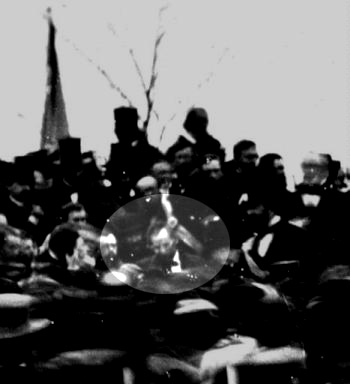
Lincolngettysburg
The only surviving image of Abraham Lincoln
at Gettysburg.

Tomorrow, on Memorial Day, we honor the men and women who died in military service to the United States.  We pay them our respects by remembering them, their families, and their searing sacrifice. 

Abraham Lincoln commemorated the Union dead on November 19, 1863, at Gettysburg, Pennsylvania.  We, today, can think of no better way to remember all of our nation’s sons and daughters than with his words:

Four score and seven years ago our fathers brought forth on this continent a new nation, conceived in Liberty, and dedicated to the proposition that all men are created equal.
Now we are engaged in a great civil war, testing whether that nation, or any nation, so conceived and so dedicated, can long endure. We are met on a great battle-field of that war. We have come to dedicate a portion of that field, as a final resting place for those who here gave their lives that that nation might live. It is altogether fitting and proper that we should do this.
But, in a larger sense, we can not dedicate—we can not consecrate—we can not hallow—this ground. The brave men, living and dead, who struggled here, have consecrated it, far above our poor power to add or detract. The world will little note, nor long remember what we say here, but it can never forget what they did here. It is for us the living, rather, to be dedicated here to the unfinished work which they who fought here have thus far so nobly advanced. It is rather for us to be here dedicated to the great task remaining before us — that from these honored dead we take increased devotion to that cause for which they gave the last full measure of devotion — that we here highly resolve that these dead shall not have died in vain — that this nation, under God, shall have a new birth of freedom — and that government of the people, by the people, for the people, shall not perish from the earth.

Amen.

Barry Barnett

Feedicon14x14 Get our free feed.

Lionelhutz
Lionel Hutz (Phil Hartman) — lawyer, realtor,
and cobbler.

Blawgletter loves The Simpsons — not least for its often hilarious treatment of our justice system.  Who can forget the blue-hair lawyer and his "let the record show the witness made the drinky-drinky motion"?  Lionel Hutz’s law-and-shoe-repair practice?  Jimbo’s question, to Judge Constance Harm, whether she "used to be a dude"?  Super lawyer Eleanor Abernathy’s transformation into the crazy cat lady?  And the trial (with Ned Flanders as Satan presiding) over ownership of Homer’s soul?

We mention all this because The Simpsons Movie comes out this summer (July 27, we think).  You can check out previews here and here.

Barry Barnett

Feedicon14x14 Business trial law with a sense of humor.  Free.

The Ninth Circuit today issued a writ of mandamus directing a district court to explain its reasons for granting indefinite stays of civil discovery.  The defendants sought relief to avoid invoking their fifth amendment right not to incriminate themselves.  The district court granted the defense motions without comment.  The Ninth Circuit held that the orders could delay the civil case for years and would effectively put the plaintiffs out of court.  The court vacated the orders and remanded for further proceedings.  Blue Cross & Blue Shield v. Rubin, No. 05-56261 (9th Cir. May 25, 2007).

Barry Barnett

Feedicon14x14_2 Stay with us via our free feed.

Mary Flor Morón-Barradas sued the Commonwealth of Puerto Rico for refusing to hire her as a teacher and denying her a teaching certification.  The First Circuit today affirmed.  Morón-Barradas v. Dept. of Ed. of Commonwealth of Puerto Rico, No. 06-1456 (1st Cir. May 25, 2007).

Yes.  We realize the puerility of this post.

Barry Barnett

Feedicon14x14 Get our juvenile humor every day with our free feed.

Federal courts of appeals have grown fond of citing pressure to settle as a reason to grant discretionary review of rulings on class certification motions.  But they don’t cite any evidence to support the notion that certifying a class forces defendants to debauch themselves.  They in effect take judicial notice of the "hydraulic" effect on defendants.

Rule 201 of the Federal Rules of Evidence allows courts to "notice" a fact, but it "must be one not subject to reasonable dispute in that it is either (1) generally known within the territorial jurisdiction of the trial court or (2) capable of accurate and ready determination by resort to sources whose accuracy cannot reasonably be questioned."

Blawgletter’s experience with class actions leads us to believe that class certification may increase the class plaintiffs’ leverage in settlement negotiations but hardly compels defendants to settle and certainly not for more than the case justifies.  If a rise or drop in negotiating leverage justifies review of a certification order, we have a hard time understanding how courts can refuse to take a look at any such order.

Take judicial notice of that, please.

Barry Barnett

Feedicon_2 Review our feed for free.