Billlerach
Bill Lerach vowed a swift appeal
to the U.S. Supreme Court.

The Fifth Circuit’s decertification order hinges on its conclusion that neither the Affiliated Ute nor the Basic, Inc. v. Levinson fraud-on-the-market presumption of reliance applies to the facts of the case.  Delving into the merits of the fraud by silence claims, the court held that the district court arrived at "an erroneous understanding of securities law" and that the mistake led to the further — and fatal — error of allowing the class the benefit of presuming that all purchasers of Enron relied on the investment banks’ failure to disclose their deceptive scheme.  Two judges said the decision sounded the death knell for class certification; the third panel member thought otherwise.  Regents of the University of California v. Credit Suisse First Boston (USA), Inc., No. 06-20856 (5th Cir. Mar. 19, 2007).

Barry Barnett

Feedicon14x14_4 Subscribe to our free feed.

The Eleventh Circuit affirmed today a summary judgment against a woman who alleged that her employer subjected her to a hostile work environment in violation of Title VII, which prohibits sex discrimination in employment.  In reaching its conclusions, the court clarified what an employer must do to establish an affirmative defense to a Title VII claim that doesn’t involve an adverse employment action.   Baldwin v. Blue Cross/Blue Shield of Alabama, No. 05-15169 (11th Cir. Mar. 19, 2007).

The defense bears a ponderous name:  FaragherEllerth, after a pair of 1998 Supreme Court decisions, Faragher v. City of Boca Raton, 524 U.S. 775  (1998) and Burlington Indus., Inc. v. Ellerth, 524 U.S. 742 (1998).  It also has two prongs, requiring the employer to show (1) that it exercised reasonable care to prevent and correct sexually harrassing behavior and (2) that the employee unreasonably failed to take advantage of any preventive or corrective measures that the employer offered.

The court detailed the crude behavior of the Ms. Baldwin’s co-employees before holding that Blue Cross established the Faragher-Ellerth defense as a matter of law.  The court’s highly readable opinion deserves a quotation or two:

  • Regarding the first prong, "there is nothing in the Faragher or Ellerth decisions requiring a company to conduct a full-blown, due process, trial-type proceeding in response to complaints of sexual harassment.  All that is required of an investigation is reasonableness in all of the circumstances, and the permissible circumstances my include conducting the inquiry informally in a manner that will not unnecessarily disrupt the company’s business, and in an effort to arrive at a reasonably fair estimate of truth."
  • Still on the first prong, even a bad investigation won’t defeat the defense because "a reasonable result cures an unreasonable process. . . . Title VII is concerned with preventing discrimination, not with perfecting process."

The court also concluded that the Baldwin’s rejection of remedial measures (counseling of the harasser or transfer to another office) and delay in reporting incidents of sexual harassment established the second prong of the defense.

The argument that prompted the headline for this post concerned Baldwin’s retaliation claim.  She asserted that Blue Cross shouldn’t have fired her for refusing to work with her boss-harasser because she didn’t really mean that she wouldn’t work with him.  The court rejected "Baldwin’s ‘had-my-fingers-crossed’ argument because what counts is not what she believed about her stated intent but what the decision maker at Blue Cross believed".

Blawgletter predicts that HR people and in-house counsel will enjoy reading Baldwin.  It puts some real teeth into the Faragher-Ellerth defense by validating their good faith efforts to resolve discrimination claims amicably.

Barry Barnett

Feedicon14x14_2 Enjoy our free feed.  Subscribe here with a few clicks.

Last Friday, in a 2-1 decision, the Sixth Circuit overturned a nearly $500,000 award to a septuagenarian dentist for age discrimination.  The court noted that Rule 408 of the Federal Rules of Evidence bars use of a settlement offer "to prove liability for or invalidity of the claim or its amount."  The court held that the district court erred under Rule 408 by allowing Dr. Stockman to present the defendants’ settlement offer to rebut evidence that he failed to mitigate damages.  The court also determined that admission of the offer also violated Rule 403, which prohibits unduly prejudicial evidence, over the defendants’ offer to withdraw its mitigation defense.  Because Dr. Stockman’s case otherwise rested on thin proof of age discrimination, the court reversed the judgment and remanded for a new trial.  Stockman v. Oakcrest Dental Center, P.C., No. 05-1518 (6th Cir. Mar. 16, 2007).

Blawgletter guesses you could say that Rule 408 has teeth after all.

Barry Barnett

Feedicon Sink your choppers into our free feed.

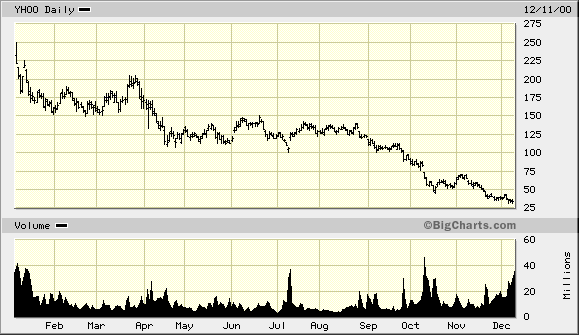
Yahoostock
Yahoo! stock performance in 2000.  See a trend?

Yahoo!  Blawgletter suspects that Michael Lessin wishes he’d never heard the word and that he rues even more that he invested $5.6 million in the eponymous stock.

After losing his entire Yahoo! investment when the tech bubble burst in 2000, Mr. Lessin arbitrated his claims to recover the loss against Merrill Lynch and his broker there.  After a six-day hearing, a panel of three NASD arbitrators awarded him a paltry $32,975.  The D.C. Circuit upheld confirmation of the award despite Mr. Lessin’s arguments that the panel improperly excluded testimony by a second expert and manifestly disregarded the law in awarding him so little.  Lessin v. Merrill Lynch, Pierce, Fenner & Smith, Inc., No. 06-7067 (D.C. Cir. Mar. 16, 2007).

Don’t cry too much for Mr. Lessin.  His account enrollment forms cited his investment goal as "speculation" and his appetite for risk as "aggressive".  The panel appears to have concluded that Mr. Lessin authored his own non-diversification strategy and his portfolio’s resulting demise.

Barry Barnett

Feedicon14x14 Enrich your portfolio with our free feed. 

Albertogonzales
Alberto Gonzales after becoming the
U.S. Attorney General.

Blawgletter doesn’t pretend to know the ins and outs of relations between U.S. Attorneys and the Attorney General, but we’ve always assumed a high degree of independence.  Practically every U.S. Attorney, in Blawgletter’s experience, has distinguished himself or herself in criminal matters, preferably as a trial lawyer or judge.  So one must take Blawgletter’s thoughts — coming as they do from a source largely ignorant of prosecuting criminal cases — with a big grain of salt.

Caveat emptor.

We learned in law school that tremendous power lay in the hands of government prosecutors.  They enjoy wide discretion in which cases to pursue, what charges to bring, and how much punishment to request.  Their credibility within the legal profession ranks at the top among lawyers, judges, and civilians, including jurors — not least because their job requires them to seek justice.

So what should we make of the ongoing flap about the firing of eight U.S. Attorneys?  Blawgletter doesn’t share the naivete of those who charge the octet’s cashierings as a purely political maneuver.  Presidential appointments of U.S. Attorneys always involve an element of politics.  Scratch just about any U.S. Attorney, and you will find a lawyer whose previous behavior suggests political compatibility with the appointing president.  The political dimension should surprise no one.

Yet the timing and circumstances of the late sackings do raise red flags.  Why now?  Why these specific eight?  Why these particular replacements?  Why the end-run around Senate approval? 

Blawgletter will leave the task of illuminating us with answers to others.  But the elevation of one political loyalist, Tim Griffin, to the U.S. Attorney post in Little Rock, Arkansas, may deserve special attention.  Didn’t the Clintons live in Arkansas for a number of years, and didn’t the Whitewater investigation focus (at first) on their activities in the state?  Didn’t Griffin work for Karl Rove, the political strategist, and the Republican National Committee?  And hasn’t ex-Little Rocker Hillary Clinton announced a bid for the presidency in 2008?

Perhaps nothing overtly political will come of Mr. Griffin’s appointment, without the Senate’s consent, to a powerful position in Mrs. Clinton’s former adoptive state.  For the sake of the high regard we have for U.S. Attorneys as a group, dare we hope?

Barry Barnett

Feedicon14x14 Subscriptions available, free, here.

The Ninth Circuit today affirmed remand of a case to state court after a new defendant removed it under the Class Action Fairness Act. The court concluded that, because under California law a lawsuit commences upon filing of the original action in state court, any later changes — including new claims, new plaintiffs, or new defendants — do not retrigger a right of removal under CAFA. Because the case began before CAFA took effect, court held, the district court properly remanded. McAtee v. Capital One F.S.B., No. 06-17125 (9th Cir. Mar. 16, 2007).

Barry Barnett

Subscribe here to our feed.  Free!

In Bellikoff v. Eaton Vance Corp., No. 05-6597 (2d Cir. Mar. 15, 2007), the court affirmed dismissal of claims arising from payment of fees to encourage Morgan Stanley and other brokers to sell Eaton Vance mutual fund shares. The plaintiffs, who owned shares in Eaton Vance mutual funds, sued under the Investment Company Act of 1940 and the Investment Advisors Act and state breach of fiduciary duty law. The court held that the statutes either didn’t provide a private cause of action, didn’t confer standing on shareholders individually, or didn’t prohibit the underlying conduct.

Barry Barnett

Free subscription to our feed here.

Yesterday, the First Circuit affirmed a judgment against an insurer that tried to avoid paying a company’s loss due to embezzlement. The court held that the evidence supported the jury’s conclusion that a false answer about check-signing authority didn’t materially increase the carrier’s risk. Federal Ins. Co. v. HPSC, Inc., No. 06-1050 (1st Cir. Mar. 15, 2007) (applying Massachusetts law).

Barry Barnett

Can you beat free?  Get our feed here.