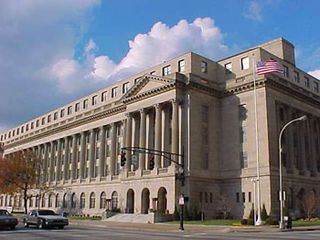
Louisville U.S. Courthouse 
Gene Snyder U.S. Courthouse and Customhouse in Louisville.  Construction ended in 1932 . . . a Depression year.

The Judicial Panel on Multidistrict Litigation has summoned lawyers handling 35 different MDL matters to Louisville, Kentucky on May 27 and May 28.  Several of them look mammoth.

Blawgletter cannot recall a session with so many cases or that will take up two separate days.

The last session, on March 26, dealt with fewer than 10.  The November gathering considered 13 or so.

What accounts for the surge?  Any coincidence that cases against big banks head the lists?

Feed-icon-14x14 Guesses welcome.

Who decides the "reasonableness" of attorney fees — judge or jury?

The Tenth Circuit held that it depends.  If you ask for fees just because you won, the person in the black robe does the work.  But if you seek fees as "damages", the question must go to the jury.

The dispute pitted Chevron against J. R. Simplot.  Chevron owned a phosphate mine, a phosphate processing plant, and a 97-mile pipeline linking the two. 

Another phosphate miner, Ashley Creek, sued Chevron for denying it access to the pipeline.  It alleged antitrust violations. 

Later, Simplot offered to buy Chevron out of the operation but insisted that Chevron agree to defend Simplot if Ashley Creek brought it into the case.  Chevron said fine.  The deal closed. 

Sure enough, after Ashley Creek sued Simplot also, Chevron rejected Simplot's demands that Chevron cover Simplot's defense costs.  Ashley Creek lost the litigation but not until Simplot paid $5.1 million in fees and expenses.

Simplot sued Chevron to get its money back.  The district court granted summary judgment for Simplot and awarded it the $5.1 million it requested.  The Tenth Circuit upheld the summary judgment on liability but reversed the award of fees and costs.  Remanding, the court instructed that the seventh amendment required a jury to decide "any portion of Simplot's damages claim [for attorneys' fees] that cannot be resolved as a matter of law."  J. R. Simplot v. Chevron Pipeline Co., No 07-4074, slip op. at 35 (10th Cir. Apr. 23, 2009).

Debra Cassens Weiss at ABA Journal reports the new U.S. News & World Report rankings of the bestest U.S. law schools (plus tuition dollarage) as follows:

1) Yale University, $46,000

2) Harvard University, $41,500

3) Stanford University, $42,080

4) Columbia University, $45,674

5) New York University, $42,890

6) University of California, Berkeley, $30,944 in-state, $43,189 out-of-state

6) University of Chicago, $41,835

8) University of Pennsylvania, $44,330

9) University of Michigan, Ann Arbor, $41,500 in-state, $44,500 out-of-state

10) Duke University, $42,938

10) Northwestern University, $45,332

10) University of Virginia, $36,800 in-state, $41,800 out-of-state

The Ninth Circuit today upheld a $49 million settlement of antitrust claims against West Publishing for its rough tactics in marketing bar exam prep courses. 

The panel rejected objectors' point that the district court should have judged the pact by looking at treble damages instead of single damages.  "It is our impression that courts generally determine fairness of an antitrust class action settlement based on how it compensates the class for past injuries, without giving much, if any consideration for treble damages."  Rodriguez v. West Publishing Corp., No. 07-56646, slip op. at 4769 (9th Cir. Apr. 23, 2009).

Their Honors looked less kindly on a fact that didn't come out until after preliminary approval of the settlement.  Between the prelim and the final, class counsel disclosed an odd feature of the fee contracts between certain firms and five class representatives.  Those agreements bound the lawyers to ask the court to award between $10,000 and $75,000 as an "incentive" award.  The amount varied with how many dollars the class got.

The arrangement troubled the court.  It put the reps and the firms in conflict with the class; it affected the reps' adequacy as reps; it split pay between lawyers and non-lawyers; and the delay in telling the district court about it trenched on counsel's ethical duty of candor.

The court remanded "the award of attorney's fees to class counsel for consideration of the effect, if any, of the incentive agreements on entitlement to fees."  Id. at 4776.

JayBybee 
Jay Scott Bybee.

The events at issue span twenty years, resulted in congressional hearings, and involve litigation in three circuits.  We are not sure if the appropriate literary metaphor belongs to Tolstoy or to Kafka, but we are going to set forth the history of this case in some detail.

United States v. Park Place Assocs., Ltd., No. 05-56235 (9th Cir. Apr. 22, 2009) (per Bybee, J.).

Judge Bybee's mention of Tolstoy refers to the length of the proceedings and of Kafka to the result.  Park Place Associates won $93,612,892 in an arbitration award against the federal government in 2004.  The award granted the damages for mismanagement of — get this — "a legal card-playing club".  The feds seized the club through forfeiture proceedings against drug traffickers who owned a majority interest in it.

Blawgletter will leave it there except to note that the Ninth Circuit affirmed the district court's decision not to vacate the award but reversed its confirmation of the award.  The district court had jurisdiction to do the former but not the latter.  Wow.

Feed-icon-14x14 Double wow.

Yesterday Blawgletter noted the confirmation of Christine A. Varney as the new head of the Antitrust Division in the U.S. Department of Justice.  See Varney Takes Charge.

Today the Division announced that Ms. Varney has already filled six key leadership positions.  They all look like heavy hitters.

The press release says:

ANTITRUST DIVISION SENIOR LEADERSHIP NAMED

WASHINGTON — The Department of Justice's Antitrust Division today announced the appointment of its new leadership team including the Chief of Staff, four Deputy Assistant Attorneys General, and a Special Counsel for Competition Policy. Two Deputies will oversee civil matters, one Deputy will oversee economic analysis and one Deputy will oversee international, policy and appellate issues.

"This is an outstanding team of dedicated and highly regarded professionals who are well respected within their fields of expertise," said Christine A. Varney, Assistant Attorney General in charge of the Department's Antitrust Division. "This dynamic team of individuals has the vision, intellect and experience to ensure that the Antitrust Division aggressively pursues all areas of antitrust enforcement in order to protect American consumers from anticompetitive harm."

The leadership team includes:

Sharis Arnold Pozen, Chief of Staff and Counsel–Before she came to the Department in February 2009, Pozen was a partner at Hogan & Hartson's Antitrust, Competition, and Consumer Protection Group where she worked from1995 to February 2009, on a variety of antitrust matters in the technology and healthcare industries, and served as Practice Group Director for the Washington, D.C. office. She has counseled clients on a wide range of antitrust and consumer protection matters as well as issues pertaining to mergers and acquisitions, joint ventures, and trade association matters. Prior to joining Hogan & Hartson, Pozen worked for five years at the Federal Trade Commission (FTC) as an Attorney Advisor to then Commissioners Varney and Yao, as Assistant to the Director of the Bureau of Competition, and as staff attorney. Pozen received her B.A. from Connecticut College in 1986 and her J.D. from Washington University in 1989.

Molly S. Boast, Deputy Assistant Attorney General for Civil Matters–Boast, who is expected to arrive at the Department in May, is a seasoned antitrust veteran with extensive antitrust and management experience. Since 2001, she has been a partner at the New York law firm of Debevoise & Plimpton LLP where she leads the antitrust practice group. From July 1999 to June 2001, Boast was Senior Deputy Director and Director of the FTC's Bureau of Competition. During that time, she had management responsibility for merger and civil nonmerger Commission litigation and investigations, and has experience in competition issues in the energy and pharmaceuticals industries. Boast also served as the FTC's representative to the European Community/FTC/Department of Justice Mergers Working Group. From 1987 to 1999, she worked at the New York law firm of LeBoeuf, Lamb, Greene & MacRae where she was head of the litigation department and a member of the firms' Steering Committee. She has served in various positions within the American Bar Association's Sections of Antitrust and Litigation. Boast received her B.A. in 1970 from the College of William and Mary, her M.S. in 1971 from the Columbia University School of Journalism, and her J.D. in 1979 from the Columbia University School of Law.

William Cavanaugh Jr., Deputy Assistant Attorney General for Civil Matters–Cavanaugh, who is expected to arrive at the Department in May, is a highly experienced and lauded antitrust litigator. Since 1985, Cavanaugh has been with the New York law firm of Patterson, Belknap Webb & Tyler LLP where he has served as the firm's Co-Chair, Chair of the Litigation Department and a Litigation Partner since 1991. He has extensive trial and litigation experience in complex antitrust, patent and commercial matters. From 1981 to 1985, Cavanaugh was a Litigation Associate handling complex product liability, insurance coverage and general commercial matters at the New York law firm of Rivkin Radler LLP. He is a Fellow of the American College of Trial Lawyers, was named as one of the Best Lawyers in America for Antitrust Law and Commercial Litigation, and was named as one of New York's "Super Lawyers" for Antitrust Litigation. He received his B.S. in 1977, from St. John's University and his J.D. in 1980 from St. John's University School of Law.

Carl Shapiro, Deputy Assistant Attorney General for Economic Analysis–Shapiro, who arrived at the Department in March, is a leading scholar in economics and brings to the Department a wealth of experience on issues, including patents, intellectual property and licensing, network economics, and unilateral effects in mergers. Shapiro is taking a leave of absence from the University of California at Berkeley, where he is Transamerica Professor of Business Strategy in the Haas School of Business and a Professor of Economics. He has been at the Haas School of Business since 1990. Shapiro was previously the Antitrust Division's Economics Deputy from August 1995 to June 1996, where he provided economic analysis on a variety of antitrust cases, including Microsoft, NASDAQ and several mergers. Shapiro had been a Senior Consultant with CRA International, an economic consulting company. He was vice-chair of the American Bar Association Antitrust Section's Economics Committee from 1995-1998. Shapiro taught at the Woodrow Wilson School and the Department of Economics at Princeton University for 10 years. He has published one book, "Information Rules: A Strategic Guide to the Network Economy," and numerous articles in the areas of industrial organization, competition policy, patents, network economics and the economics of innovation and competitive strategy. Shapiro received his Ph.D. in Economics from the Massachusetts Institute of Technology (MIT) in 1981. He also earned B.S. degrees in mathematics and economics from MIT as well as an M.A. in mathematics from UC Berkeley.

Philip J. Weiser, Deputy Assistant Attorney General for International, Policy and Appellate Matters–Weiser, who is expected to arrive at the Department in July, is an Antitrust Division veteran, and is currently a Professor and Associate Dean for Research at the University of Colorado, where he has taught since January 1999, in the School of Law and in the Interdisciplinary Telecommunications Program. During his tenure at the Department, Weiser will be on a leave of absence from the University of Colorado. Weiser has also served as a visiting Professor at the New York University School of Law (2008) and the University of Pennsylvania School of Law (2006). From August 2001 to June 2002, he was a Law and Public Affairs Program Fellow at Princeton University, one of only six law Professors selected as a scholar-in-residence. Weiser is the Founder and Executive Director of Silicon Flatirons Center for Law, Technology, and Entrepreneurship, which focuses on spurring interdisciplinary engagement, facilitating community outreach, and supporting interest in the intersection of technology, policy and business. From September 1996 to August 1998, Weiser was a Senior Counsel to Joel Klein, Assistant Attorney General of the Department's Antitrust Division, where he advised Klein on antitrust policy in the telecommunications industry as well as participated in civil investigations. He served this fall as the lead agency reviewer of the FTC for the Presidential Transition Team, serves as the co-Chair of the Colorado Innovation Council, was a Special Master for the Colorado Public Utilities Commission, and was a Special Counsel to Cablevision Systems Corporation. Weiser clerked for Justices Byron R. White (Ret.) and Ruth Bader Ginsburg at the U.S. Supreme Court from September 1995 to August 1996. He also clerked for Judge David M. Ebel, Tenth Circuit Court of Appeals, from September 1994 to August 1995. He has published two books and numerous articles on and has regularly taught in the areas of competition policy and technology law. Weiser graduated with high honors from Swarthmore College in 1990 and with high honors from the New York University School of Law in 1994.

Gene Kimmelman, Chief Counsel for Competition Policy and Intergovernmental Relations–Kimmelman, who arrived at the Department in April, was most recently Vice President for Federal and International Affairs at Consumers Union (CU). During his tenure at CU, from 1995 to 2009, he directed CU's federal and international policy programs. Kimmelman has extensive knowledge of deregulation, market structure and consumer protection issues. He is a recognized expert in a wide variety of areas, including telecommunications, Internet/media policy, product liability and antitrust law. He has represented consumers during the break up of AT&T, consideration of the Telecommunications Act of 1996, major media and telecommunications mergers, and at numerous congressional hearings. Prior to his employment at CU, from 1993 to 1995, Kimmelman served as Chief Counsel and Staff Director for the Antitrust Subcommittee of the U.S. Senate Judiciary Committee. Previous to that, from 1984 to 1993, he was Legislative Director for the Consumer Federation of America (CFA) where he directed their legislative and regulatory programs. In 1981, he began his career as a staff attorney for Public Citizen's Congress Watch. Kimmelman received his B.A. from Brown University in 1977 and his J.D. from the University of Virginia in 1981. He studied in Denmark as a Fulbright Fellow at Copenhagen University's graduate program on the public sector.

Feed-icon-14x14 Behemoths beware!

MonopolyGame 
Do not pass Go.  Do not collect $200 million.

Christine A. Varney, late of Hogan & Hartson, yesterday got a welcome to her new job as head of the Department of Justice's Antitrust Division.  Attorney General Eric Holder said Varney "will help lead the Department with dedication, sound judgment and integrity . . . [in] aggressively enforcing the antitrust laws".

On April 20, the U.S. Senate confirmed President Barack Obama's nomination of Ms. Varney as Assistant Attorney General by a vote of 87 to one.

Joy!

The Deal reports that "everyone seems to believe she'll intervene more often in mergers than her Bush administration predecessor, Tom Barnett, who generally approved mergers, though frequently with concessions in the form of divestitures."

The AD's homepage now includes Ms. Varney's name and title.

Blawgletter expects the Division will now turn away from racking up case stats and focus anew on its core mission — shutting down monopolies and cartels that hurt lots of people.  The job over the last several years has seemed too much about jailing small-time crooks.  Let's go after the bad guys who cost us billions, shall we?

We think Ms. Varney can — and will — do just that.

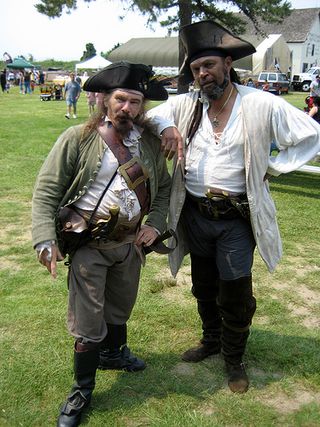
Pirates 
Hedge fund managers?

You know the financial center of gravity has shifted when the "barbarians" of the 1980s start taking pains to distinguish themselves from an upstart swarm of buccaneers.

Now the "private equity" outfits that hostilely boarded many a corporate vessel – firms like KKR, Blackstone, Carlyle Group, and TPG — pose as stodgy.  In comparison to what, you say?  Those dastardly hedge funds, of course.

Dow Jones reporters Laura Kreutzer and Shasha Dai summarize the new PE line thus:  "As regulators gear up to monitor private pools of capital more, private equity firms have a message they really, really want to get across: we’re not hedge funds."

PE representatives say PEs, in contrast to hedge funds:

  • invest "patient capital," making them "less susceptible to short-term swings."
  • lock up investors' funds for at least five years.
  • put "their core focus on investing in companies, not in obscure financial instruments."
  • have "historically been more careful about [their] use of leverage".

But perhaps the PEs' PR message doesn't completely wash:

In fact, during the recent boom, a number of the larger private equity firms came to resemble their hedge fund cousins rather markedly – an example of the much-vaunted convergence between the two types of managers at the time. TPG Capital LP, Apollo Management LP and Bain Capital, to name a few, have all set up credit arms that invest in debt securities – not companies. Kohlberg Kravis Roberts & Co. has a capital market division that has syndicated out some debt, and Blackstone Group simply bought a hedge fund manager, GSO Capital Partners, outright a few years ago. Some financial arms set up by the largest private equity firms have suffered heavily over the past couple of years, although these firms were careful to hive off much of the risk of these vehicles. Take Carlyle Capital Corp., a publicly listed affiliate of Carlyle that invested in mortgages. It collapsed at around the same time as Bear Stearns Cos. did last year, and for similar reasons.

So PEs have started to look more like hedge funds.  Imagine Blawgletter's surprise. 

Still, PEs do have a point.  We know that, from January 1, 2003 through early 2008, the 50 largest PE firms raised $810 billion in direct investment capital, according to Private Equity International.  How many dollars, euros, and yuan have flowed into the hedge fund maw?  Nobody seems to know.

And there lies the problem.  An almost complete lack of public transparency — and, with it, public accountability — characterizes the hedge fund industry.  Which makes private equity firms look good but only by comparison.  Yes, the center of gravity has moved but not to a better place.

We don't know the extent of the problem.  "Prophylactic" regulation — the kind aiming to prevent the excesses that produce booms and busts – would help.  Starting right about 18 years ago, when Congress and President Clinton did the opposite.

FeedIcon Hedge your risk right here.

The Supreme Court of Texas today adopted "a rule short of completely barring mandamus review" of orders that compel arbitration — but only just. 

Their Unanimous Honors acknowledged the court's practice of regularly granting mandamus relief from orders denying arbitration.  Yes, Justice Brister explained, the court does deem the remedy of appeal from final judgment inadequate as a matter of law when a trial court refuses to compel arbitration but adequate as a matter of law when the trial court compels arbitration.  In re Gulf Exploration, LLC, No. 07-0055 (Tex. Apr. 17, 2009) (granting mandamus to overturn court of appeals mandamus order that overturned trial court order compelling arbitration). 

Blawgletter has our doubts.  A manifest mistake in refusing to enforce an arbitration clause that plainly applies to a dispute strikes us as no worse than a patent error in granting enforcement of one that doesn't apply.  Either way, somebody has to endure a proceeding he, she, or it didn't agree to.

And we respectfully disagree with the court's justification for the differential treatment — that the statutory allowance of interlocutory review in the refusal-to-enforce scenario but withholding of it in the improper enforcement setting makes all the difference.  Doesn't a disputant whose only possible remedy is mandamus (short of appealing a final judgment that enforces an invalid arbitration award) need it even more?

The Fifth Circuit did yesterday something it does seldom — it affirmed rejection of a motion to compel arbitration.  Nicholas v. KBR Inc., No. 08-20140 (5th Cir. Apr. 15, 2009).

The decision turned on whether the party seeking arbitration waived the right to get it.  The Fifth Circuit agreed with the district court that she did.

The court noted the unusual circumstance that the plaintiff wanted arbitration: 

In the vast majority of cases involving the question of waiver, it is the party being sued that belatedly seeks arbitration.  Here, in contrast, it is the plaintiff, who, despite filing suit and pursuing her claims in court for more than ten months, now seeks to compel arbitration.

Id., slip op. at 5.  The court concluded "that the act of a plaintiff filing suit without asserting an arbitration clause constitutes substantial invocation of the judicial process, unless an exception applies. Indeed, short of directly saying so in open court, it is difficult to see how a party could more clearly 'evince[ ] a desire to resolve [a] . . . dispute through litigation rather than arbitration,' Gulf Guar. [Life Ins. Co. v. Conn. Gen. Life Ins. Co.], 304 F.3d [476,] 484 [(5th Cir. 2002)], than by filing a lawsuit going to the merits of an otherwise arbitrable dispute."  Id. at 6.  

"[T]he legal standard for waiver is the same regardless of which party is the party alleged to have waived arbitration.  Differences between the two sides arise from the voluntariness and timing of their actions, not the legal standard."  Id.

As for the requirement that the party opposing arbitration must demonstrate "prejudice", the court cited evidence that KBR's "litigation activities were significant in the context of this dispute", which involved "limited . . . and relatively straightforward . . . denial-of-benefits claims."  Id. at 10.  The court also pointed to the plaintiff's unsuccessful litigation of a legal issue (whether the Employee Income Retirement Security Act applied) and deposition of a third part witness (whose deposition an arbitrator might not have allowed or had the authority to require).

Blawgletter agrees that the difference in the roles of plaintiffs and defendants in litigation justifies the asymmetrical result that plaintiffs more easily satisfy the "substantial invocation of the judicial process" prong of the waiver test.  We feel less confident about the prejudice piece. 

Courts say that litigation expense, by itself, can't qualify as "legal" prejudice.  But that principle neutralizes the one advantage plaintiffs generally have in a prejudice analysis — their relative inability to afford litigation costs. 

And, by making the prejudice question pivot on whether the arbitration-opposing party would lose a "legal" right or advantage by having to go to arbitration, the analysis again tends to favor defendants.  Courts seem to view plaintiffs' rights as boiling down to the right to ultimate affirmative relief, but they also think that defendants would "lose" rights simply by virtue of foregoing the benefit of a court's pre-trial rulings that went their way.  Because plaintiffs still may have a shot at winning in arbitration, their losses (from having to arbitrate after defendants engaged in merely tactical invocation of the judicial process) appear to weigh less.  But they don't.