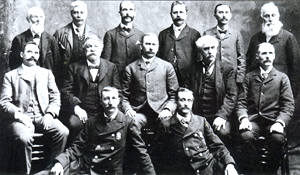
None of these guys had a BlackBerry.
The NYT has an article today about hooligan jurors. They take their job so seriously — and their oath so lightly — that they Google their way to enlightenment about the True Facts. Mistrials abound.
What to do?
None of these guys had a BlackBerry.
The NYT has an article today about hooligan jurors. They take their job so seriously — and their oath so lightly — that they Google their way to enlightenment about the True Facts. Mistrials abound.
What to do?
Blawgletter has pondered the fraudulence of credit default swaps.
We've noted Congress's culpability in 2000, when it un-hinged the speculative CDS market from any prophylactic regulation, and in 2005, when it exempted CDS instruments from bankruptcy law protections.
Now we weigh in on Congressional outrage over American International Group's payment of around $450 million in bonuses to people in an AIG business unit that lost over $40 billion last year. Also its bulging-vein apoplexy about AIG's forking over billions — redeploying U.S. taxpayer funds — to counterparties that bought CDS-style insurance from the financial titan.
We wonder how any company can make like a slot machine for outside gamblers (who bought CDS insurance for events in which they had no financial risk) and for the very AIG employees whose bets on CDSs cost the company tens of billions.
More important, we marvel that an insolvent enterprise could favor any particular creditor at the expense of others, particularly including U.S. taxpayers. For AIG has survived the last six months solely because the feds have pumped in $160 billion to save it from collapse.
In the normal case, creditors that take money from an insolvent debtor risk having to pay the cash back under fraudulent transfer laws and under bankruptcy law provisions regarding "preferences". But with AIG we seem to have shot right through the looking glass. The government, which now owns 80 percent of AIG's "equity", has magically made it solvent, we suppose.
The NYT reported yesterday that the Obama administration will drop the "enemy combatants" moniker for people who joined or helped Taliban or al Qaeda. The administration also will detain only those non-members who "substantially" aided the terrorist organizations. The new standard accords with international standards for holding potentially bad guys. Or at least so the DOJ argues in its memorandum.
The previous administration claimed the broader right to confine anyone who "directly" provided aid, whether "substantially" or not. Direct aid could take the form of contributing funds to an organization that associated with a terrorist outfit. The old standard didn't comply with international law — or at least complied with it less.
But the article doesn't disclose what nomenclature will apply to members and substantial aiders going forward.
Blawgletter, in researching for Blawg Review #201, re-learned something our Texas history teacher imparted in seventh grade. Responding to unrest in the Texas y Coahuila province of Mexico, Mexican President Santa Anna induced the Mexican Congress to deem those causing the trouble "pirates". The new law in 1835 said:
Foreigners landing on the coast of the Republic or invading its territory by land, armed, and with the intent of attacking our country, will be deemed pirates and dealt with as such, being citizens of no nation presently at war with the Republic and fighting under no recognized flag.All foreigners who shall import, by either sea or land, in the places occupied by the rebels, either arms or ammunition or any kind for their use, will be deemed pirates and punished as such.
The Searle Civil Justice Institute at the Northwestern University School of Law has issued a Preliminary Report on "Consumer Arbitration Before the American Arbitration Association". The basic finding? That consumer arbitration works reasonably well — at least in cases that manage to complete the process.
Blawgletter hasn't studied the 139-pager in detail but do note a grave shortcoming, which (to its credit) the report admits. The study analyzes only arbitrations "that were closed by an award" — meaning it didn't look at cases that consumers didn't file or, having filed, withdrew or abandoned. "We have no data on how frequently consumers fail to bring claims, so we cannot test for this possibility," the report concedes.
For our money, any sensible assessment of arbitration must consider the deterrence effect of mandatory arbitration clauses in consumer contracts. A great many clauses purport to impose severe restrictions. These include things like:
Capping recoverable damages (including consequential, punitive, and treble damages) and costs;
Mandating venue far from a consumer's residence;
Prohibiting group or class arbitration; and
Excluding claims by businesses from mandatory arbitration.
Nor does the study capture the collateral costs of litigation relating to arbitrations, usually to compel consumers to submit to arbitration.
The Arbitration Fairness Act would give consumers a choice between arbitration and going to court regardless of contracts that purport to mandate arbitration.
What do you think? Should consumers (and businesses) have the right to pick the forum for resolving their disputes? Or should mandatory arbitration continue to be the price of buying consumer goods and services?
Say you received part interest in a stock certificate representing 2.7 million shares. You got it in partial satisfaction of a contingent fee you earned in settlement of lawsuit. You value your stock interest at $12 million. But after taking the interest you learn that the issuing company cancelled the shares. You demand re-issuance; the transfer agent and the company both refuse. What do you do?
If your name is Arthur Tifford – "the owner of the eponymous corporate plaintiff," Arthur W. Tifford, PA — you sue for conversion and civil conspiracy.
And Mr. Tifford did indeed sue. He claimed that transfer agent Manhattan Transfer Registrar, the issuer Tandem Nevada, and several Tandem affiliates and officers conspired to and did convert Tifford's interest in Tandem Nevada stock certificate no. TE 1069.
But the district court granted summary judgment for defendants, concluding that a Nevada state court's 2005 order directing cancellation of the shares invalidated Tifford's acquisition in 2006 of its interest in TE 1069. The court also held that the Nevada order operated in rem (bound anybody with a claim to the stock) and therefore barred Tifford's claim under principles of res judicata (or claim preclusion).
The Fifth Circuit reversed. Their Unanimous Honors believed that genuine issues of material fact existed on several key issues, including whether Tifford took its stock interest in good faith and therefore qualified as a bona fide purchaser for value. (You'll recall that the law preserves claims by a BFP to enforce a property interest that the BFP acquires without notice of an impairment to that interest — here, the order that directed cancellation of the Tandem Nevada shares). The court also ruled that the Nevada order didn't operate in rem and therefore didn't affect the claims of non-parties such as Tifford. Claim preclusion thus didn't apply. Arthur W. Tifford, PA v. Tandem Energy Corp., No. 08-50413 (5th Cir. Mar. 11, 2009).
Blawgletter notes that Circuit Judge DeMoss wrote an engaging and thorough opinion. Highlights include the "eponymous" statement above, a "pump and dump" scheme allegedly involving a "securities fraud felon", an argument that "Tifford should have smelled a rat", and an incisive analysis of Texas and Nevada law. Kudos.
Three liquid crystal display manufacturers pleaded guilty last November to charges that they conspired to fix prices on LCD panels. Yesterday, the Antitrust Division announced that a fourth company, Hitachi Displays, Ltd., also "agreed to plead guilty and pay a $31 million fine for its role in a conspiracy to fix prices in the sale of Thin Film Transistor-Liquid Crystal Display panels (TFT-LCD) sold to Dell Inc."
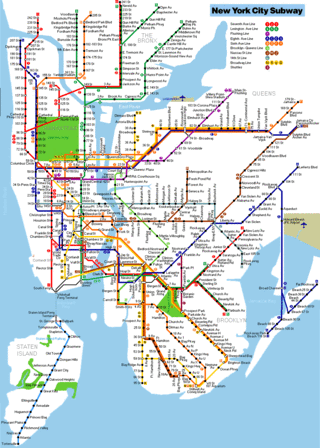
The Second Circuit this week overturned a preliminary injunction that barred a maker of subway train braking equipment, Wabtec, from selling its product. The court agreed with the district court that Wabtec misused the trade secrets of the plaintiff, Faiveley Transport, and would likely continue. But the district court hadn't found that the Wabtec's improper use of the trade secrets would cause Faiveley Transport "irreparable harm".
The evidence on the contrary showed that Wabtec had every incentive to keep the trade secrets hush-hush, rendering damage from permanent loss of secrecy improbable. Nor would possible loss of sales by Faiveley Transport to misappropriator Wabtec count as irreparable injury, the court concluded. "Where a misappropriator seeks only to use those secrets — without further dissemination or irreparable impairment of value — in pursuit of profit, no such presumption [of irreparable harm] is warranted because an award of damages will often provide a complete remedy for such an injury." Faiveley Transport Malmo AB v. Wabtec Corp., No. 08-5126-cv (2d Cir. Mar. 9, 2009).
Blawgletter notes that the availability of a damages award won't always — or even most of the time — preclude a finding of irreparable harm in trade secrets cases. Faiveley Transport involved sales to just one customer — the New York City Transit Authority, which of course operates the Big Apple's subway system. Wabtec's profits and Faiveley Transport's losses from the misappropriation presented a reasonably knowable proposition. In other cases, with sales to many customers, the job becomes much harder; and the difficulty of determining damages in itself may warrant a finding of irreparable injury.
President Barack Obama's nominee to chieftain the Department of Justice's Antitrust Division, Christine Varney (post here), testified today before the Senate Committee on the Judiciary. Her opening statement went like this:
Mr. Chairman, Senator Specter, and members of the Judiciary Committee,
I am deeply honored to appear before you today. As someone who has spent more than a decade working on antitrust matters, I sincerely appreciate the fact that this Committee, along with the Antitrust Subcommittee led by Chairman Kohl and Ranking Member Hatch, have been a consistent supporter of the Antitrust Division. If I am fortunate enough to be confirmed as Assistant Attorney General for the Antitrust Division, I look forward to working with all the members of this Committee to promote the effective enforcement of our antitrust laws and to renew our nation's status as the international leader in antitrust policy development and convergence.I am pleased that my family is here today, and I want to recognize my husband, Tom Graham. We have two sons who are currently in college. My other family members here include my father, Jack Varney, who actually served as an attorney in the Antitrust Division 50 years ago; my sister Jackie; and my niece Molly.
Strong antitrust enforcement and respect for our competition statutes are the primary safeguard of our distinctive free enterprise system. There are three main areas that, if confirmed, I will focus on as the Assistant Attorney General for Antitrust.
First, we must rebalance legal and economic theories in antitrust analysis and enforcement. The Antitrust Division can provide strong intellectual leadership in competition policy by advancing our collective understanding of competitive behavior and adapting our thinking to reflect our ever evolving markets. Second, we need renewed collaboration between the Antitrust Division and the FTC, whose policies and processes have unfortunately diverged too frequently in recent years. Policy disputes and jurisdictional squabbles between agencies with overlapping enforcement mandates lead to uncertainty for consumers, business, and for overseas' antitrust enforcers who look to the US for consistent guidance. Third, we must continue our cooperation with worldwide antitrust authorities, discussing our differences with international enforcers respectfully and engaging with emerging antitrust regimes such as China and India as they implement new antitrust laws. Working with the committed and talented staff at the Division, I am sure these goals can be achieved.
There is no doubt that the challenges we face in our current economic crisis are great, but I believe it is important to remember that robust antitrust enforcement is essential for the free market to function properly. In these tough economic times, more than ever, it is important to remember that clear and consistent antitrust enforcement – protecting competition and thus consumers while being conscious of the need for economic stability – is essential to a growing and healthy free market economy.
While these challenges are daunting, I believe that I am well equipped to meet them and I look forward to serving our nation as its chief antitrust enforcer, if confirmed. I believe that competition is what has made this country great, and I hope to build upon the broad bipartisan consensus that competition – protected by the antitrust laws – is essential. I will approach the challenges we face from my unique vantage point as a former FTC Commissioner, which I believe will help me to bridge the gap that exists between the antitrust enforcement agencies on several crucial substantive and procedural issues. I will work diligently and act decisively to thwart those who would reduce competition and harm American consumers. I will work collaboratively with other antitrust enforcers in the US and overseas. I firmly believe that antitrust law is a cornerstone of our economic prosperity, and I therefore am committed to recruiting the best, brightest, and most experienced antitrust minds in the country to fill the Division's key positions working alongside the talented and committed career staff.
I look forward to working with you to promote the effective enforcementof our antitrust laws and to renew our status as the international leader in antitrust policy development and convergence.
Thank you.
Nominee Varney also testified that she wondered why mergers between XM and Sirius and Maytag and Whirpool got a pass from antitrust enforcers.
Blawgletter rejoices that the U.S. may soon rediscover the signal importance of antitrust law to enhancing vigorous competition and correcting efforts to thwart it. We urge the Senate to confirm Ms. Varney's nomination without delay.
The Supreme Court today reversed an order compelling arbitration because, the 5-4 Court held, the district court lacked jurisdiction to make the order. The federal Arbitration Act, the majority reminded us, provides no independent basis for federal court jurisdiction; the underlying controversy must furnish the jurisdictional basis. Since the original claim — a state court action by Discover to collect a credit card debt — involved neither diverse parties nor a question of federal law, the district court lacked authority to entertain Discover's motion in federal court to compel arbitration. Vaden v. Discover Bank, No. 07-773 (U.S. Mar. 9, 2009).
The dissent (per Chief Justice Roberts with Justices Alito, Breyer, and Stevens joining him) urged that Discover's federal court motion to compel arbitration invoked federal jurisdiction on the ground that the Federal Deposit Insurance Act completely pre-empted Vaden's state court counterclaims against Discover.
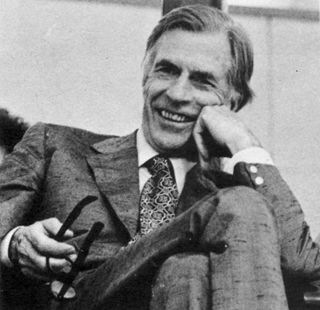
John Kenneth Galbraith (1908-2006).
During Blawgletter's college years, a Harvard economics professor visited as a Chubb Fellow for a few days, and we got to join other students with him over lunch. We'd read one of Professor Galbraith's books, The Affluent Society (1953), and found a particular concept in it unpersuasive — his notion of "want creation". He argued that producers of goods and services create "wants" instead of satisfying "needs". He predicted someday the process would fail, with grim consequences.
We asked him whether, some 25 plus years after he posited the idea, he saw signs of want creation faltering. The question seemed to irritate him. He answered that the failure of the phenomenon might yet come to pass.
The current financial turmoil in a way vindicates the Galbraithian hypothesis in part. Firms did indeed continue to seduce consumers into purchasing stuff they don't really need — from iPods to Facebook pages and, indeed, to blogs. But the real trouble lay in the mushrooming (and ever-riskier) debt that paid for it.
Galbraith, to our ear, sounds prophetic on the calamity we've reaped from years of sowing credit excess:
As we expand debt in the process of want creation, we come necessarily to depend on this expansion. An interruption in the increase in debt means an actual reduction in demand for goods. Debt, in turn, can be expanded by measures which, in the nature of the case, cannot be indefinitely continued.
* * * *
In fact, we do not really know the extent of the danger. A tendency to liquidation of consumer debt, with accompanying contraction in current spending, could be offset by prompt and vigorous government action to cut taxes, increase public outlays and so compensate with spending from other sources. . . . But taxation and expenditure beyond the range of . . . automatic stabilizers require Executive and Congressional action. Such decision and action could be in a radically slower tempo from that of debt liquidation and the consequent slump in spending.
A possibility of trouble is not a prediction of trouble. Not many, if told of the vast expansion in consumer debt when it lay ahead, would have thought it safe. Perhaps the expansion can continnue and possibly it will one day taper off in benign fashion. But we would do well to keep an alarm signal flying over the consumer-debt creation into which the process of want creation impels us. In a society into which the production and sale of goods seem sacrosanct, there will be extreme hesitation over measures which will seem to restrain the financing of consumer's goods and hence their sale. Measures to prevent the competitive liberalization of consumer credit will encounter the heaviest resistance. . . .
Though such regulation is a commonplace in the United Kingdom and has been used in the United States in wartime, it is unlikely to be authorized in the future except in the aftermath of disaster. Interference with the process of want creation cum debt creation will be thought wrong.
John Kenneth Galbraith, The Affluent Society 148 & 151-52 (1998 ed.).


