Seventh Circuit Judge Richard Posner wrote an opinion about "prime bank" fraudsters.  It came out today.  The defendants and their cohorts pocketed $32 million from credulous victims whose greed apparently blinded them to the preposterousness of a super-safe investment that, as the scammers told them, would yield a 100 percent weekly return. 

The appeal turned on the sole question of whether the Securities and Exchange Commission properly won a summary judgment with circumstantial proof of the defendants’ scienter.  The court, noting the defendants’ invocation of the privilege against self-incrimination and the resulting presumption against them in a civil case, affirmed.  United States Securities and Exchange Comm’n v. Lyttle, Nos. 07-2466 & 07-2467 (7th Cir. Aug. 7, 2008).  Judge Posner commented:

One is reminded of the highwayman’s case.  Everet v. Williams (Ex. 1725), belatedly reported in Note, "The Highwayman’s Case," 9 L.Q. Rev. 197 (1893) . . . . One highwayman sued another, claiming that he was entitled to a larger share of the loot from a series of joint robberies.  The suit was dismissed, both were hanged, and the plaintiff’s lawyers were fined for having brought a suit "both scandalous and impertinent."

Feedicon Our feed is reminded of that thing they say about honor among thieves.

The First Circuit today affirmed dismissal of a securities fraud class action against Biogen and several of its top insiders.  The reason?  The plaintiffs didn’t plead the scienter element in a way that satisfied the tough "strong inference" test of Tellabs, Inc. v. Makor Issues & Rights, Ltd., 127 S. Ct. 2499 (2007), under the Private Securities Litigation Reform Act.  New Jersey Carpenters Pension & Annuity Funds v. Biogen IDEC Inc., No. 07-2626 (1st Cir. Aug. 7, 2008).

Feedicon14x14_2 The world has three kinds of people:  those who can count, and those who can’t.

Patrickleahy
The Senate Judiciary Committee chair wants "a whole lot" of new laws before taking up more judicial appointments.

Under the fetching headline "Senate Stall to Let Next President Tip Court Balance", James Rowley at Bloomberg reports today that the world’s Most Exclusive Club will confirm no more nominees for judgeships on the 13 U.S. courts of appeals before a new President takes the oath of office in January 2009.

Mr. Rowley notes that "[s]ix of the 13 U.S. appeals courts are closely divided between Republican and Democratic appointees" and that therefore the next nominator-in-chief will get the chance to shift the overall orientation of almost half the circuits.

Feedicon14x14 Imagine our feed’s surprise.

Sunburn
A little cocoa butter will fix that right up, buddy.

As we enter the Dog Days of Summer — and temperatures in Blawgletter’s vicinity spike to 107 Fahrenheit — let us pause to consider skincare products.  Specifically ones that feature an unguent of choice, the mother of moisturizers, the very queen of summertime salves:  cocoa butter.

A decision today out of the Third Circuit furnishes the occasion.  In the case, E.T. Browne Drug Company accused Cococare Products of infringing Browne’s trademark in "Cocoa Butter Formula".  Browne called its product "Palmer’s Cocoa Butter Formula", and Cococare named its — what else? — "Cococare Cocoa Butter Formula".  The district court threw the trademark infringement case out on summary judgment.

The Third Circuit affirmed in a soothing yet sunny opinion.  The court first identified the (eventually fatal) weakness in Browne’s case — that its trademark in "Cocoa Butter Formula" appeared only on the Patent and Trademark Office’s Supplemental Register and deserved, at best, the lowest level of trademark protection.  The court parted with the district court on the question of whether Browne’s evidence raised a fact question as to whether the mark qualified as unprotectibly "generic" or instead made it to the bottom-most protectibility rung, where "descriptive" marks sit.

Still, the court pointed out, a descriptive mark acquires trademark protection under the Lanham Act only if it obtains "secondary meaning" in the minds of customers.  Here, the court held, Browne slipped.  Browne’s proof showed, at best, that "Palmer’s Cocoa Butter Formula" had entered consumer consciousness.  That counted as no evidence that "Cocoa Butter Formula", by itself, had obtained secondary meaning (such that people associated it with Browne/Palmer’s as the source).  E.T. Browne Drug Co. v. Cococare Products, Inc., Nos. 06-4543 & 06-4658 (3d Cir. Aug. 5, 2008).

Feedicon14x14_2 Our feed also likes slather.

Tammywynette
Tammy Wynette sang D-I-V-O-R-C-E.

The Eighth Circuit today overturned claims arising from a business divorce.  Each side owned half of a company, Twin City, before one bought out the other.  The sellers sued for fraud, breach of fiduciary duty, insider trading under an Iowa statute, and breach of contract.  The court held that fact issues barred summary judgment on the fiduciary duty, insider trading, and contract claims because the record suggested that the buyers breached fiduciary duties by not disclosing impending transactions to the sellers, used the secret information to trade on it, and breached a provision for recalculating the purchase price.

The transactions may have materially affected the value of the seller’s Twin City stock, the court concluded, by ridding the company of a losing joint venture obligation, giving it control of its main operating company for cheap, and providing it with better financing.  Also, as insiders in a close corporation, the defendants under applicable Minnesota law had a duty to tell the sellers about the impending happy turn of events.  Questions of materiality and knowledge, the court held, precluded summary judgment. Dunning v. Bush, No. 07-2764 (8th Cir. Aug. 5, 2008).

The court also found ambiguity in a contract provision relating to recalculation of the purchase price for the plaintiffs’ shares in Twin City and held that the district court erred in striking a breach of contract claim as a sanction for late supplementation of an expert report on valuation.

Feedicon14x14 Our feed keeps on believing.

Spongebob
Today’s decision saves cable companies from having to do this.

The Second Circuit today reversed a summary judgment for Cartoon Network and other programming providers in a case accusing cable operators of directly infringing the programmers’ copyrights in SpongeBob SquarePants, CNN news, and Dude, Where’s My Car? (2000), among other television and cinematographic triumphs.

The lawsuit concerned a system for allowing cable subscribers to designate programs for future recording and eventual (hah!) playback.  But the system, unlike a playback device that sits in your living room or over your favorite bar, the "Remote Storage" Digital Video Recorder ("RS-DVR") system put the subscribers’ choices on hard disks in some enormous server farm.  The programmers alleged that the off-premises recording and playback constituted direct infringement of their copyrights.  The district court agreed.

But not the Second Circuit.  It held that the works never become "fixed" in a tangible medium during the 1.2 seconds or less that the "buffering" process takes to store the programs on the cable companies’ servers.  That part of the process, the court concluded, thus didn’t satisfy the definition of "fixed", which requires fixation "for a period of more than transitory duration".  The Cartoon Network LP v. CSC Holdings, Inc., Nos. 07-1480 & 07-1511-cv, slip op. at 13-21 (2d Cir. Aug. 4, 2008) (applying 17 U.S.C. 101).

The court also rejected the argument that the cable guys made "copies" of the programs.  The subscribers made the volitional choice to slap the programs on the hard disks; the cable companies simply provided the means for gratifying their wishes.  Id. at 21-29.

Finally, the panel ruled that the RS-DVR system didn’t "transmit" the movies and shows "publicly".  Because the transmissions went only to the specific subscribers, respectively, who punched the right buttons on their remote controls.  Id. at 29-44.

Feedicon14x14 Our feed adores on the fair use doctrine.

Halftoningcolor
Overlaying dots tricks the eye into seeing one color.

Today the Federal Circuit reversed a decision that invalidated patents for inequitable conduct. The court also held that the district court so deviated from proper analysis as to justify directing the Chief Judge of the originating district to reassign the case.

The dispute involved patents relating to digital halftoning. The invention permits representation of images with dots. Lots of dots.

The court tossed the inequitable conduct conclusion because the district court focused, improperly, on post-filing publication of a paper that explored ways to make halftone images more pleasing. The public disclosure, the court held, didn’t prove the "materiality" prong of the inequitable conduct defense. Research Corp. Technologies, Inc. v. Microsoft Corp. , No. 06-1275 (Fed. Cir. Aug. 1, 2008).

Blawgletter notes, as we must, that the opinion uses the phrase "this court" 19 times — and the word "indeed" four times — in the course of 14 pages. While we generally admire judicial modesty, we marvel at the extent of judicial self-effacement. Indeed.

Feedicon Our feed hits you right in efface.

Battleagincourt
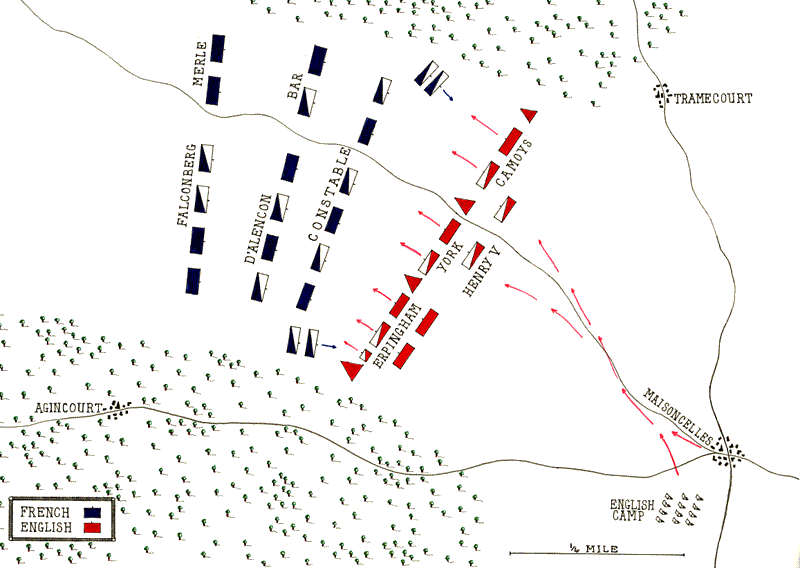
King Henry V walloped the French in 1415 at Agincourt.

Blawgletter had the distinct honor this morning of talking with a group of state trial judges about ways to expedite and streamline civil litgation.  Our presentation included a visual (above) depicting the array of English and French forces in the Battle of Agincourt.  But time ran out before we could recite the last part of the bard’s recreation of how Henry V rallied his weary warriors on the eve of the decisive engagement. 

We reproduce it here:

This story shall the good man teach his son
And Crispin Crispian’s shall ne’er go by
From this day to the ending of the world
But we in it shall be remembered.
We few, we happy few, we band of brothers.
For he today that sheds his blood with me
Shall be my brother; be he ne’er so vile.
This day shall gentle his condition.
And gentlemen in England now a-bed
Shall think themselves accursed they were not here
And hold their manhoods cheap whiles any speaks
That fought with us upon St. Crispin’s day.

Feedicon Our feed asks what light on yon window breaks.

Wholefoods

The D.C. Circuit — in a 2-1 decision — today reversed the district court’s refusal to enjoin Whole Foods from acquiring Wild Oats.  The majority concluded that "the district court committed legal error in assuming market definition must depend on marginal consumers; consequently, it underestimated the FTC’s likelihood of success on the merits."  Federal Trade Comm’n v. Whole Foods Markets, Inc., No. 07-5276, slip op. at 2 (D.C. Cir. July 29, 2008).

The court remanded the case so that the district court could weigh the "equities" before ruling on whether to enter a preliminary injunction.  The court ordered a stay of the acquisition in August 2007 but soon after dissolved it.  The merger closed on August 28, 2007.

Feedicon14x14 Crunchy!

Monicagoodling
Monica, Monica, Monica!

Tell us about your political philosophy.  There are different groups of conservatives, by way of example:  Social Conservative, Fiscal Conservative, Law & Order Republican.

[W]hat is it about George W. Bush that makes you want to serve him?

Aside from the president, give us an example of someone currently or recently in public service who you admire.

An Investigation of Allegations of Politicized Hiring by Monica Goodling and Other Staff in the Office of the Attorney General at 18 (July 28, 2008) (quoting questions that Ms. Goodling asked of candidates for non-political positions in the Department of Justice).

Feedicon Subscribe to our apolitical feed.