A 5-4 Supreme Court today recognized an individual right to own weaponry under the second amendment to the Constitution.  The Court thus struck down a District of Columbia law that severely limited handgun possession.  District of Columbia v. Heller, No. 07-290 (U.S. June 26, 2008).

Justice Scalia wrote the majority opinion, in which Chief Justice Roberts and Justices Alito, Kennedy, and Thomas joined.  They held that a proper interpretation of the language breaks the second amendment into a "prefatory" clause and an "operative" clause:

  • Prefatory:  "A well-regulated Militia, being necessary to the security of a free State,". 
  • Operative:  "the right of the people to keep and bear arms, shall not be infringed."

The prefatory part states the purpose behind the right but doesn’t limit it, the Court seems to say, and the operative clause defines the right.  Once you free the definition from limitation by the purpose, you get an individual right rather than a collective one.

Justice Stevens authored the principal dissent, and Justices Breyer, Ginsburg, and Souter joined in it.  They agreed that individuals can enforce the "right of the people" to keep and bear arms but concluded that the right does not protect "the use or possession of firearms for purely civilian purposes."


Feedicon14x14 Our feed wishes the Justices a happy summer recess.

Itsasmallworld
The Simpsons parodied this Disney ride‘s theme song with: "Duff beer for me, Duff beer for you/I’ll have a Duff, you have one, too."

Over the years, Blawgletter has developed — shall we say — aversions to certain common phrases.  When we see them, our eyes wish to avert from them.  Why?  Apart from their banality, they seem to us a crutch for unclear thinking, which unerringly produces opaque expression.

Take "after all".  We see it quite a lot in legal opinions, briefs, and memos.  It means, we think, something like "contrary to what you’d expect" or — worse — "in view of all circumstances".

Disney deploys the first meaning in its emblematic song and animatronic ride — "It’s a Small World After All".  We think of the globe as large, and yet the things we have in common makes it small.  Contrary to what you’d expect.

Legal writers whip out the second sense of the phrase.  For instance:

Blackacre exists only in the imagination of law professors and treatise-writers.  After all, who else would use such a ridiculous name?

After all what, we want to know.  In view of all we know about legal didacts and authors of black-letter precepts?

You will see that "after all" presupposes awareness that the reader may not possess — especially if you, the writer, haven’t furnished it.  When the audience sees the phrase, it either nods in knowing agreement or wonders what the heck you mean.  Which wonderment irritates and confuses.  Which detracts from persuasion.  Which is your job.

After all.

Feedicon FYI — in the end, lots of phrases, as such, irritate our feed. 

Exxonvaldez
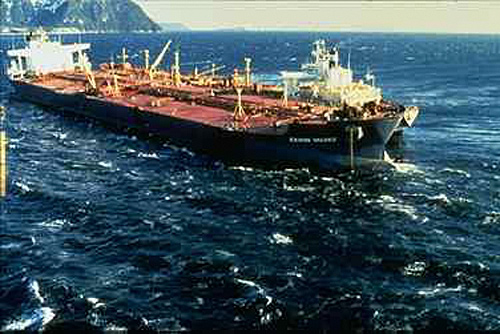
The Exxon Valdez.

Applying maritime common law, the Supreme Court today slashed a punitive damages award against Exxon Mobil to $507.5 million in the Exxon Valdez case.  The Alaska federal jury originally awarded $5 billion (on top of $507.5 million in actuals), but the Ninth Circuit halved it to $2.5 billion.  Adopting a 1:1 ratio between actual damages and punitives as the upper limit in maritime cases, the 5-3 Court further reduced the punitive award to equal the $507.5 million award of actual damages.  Exxon Shipping Co. v. Baker, No. 07-219 (U.S. June 25, 2008).

Justice Alito having recused himself earlier, the Court divided equally on the question of whether maritime law allows imposition of punitive damages on a company that didn’t acquiesce in the wrongdoing. 

All justices agreed that the Clean Water Act, by omitting a punitive remedy, didn’t preempt one. 

Justices Stevens, Breyer, and Ginsburg dissented on the reduction of the award, concluding that Congress — not the Court — should make judgments about limits on punies under maritime law.

Blawgletter mentioned, when the Court accepted the case last October, our suspicion that the Court would "fashion yet another way to stop punitive damages awards — by ruling that the malfeasor didn’t get enough notice that mere malfeasance could subject it to punitive damages."  We also observed that "reaching out for the Exxon Valdez case continues a pro-business trend by the Court" and "suggests distrust, or worse, of juries."  In the event, the Court’s equal division on the permissibility of awarding punitives in the first place prevented a precedential decision on that point, but the Court did for sure signal (again) a determination to establish "predictability" of civil punishment and deterrence.  Hence the 1:1 ratio.

Feedicon14x14_2 Our feed gets knocked down, but it gets up again.

An American Express press release discloses that the company will receive from MasterCard up to another $1.8 billion — on top of up to $2.25 billion from Visa — to settle an antitrust suit alleging that MasterCard and Visa illegally blocked their card-issuing member banks from vending Amex cards.  The release says:

AMERICAN EXPRESS SETTLES ANTITRUST CLAIMS AGAINST MASTERCARD FOR $1.8 BILLION

Agreement Would Bring Total Payments From MasterCard And Visa To $4 Billion

Settlement To Help Lessen Impact of Weakening Economy

NEW YORK, June 25, 2008 — American Express announced today that it has reached an agreement with MasterCard Inc. to drop a lawsuit alleging that MasterCard had illegally blocked American Express from the bank-issued card business in the United States.

Under the terms of the agreement, MasterCard will pay American Express up to $1.8 billion. This follows an earlier agreement with Visa to settle similar claims for up to $2.25 billion. Subject to certain performance criteria, American Express would receive more than $4 billion for agreeing to drop its claims against the two credit card networks. The combined antitrust settlement is the largest in U.S. history.

The MasterCard payments to American Express will be made in quarterly installments over three years. Together with the previously announced payments from Visa, this represents $880 million annually for American Express over the next three years, starting in the third quarter of 2008 and running through mid-year 2011. American Express would receive two subsequent quarterly payments of up to $70 million from Visa in the latter half of 2011.

"The $4 billion settlement represents a very satisfactory resolution of our lawsuits against the country’s two major card associations," said Kenneth I. Chenault, chairman and chief executive officer.

Mr. Chenault also said, "Business conditions continue to weaken in the U.S. and so far this month we have seen credit indicators deteriorate beyond our expectations. While it is too early to assess the impact of these indicators, the antitrust settlement we’ve reached with MasterCard provides us with a multi-year source of funds that should, among other things, help to lessen the impact of this weakening economic cycle and, when conditions improve, give us the ability to step up investments in the business."

American Express filed the suit in Federal court (November 2004) to seek monetary damages for the lost business opportunity that resulted from the illegal conspiracy to boycott American Express. Following American Express’ settlement with Visa (November 2007) and the dismissal of all the bank defendants, MasterCard was the sole remaining defendant in the antitrust lawsuit. The case will now be dismissed.

The payments from both MasterCard and Visa are subject to American Express achieving certain quarterly performance criteria in its U.S. Network services business. Given the strong growth momentum within that business, the Company is highly optimistic about its ability to meet those performance requirements. Proceeds from a possible settlement with MasterCard were not built into the American Express 2008 financial plan.

American Express Company is a leading global payments and travel company founded in 1850. For more information, visit www.americanexpress.com.

Editors Note: Below is a brief summary of the settlements discussed above:

Visa Settlement: American Express reached a $2.25 billion settlement with Visa in November 2007 and recognized an initial payment of $1.13 billion in the fourth quarter of last year. The first installment of $70 million was recognized in first quarter 2008. The remaining payments of up to $70 million per quarter are scheduled to be received over the next 15 quarters, ending fourth quarter 2011.

MasterCard Settlement: Under terms of the $1.8 billion settlement with MasterCard, American Express would receive quarterly payments of up to $150 million over the next 12 quarters, starting in the third quarter of 2008 and ending second quarter 2011.


This release includes forward-looking statements, which are subject to risks and uncertainties. The words "believe," "expect," "anticipate," "optimistic," "intend," "plan," "will," "could," "would," "likely," and similar expressions are intended to identify forward-looking statements. Readers are cautioned not to place undue reliance on these forward-looking statements, which speak only as of the date on which they are made. The Company undertakes no obligation to update or revise any forward-looking statements. Factors that could cause actual results to differ materially from these forward-looking statements include, but are not limited to the Company’s ability to grow and expand the Global Network Services business in the United States and the success of such Global Network Services business in meeting the performance requirements called for by the settlement agreement described in this release. A further description of our risks and uncertainties can be found in the Company’s Annual Report on Form 10-K for the year ended December 31, 2007, and our other reports filed with the SEC.

Feedicon14x14 Our feed is always forward-looking.

Wartsilagenerator
A Wartsila diesel generator.

Applying Maryland law, the Third Circuit vacated a judgment on the ground that the jury award violated an "exculpatory clause" in the contract between a construction consulting firm and the builder of a power plant in El Salvador.  Wartsila NSD N. Am., Inc. v. Hill Int’l, Inc., No. 06-3595 (3d Cir. June 20, 2008).

Coastal Salvadorian hired Wartsila NSD North America to design and construct the project.  Wartsila subcontracted work to Black and Veatch International ("BVI").  And, when the construction fell behind schedule, Wartsila hired Hill International to furnish a consultant to rectify the problems.

But the Hill consultant, Richard LeFebvre, lied about his education on the resume he and Hill submitted to Wartsila.  He didn’t, as he claimed, attend buiness law classes at the University of North Florida; receive a business degree from Duquesne University; or earn a B.S. in electrical engineering from Penn State University.

Problems with the project persisted, culminating in a dispute between Wartsila and BVI, which blamed Wartsila.  The fight proceeded to arbitration.  After BVI’s counsel revealed during examination of LeFebvre that he misrepresented his credentials, the panel of arbitrators awarded BVI $4.65 million against Wartsila.

Wartsila sought to recoup its loss in the arbitration from Hill.  But Hill cited the exculpatory clause in the consulting contract.  The clause barred recovery of "incidental, special, indirect or consequential damages of any kind or nature whatsoever arising from Consultant’s performance or failure to perform any services under this Agreement."  The district court held the clause unenforceable under Maryland law, which the parties had chosen to govern the contract.  The jury returned a verdict awarding Wartsila $2,047,952, on which the district court entered judgment.

The Third Circuit vacated and remanded for new trial on damages.  The exculpatory clause, the court held, didn’t run afoul of Maryland law, which enforces such provisions unless (1) the wrongdoer intentionally or recklessly causes harm, (2) the contract resulted from grossly unequal bargaining power, or (3) the transaction involves the public interest.  The court also concluded that the award included non-direct damages (consisting primarily of the costs and other losses that Wartsila sustained in connection with the BVI arbitration).  The court accordingly sent the case back for retrial to determine "direct" damages only.

Feedicon Our feed lives in the moment.

Payphone
If you use one of these to place a 1-800 call, the carrier that connects you owes "dial-around" compensation to the payphone owner.

A 5-4 Supreme Court held today that assignees have standing to sue even if they don’t stand to gain financially from a favorable outcome.  Sprint Communications Co., L.P. v. APCC Services, Inc., No. 07-552 (U.S. June 23, 2008).

The case involved claims to recover compensation from long-distance carriers for "dial-around" services that payphone operators provided to payphone customers.  The operators assigned their claims to "aggregators" for purposes of collection.  The aggregators in turn promised to remit the proceeds of their collection efforts to the operators, who agreed to pay the aggregators for their services.  The district court refused to dismiss the claims for lack of standing, and the D.C. Circuit affirmed.

The Court rejected the petitioners’ arguments for denying the aggregators Article III standing and "prudential" standing.  Chief Justice Roberts and Justices Alito, Scalia, and Thomas dissented.

Feedicon14x14

The Supreme Court of Texas yesterday held, in two cases, that a defendant didn’t waive its right to arbitrate a dispute between a mobile home manufacturer and a dealer and that a forum selection clause in an agreement for financing leases of magnetic resonance imaging equipment required dismissal.  The court, in per curiam opinions and without hearing oral argument, granted mandamus and ordered the district courts, respectively, to compel arbitration, In re Fleetwood Homes of Texas, L.P., No. 06-0943 (Tex. June 20, 2008), and to dismiss in favor of a Pennsylvania forum, In re Lyon Fin. Svcs., Inc., No. 07-0486 (Tex. June 20, 2008).

Feedicon14x14 Mm, mm good mandamus.

Asbestosis
The plan will pay claims of people whose lungs look like this.

Today Blawgletter learned something we didn’t know before.  That happens quite often.  Sometimes we even learn things we did know but just can’t remember.  Some might in fact say that the frequency of the latter exceeds the oftenness of the former.

But back to our discovery.  It relates to insurance.  Insurance of a peculiar kind.  Indemnity insurance.

The revelation arrived courtesy of the Second Circuit, which upheld a cumbersome plan for paying claims for asbestosis and other ailments against Prudential Lines, a shipping company that dove into the bankruptcy tank in 1986.  Desirous of paying (and discharging) the claims, the trustee of Prudential called on the shipper’s insurance carrier to fork over the necessary funds.  But the insurer, which we’ll call American Steamship for short, balked.  It insisted that the trustee pay the claims himself first.

But why?  Because an indemnity policy has what those in the biz refer to as a "pay-first" provision.  That meant the trustee couldn’t call on American Steamship to satisfy a claim directly but instead had to pay and then request American Steamship for indemnity — what most people would think of as reimbursement.

We won’t go into the torturous details of the trustee’s efforts to short-circuit the process.  Suffice to say that the Second Circuit booted the first plan as a "sham" because the trustee wouldn’t actually part with money until after the insurer paid the trustee’s claim for indemnity. 

The new plan met the same fate in the bankruptcy and district courts, but the Second Circuit okayed it.  Yes, the trustee would pay a claim, get indemnity, and use the proceeds to pay the next claim — and so on until all claimants received their due — but that hardly amounted to a sham.  The trustee’s actual parting with the funds distinguished it from the earlier scheme.  That it would happen according to a plan didn’t matter.  And so the court told the bankruptcy court to implement the seriatim pay-indemnify-pay plan on remand.  Asbestosis Claimants v. Am. Steamship Owners Mut. Prot. & Indemn. Ass’n, Inc. (In re Prudential Lines, Inc.), No. 05-5925-bk (June 19, 2008).

Feedicon14x14 Our feed likes learning stuff.

Dukw
What — you’ve never seen a DUKW before?

Today the First Circuit plumbed the trademark law distinction between "generic" and "nongeneric" marks.  It held that the district court clearly erred when it deemed the phrase "duck tours" nongeneric and so dissolved a preliminary injunction.  Boston Duck Tours, LP v. Super Duck Tours, LLC, Nos. 07-2078 & 07-2246 (1st Cir. June 18, 2008).

Blawgletter concedes that the result seems obvious.  Except that the duck tours didn’t involve walking around and gawking at waterfowl.  No.  It dealt instead with sightseeing on land, sea, lake, and river in an amphibious truck — a "DUKW" or "duck" (also magoo or old magoo).

In the 1990s, Boston Duck Tours started running tours in and around the Back Bay area of Boston.  It used old DUKWs from the World War II and Korean War eras after spiffing them up.  And it registered "BOSTON DUCK TOURS" and its cartoon-duck logo on the Principal Register at the U.S. Patent and Trademark Office, giving the marks a presumption of validity.

But the shadow of Super Duck Tours eventually fell.  The Super Duck people, carpetbagging from Portland, Maine, began plying its amphibious trade along the Boston waterfront with custom Hydra-Terras — a newer and larger vehicle/vessel.  Its ads (with a "super" duck cartoon logo) shouted:  "It’s a bus!  It’s a boat!  It’s a Super Duck!"

Boston Duck sued Super Duck and got a preliminary injunction on the theory that "duck tours" infringed the Boston Duck Tours trademark.  But the First Circuit reversed, holding that the phrase’s "generic" character made the "Boston Duck Tours" mark merely "descriptive" of the company’s services and thus entitled it to "weak" trademark protection.  (Generic marks get no protection, and others receive varying degrees — from "descriptive" to "suggestive" to "arbitrary" to "fanciful".)

After reviewing several factors for determining whether Super Duck Tours infringed — including the mark’s weakness, actual consumer confusion, and Super Duck’s intent — the court held the district court clearly erred in finding the "likelihood of confusion" element of a trademark claim.  The court also concluded that Boston Duck failed to show that it would likely succeed on its "design" trademark claim because, among other things, the parties’ cartoon-duck logos looked different.

Quack.

Feedicon14x14 Our feed feels a bit goosey tonight.