Alitaliajet
The Repubblica Italiana’s former national air carrier may not get a new trial.

What should happen after an appellate court decides that the trial court erred by putting the case to a jury instead of conducting a non-jury trial?  Do the original trial and verdict count for naught?  Judge Richard Posner of the Seventh Circuit furnished a primer on the questions yesterday.  Olympia Express, Inc. v. Linee Aeree Italiane, S.P.A., Nos. 07-1708 & 07-1821 (7th Cir. Nov. 30, 2007).

The court first concluded that the Foreign Sovereign Immunities Act entitled the losing party, Alitalia Airlines, to avoid trial by jury because the Italian government owned most of it.  The panel thus vacated an $8.5 million judgment in favor of two Alitalia ticket sellers, which had sued the air carrier for breach of contract.  Then arose the question of what to do next. 

His Honor started the court’s answer by defining "nonjury trial":

Does it mean that the trial must be conducted in the absence of a jury or merely that the "verdict" must be rendered by the judge rather than by a jury?  We think it is [the] latter.  In many trials some factual issues are to be resolved by a jury and others by a judge . . . , and in these mixed bench/jury trials all the evidence is introduced in the presence of both triers of fact and the jury resolves the issues triable by the jury and the judge the other issues, except that if there are factual issues common to both the jury- and the judge-tried claims the jury’s verdict binds the judge.

The definition allowed the panel to conclude that the district court needn’t start completely over on remand.  Instead:

Consistent with the practice in mixed trials, on remand the magistrate judge should first decide whether the development of the facts at the first trial was sufficient to enable him to make his own findings of fact and conclusions of law on both liability and damages.  If so, he need not conduct a further evidentiary hering; it would be redundant. . . . But he may instead realize that he’s forgotten some of the evidence (the trial took place more than a year ago), or that since he was not the trier of fact he did not pay as close attention to it as he would have done in a bench trial, or that in a bench trial he would have elicited additional evidence (judges are reluctant to question witnesses in jury trials for fear of confusing jurors about who is the trier of fact, but there is no similar inhibition in a bench trial).

So the magistrate judge may take advantage of the existing record.  He may also more or less start from scratch.  But, regardless, does the original verdict carry any weight?  Nosir, the court said:

On any of these assumptions [the magistrate judge] should conduct a further evidentiary hearing.  Of course if he takes the first course and decides the case without taking additional evidence he must give no weight to the jury’s verdict, for there should not have been such a verdict.

And there you have it.

Barry Barnett

Feedicon Our feed prefers to fly like an eagle to the sea.

Blawgletter confesses that we don’t often think of Saudi Arabian judges as exemplars of magisterial integrity.  Indeed, until recently, we didn’t know that the penisula nation had a functioning court system. 

Whatever impulse we had in the direction of admiring Saudi justice died when we read about a Saudi court’s decision to disbar a lawyer for "perturbing" the judiciary. 

We understand that the lawyer popped off in public about specific decisions of particular courts and judges.  But his provocation seems to us at least equal to his response.

A young woman, about to marry, got into a car.  The vehicle contained men she didn’t know.  One of them, a friend, had induced her by saying he’d give her an old picture of herself, a photograph that she wanted her groom to have.  The men drove away with her.  Four of them took turns raping her. 

The Saudi courts responded by convicting the victim of violating sharia law, which bars women from meeting men without their husbands or close relatives, and sentenced her to 90 lashes for offending Islam.  The rapists got prison sentences of one to nine years — with no lashes.

The 19-year-old woman’s lawyer objected to what he saw as a grave injustice to her.  He said so publicly and, perhaps, intemperately.  A Saudi judge reacted by disbarring him for "perturbing" the judiciary.  Also by increasing his client’s punishment to 200 lashes.

Wow.  We agree that holding a law license obliges lawyers not to cast unnecessary public doubt on the integrity of the adversarial process.  But, good heavens, this Saudi lawyer may lose his privilege to practice merely because he perturbed judges with his arguments.  And the teenager will receive 110 more lashes.

The lawyer’s offense?  Pointing out, powerfully, that the judges ordered a horrible punishment of a rape victim because she didn’t bring her father or brother to watch as she fetched a photograph that she wanted to give to her fiance.

How would you respond to such a case of extreme injustice?  Would you risk your law license, your family’s livelihood, and indeed your personal honor simply to condemn an inhumane, repellent, and intolerable ruling?

We’ve always believed that how a person behaves when he has nothing to gain from trying to do the right thing tells a great deal about that person’s integrity.  Abdulrahman al-Lahim seems to us to have upheld the highest traditions of our profession.  He, like our Pakistani bretheren and sisteren, deserves our vocal support.

Barry Barnett

Feedicon14x14_2 Our feed remembers that Tocqueville believed in the pivotal, glue-ish, and connective role that lawyers play in democracy.

Hogtie
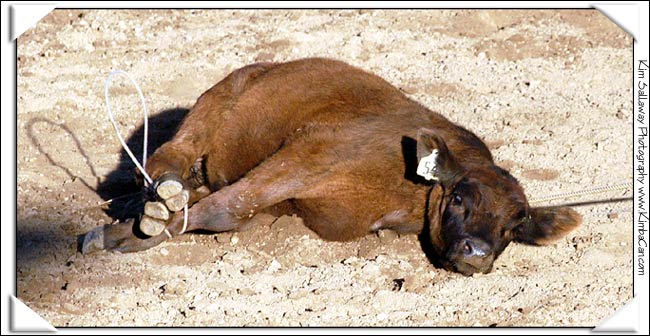
This steer would prefer not to serve as model for hog-tying.

In March of this year, Blawgletter invoked Chief Justice Marshall’s dictum about the power to tax as the power to destroy in the context of Texas Supreme Court decisions on class actions:

Blawgletter doesn’t see a new day dawning for class actions in the Lone Star State.  So long as the Supreme Court continues to tax class cases with the delays and uncertainties of interlocutory review, Rule 42 will lay in the ruins it has become.  The power to tax involves the power to destroy.  Indeed.

Today the court proved our failure to "see a new day dawning for class actions in the Lone Star State" in spades.  The unanimous nine justices reversed affirmance of an order certifying a statewide class.  The class consisted of consumers whom Best Buy charged a "restocking fee" for the privilege of returning merchandise.  The court held, per curiam, that Best Buy’s hopes of showing that some class members knew about the restocking fee or that some planned to use the goods for awhile and then take them back for a full refund precluded class certification.  Best Buy Co., Inc. v. Berrera, No. 07-0028 (Tex. Nov. 30, 2007) (per curiam) (reversing Best Buy Co., Inc. v. Berrera, 214 S.W.3d 66 (Tex. App. — Corpus Christi 2006)).

The court reaches the outcome by focusing not on what the plaintiffs claim and how they will present their case but on "the individualized inquiry [that] Best Buy seeks".  The solicitousness for defendants indeed explains why Ms. Berrera lost.  So long, apparently, as a defendant makes a colorable argument for an "individualized inquiry" of some kind, individual issues will predominate over common ones, rendering the case uncertifiable under Rule 42 of the Texas Rules of Civil Procedure.

Since Sw. Ref. Co. v. Bernal, 22 S.W.3d 425 (Tex. 2000), plaintiffs have lost 14 out of 15 class action appeals.  The sole exception?  A case by the state attorney general.  But even he had to start over in the trial court.  See "Texas in Class of Its Own".

Indeed, we struggle to imagine a case that will pass Rule 42 muster if Best Buy can’t.  For going on seven years, the court has provided only negative guidance to bench and bar — telling them that they messed up but never explaining (except in the AG’s case) how they could fix the problems next time.

The only good news?  That the Texas Supreme Court will allow just as many class certifications under Rule 42 as federal courts permit under Rule 42 of the Federal Rules of Civil Procedure — a rule that deals with the entirely different subject of consolidation and separate trials.  In other words, the court will okay exactly zero.

We hope they prove us wrong.

Barry Barnett

Feedicon14x14 One must normally lasso before hog-tying.

  • Billgatesdeposition
    Bill Gates made a bad video deponent.  Could his lawyers have helped him more — by bonding with him, for example?

Blawgletter has concluded after 22 years of preparing witnesses to give depositions and testify at trial that even the finest testifying techniques can do only so much if you — yes you, the lawyer — don’t establish a good personal connection with the testifier.

The conclusion came back to us the other evening as we visited with a famous trial consultant.  A smart and insightful man, the consultant reminded us of the "witness school" — available for a fee — to us and our clients.

We don’t recall that witness schooling services existed when we started practicing in 1985.  They didn’t come into vogue until after the pre-video deposition era, during which perfection in witness preparation still seemed possible. 

Back then, the transcript didn’t show a deponent’s hesitation, his glancing at his lawyer for how to answer, the whisper-whisper conferences between witness and lawyer, or even the deponent’s shifty eyes and constant rocking motion as if to comfort himself.  It reflected only the perfect responses to each question.  Now of course the video shows all.

So you can’t have a deposition witness who looks incredible.  She needs to do as well in deposition as she ought to do at trial.

But how can you help the witness avoid the appearance of unbelievability?  Simple — by convincing her that you believe in her, that you care about her, and that you will work hard to help her avoid avoidable mistakes.

How do you persuade the witness of those things?  The normal preparation work remains essential:  review of the key documents, discussion of the legal and factual issues in the case, and anticipation of the toughest questions. 

But you must also promise the witness that you will also concentrate as much as he does during the deposition.  Tell him that, because he has to wear his coat while testifying at deposition, you will keep yours on, too.  (Many lawyers shed their jackets, lean back in their chairs, and check their emails or buy stuff on amazon.com during their "defense" of a deposition.)  Assure him that, the few times you do make an objection, you will do it only to prevent him from saying something inaccurate and not to engage in lawyers’ nit-picking.  (Lots of lawyers jabber objections in hopes of throwing off the questioner or impressing the client with toughness, but usually with the main effect of causing the witness to peg him as someone who thinks the world revolves around him.)  And your objections will come if, but only if, the witness has started rambling, volunteering, tiring, or otherwise behaving in ways that could lead to incorrect testimony.  (Too many lawyer comments during deposition show just how little the lawyer has paid attention.)

The time when you could prepare a witness to give perfect testimony and then sit back and watch him give it has gone.  For at least the last decade or so, the unwinking eye of the camera has demanded prompt, firm, and confident answers.  We’ve adapted slowly to the new reality.  But the good news is that your witness can better meet the demand for spontaneity if she knows you will protect her from error and that you won’t confuse her by talking too much. 

Bond with your witness.  Or suffer the consequences.

Barry Barnett

Feedicon_3 Our free but strangely alluring feed tries not to talk too much.

Tonyromo
If you couldn’t see the Packers v. Cowboys showdown last night, blame your cable company.

What should we make of the National Football League’s refusal to let cable companies show pro gridiron matches unless they, in turn, let subscribers watch the games in their standard "bundle" of cable channels instead of only on premium "tiers" that cost extra?

The Dallas Morning News — that leader in deep, probing analysis of complex issues — threw up its editorial hands yesterday and opined that "both sides need to stop treating customers as pawns in their games and just make a deal."  Despite its exhortation to "both sides", the News put most blame on the NFL:  "If this were truly about the fans, the NFL would negotiate.  Instead, the league is just patiently applying pressure to the cable providers through a pervasive PR campaign and lobbying efforts in statehouses and in Washington."

As Hemingway wrote, isn’t it pretty to think so.

[By the way, didn’t the cable companies just score a major victory by, um, persuading three of five Federal Communications Commission members to vote against expanding the agency’s legal ability to regulate the industry?]

Blawgletter sees the problem as a battle of a little, but legal, monopolist (the NFL) against gargantuan, and likely illegal, ones (the cable giants).  The NFL manages its content — primarily the games but also lots of other intellectual property that interests fans — while the Comcasts, Time Warners, Charters, and the like control the physical pipes through which NFL content may wend its way into living rooms, sports bars, and other video outlets.  The right to use public facilities (like streets, easements, poles, and airwaves), unlike the right to create proprietary content, implies an obligation to serve the public interest.  And the difference between choosing who gets to use your copyrights and trademarks, on the one hand, and deciding who can reach consumers, on the other, strikes us as huge.

Indeed, cable companies can, and do, vend all sorts of junk content by "bundling" the sorry channels that purvey it together some good ones (often broadcast network channels) while proclaiming how "exciting" customers should find their range of selections.  Comcastic!

Plus satellite broadcasters Dish and DirecTV provide the NFL Network "at no extra cost", according to the iwantnflnetwork.com website, which the NFL no doubt sponsors.  How could they do that if the cable behemoths in fact had to kow-tow to the (tiny-by-comparison) NFL?  More important, how could they do that if satellite broadcasters represented effective competition with cable providers?

Truth to tell, Comcast and Time Warner don’t face effective competition, particularly in the "clusters" where they own upwards of 80 percent of cable subscribers.  That situation prevails in more metropolitan areas than we’d like to count — including Boston, Chicago, and Philadelphia for Comcast alone.

So, unlike the News, our local paper, Blawgletter doesn’t urge the NFL to "just make a deal".  We instead exhort federal authorities to rein in the cable monopolies.  (We also congratulate the more petite monopoly of the NFL for standing up against bullies.)  Only then will Comcast, Time Warner, and others include in the "bundles" that they brag so much about the channels that subscribers actually want.  Or, better yet, they will let consumers choose their channels!

For more background on cable monopolies, see here, here, and here.

Barry Barnett

Feedicon_2 Our feed once again reminds everybody that we do have a major antitrust lawsuit against Comcast pending.

Anne Reed proved once again today that she knows her stuff — specifically about persuading a jury.  Her Deliberations blawg gently breaks the news that Blawgletter didn’t make the ABA Journal Blawg Top 100 list by asserting — without a scrap of a shred of proof — that "[a]nyone can see that Blawgletter [and several other blawgs] are better than mine and aren’t on the list."  We didn’t know because we, um, missed the cut-off.

Well done.

We draw two inferences: 

First, that we should vote for Deliberations — and we have — and ought to urge others to do likewise (here) — and we do. 

Second, that we prefer the Justia Law Blawgs rankings, which put us at 45 (out of 2235) in the all time popularity list.  Of course we do.

Barry Barnett

Feedicon The Canterbury Tales listed envy as among the seven deadly sins.

Today the Second Circuit vacated an order certifying a class of freelance authors and approving a settlement with electronic publishers.  The case involved claims that the publishers infringed the writers’ copyrights by using electronic versions of their works without express permission.  The court held that the lack of registrations for "the overwhelming majority" of the copyrights with the U.S. Copyright Office deprived the district court of jurisdiction over their claims.  Even mere class members, the court concluded, must satisfy the jurisdictional requirement of registration.  In re Literary Works in Electronic Databases Copyright Litig., Nos. 05-5943 & 06-0223 (2d Cir. Nov. 29, 2007).

Judge Walker dissented.

Barry Barnett

Feedicon14x14_3 Blawgletter owns the copyright in this post.

Michael Smith publishes the EDTexWeblog.com.  He writes often about patent cases, which have proliferated in the Eastern District of Texas over the last several years.  As Mr. Smith takes pains to explain, the Eastern District attracts important patent infringement suits not because patentholders usually win but because the judges there handle the litigation efficiently, fairly, and — most important — speedily.

Yesterday he wrote about Judge Clark’s rulings on post-verdict motions in a patent infringement case against Microsoft.

Blawgletter likes Mr. Smith’s style.  He writes in East Texan, a dialect up with which we grew.  We say check EDTexweblog out.

Barry Barnett

Feedicon14x14_2 Our feed recommends only the best.

In Elbex Video, Ltd. v. Sensormatic Electronics Corp., No. 07-1097 (Fed. Cir. Nov. 28, 2007), the court held that the defendant failed to show a "clear and unmistakable" disavowal of a patent claim’s literal scope during prosecution of the patent.  The disavowal in Elbex concerned whether, in a closed circuit television system, a signal for controlling cameras in the system had to go to a "monitor" rather than a "receiving means".  The latter phrase appeared in the patent claim, but Sensormatic argued that Elbex abandoned any definition of "receiving means" broader than "monitor" — the receiving means and monitor were the same, it urged.  But the Federal Circuit, unlike the district court, held the evidence of disavowal neither clear nor unmistakable.  It also affirmed summary judgment on two of the three technologies that Sensormatic used in its CCTV systems.  So the court affirmed in part and reversed in part and remanded.

Clear but mistakable doesn’t suffice.  Nor does unclear but unmistakable.  The disavowal must appear both clear and unmistakable.

Barry Barnett

Feedicon14x14 Our feed makes claer and umnistakble errors.

Chocolatebar
Have Nestle, Cadbury, Mars, and Hershey bitten off more than they can chew?

There.  Blawgletter said it.  The it meaning the title of this post.

You’d have done the same thing in our place.

Our provocation?  We learned today that Canadian antitrust authorities have started an investigation into whether multinational chocolatiers fixed prices on the food of the gods — specifically flat rectangular hunks of same.  People in the Great White North buy $2.3 billion a year in chocolate and candy.

Who does the price-fixing hurt?  Dentists dislike it because higher prices lower demand for the sweet cavity-producing substance and, hence, drill-and-fill work.  But most obviously it injures the men, women, and children who pay an artificially high price for cocoa confections. 

Barry Barnett

Feedicon14x14 Blawgletter adores Hershey’s Chocolate World but hates price-fixing.