Today the Third Circuit published a 93-page opinion detailing several ins and outs of the attorney-client communication privilege.  The rulings will interest in-house counsel everywhere.  In re Teleglobe Communications Inc. (Teleglobe USA Inc. v. BCE Inc.), No. 06-2915 (3d Cir. July 17, 2007).

The case involved claims by subsidiary corporations against their former parent for abandoning them after they started bleeding money.  Advice from lawyers — about the staunchability of the sanguinary flow, its staunchworthiness, and the legal implications of staunching it in various ways — ran to the parent, Bell Canada; Teleglobe, a first-tier subsidiary of Bell Canada; and several second-tier subs.  The second tiers bled out and took bankruptcy, sued Bell Canada, and sought documents reflecting the legal advice.  The district court sided with the offspring and ordered papa Bell Canada to fork over the materials.

The Third Circuit reversed and remanded and in the course of doing so elucidated many nooks and crannies of privilege law as it applies to corporate families and the aftermath of their breaking up.  So many, in fact, we won’t discuss them here.  Happy reading!

Barry Barnett

Feedicon14x14 A privilege to help.

David Brooks used his NYT column today to talk about President George W. Bush’s "unshakable self-confidence."  (Sorry; you have to subscribe to TimesSelect or buy the print version to see it.)

How, you say, does Mr. Bush’s esteem for his beliefs relate to business trial law, the nominal theme of Blawgletter?  Only this:  it may help us understand why Mr. Bush so often acts in ways that, to us, suggest disrespect for the rule of law.

They key for us comes in Mr. Brooks’s seventh paragraph, in which he quotes Mr. Bush as follows:

It’s more of a theological perspective.  I do believe there is an almighty, and I believe a gift of that Almighty to all is freedom.  And I will tell you that is a principle that no one can convice me that doesn’t exist.

The view harkens to the notion of divine law, which originates in the will of God.  The laws of men, by definition, cannot compete with divine law and must give way to it — or, at least, to the believer-in-chief’s conception of it.

God help us.

Barry Barnett

Feedicon Come on over to our feed.

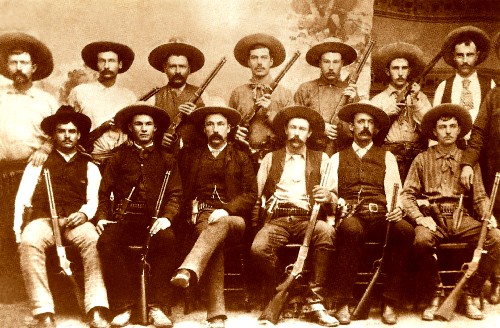
Texasrangers1
Notice any females?

The Fifth Circuit today reversed a summary judgment against a woman who alleged sex discrimination in the denial of a transfer within the Texas Department of Public Safety from Special Crimes Service to the Texas Rangers Division.  The court held that "there was evidence sufficient to raise a genuine issue of material fact on whether Alvarado’s non-selection to the Rangers was an adverse employment action."  Alvarado v. Texas Rangers, No. 05-51064 (5th Cir. July 16, 2007).

To which Blawgletter says:  duh.

Barry Barnett

Feedicon14x14_2 One riot, one Ranger.

U.S. District Judge Lewis A. Kaplan in Manhattan today dismissed federal criminal charges against 13 people who worked at KPMG LLP because, he held, the government unconstitutionally coerced the firm not to pay their legal fees.  WSJ story here; NYT here.  The decision stemmed from the Second Circuit’s rejection, in May 2007, of Judge Kaplan’s attempt to remedy the violation by requiring KPMG to reimburse past fees and pay future ones.  Blawgletter post here

The case, over aggressive tax shelters, will continue as to three ex-KPMG partners and two people who worked elsewhere.

Barry Barnett

Feedicon14x14 Pay someone a compliment — forward our feed.

The WSJ editors, under the fetching title Black and Blue, pouts today about the conviction last Friday of Conrad Black on mail fraud and obstruction of justice charges, fussing that "[n]o one seems to like a conservative press baron these days, especially no one else in the media."

Who could "conservative press baron" possibly refer to?  And who cares whether anybody likes him?  A paper that thinks he’ll soon own it?

But the self-referential nature of the editorial doesn’t disturb Blawgletter as much as its judgment that Mr. Black’s criminality "strikes us more as a case of hubris than rapacious intent."  Why?  Because "the jury convicted Lord Black of stealing a few million dollars" rather than tens or hundreds of millions.  Chump change!

The WSJ seems to have forgotten the 2004 report, by a special committee of the Hollinger International board, that described Mr. Black’s press barony as "a corporate kleptocracy".  The report went on:

[T]he evidence reviewed by the Committee establishes an overwhelming record of abuse, overreaching, and violations of fiduciary duties by Black and [former chief operating officer F. David] Radler, the two controlling shareholders.

*  *  *  *

At Hollinger, Black as both CEO and controlling shareholder, together with his associates, created an entity in which ethical corruption was a defining characteristic of the leadership team.

*  *  *  *

Not once or twice, but on dozens of occasions Hollinger was victimized by its controlling shareholders as they transferred to themselves and their affiliates more than $400 million in the last seven years.

Does $400 million worth of peculation plus diverting millions more strike you as a "more a case of hubris than of rapacious intent"?

Barry Barnett

Feedicon Divert our feed to your personal use.

In what percentage of Rule 23(f) cases do U.S. courts of appeals kick class actions?  Did you guess more often than not?  Did you really?

The Class Action Defense Blog ranks seventh in the all-time category on Justia.com.  It does so in part, Blawgletter suggests, because defending against class actions has become a lot easier in recent years.  Our proof?

Today we surveyed all federal court of appeals opinions since January 1, 2006.  In five of 24 decisions, the courts either upheld class certification or reversed its denial.  Which leaves 19 cases (79 percent) in which the courts affirmed denial of certification or reversed orders granting class treatment.

That strikes us as similar to shooting fish in a barrel.

Barry Barnett

Feedicon14x14_2 Eat what you kill with our feed.

Blawg Review features a new host every week.  Blawgletter will enjoy that honor the seven-day of July 23.

We haven’t settled on our theme just yet, but we did learn something fascinating when having a look at the current Blaw Review host, Corporate Blawg UK — that Thomas Jefferson wrote the Declaration of Independence in iambic pentameter, the rhythm of Shakespeare.

No wonder it so totally rocks.

Barry Barnett

Feedicon14x14 The poet in you will enjoy our feed.

The WSJ reports, on this Friday the 13th afternoon, that the Securities and Exchange Commission has opened an informal investigation into web postings by the chief executive officer of Whole Foods, John Mackey, about Wild Oats, a competitor that Whole Foods has offered to buy. 

Carrie Johnson reports the story in The Washington Post here.

Blawgletter’s firm tried a case a few years back about web postings by Competitor A about Competitor B.  The jury found that the poster, a non-officer VP, acted outside the scope of his employment. 

We wonder whether a company could succeed with the same defense as to its CEO — even if he uses, as Mr. Mackey did, a transposition of his spouse’s name for his online moniker.

Barry Barnett

Feedicon14x14_2 Nurture your prospering practice with our feed.

The U.S. Supreme Court finished its 2006 Term on June 28, 2007.  For business trial lawyers and their clients, the key decisions included these — all of which plaintiffs lost:

Better luck next Term?

Barry Barnett

Feedicon14x14 We have a term for you — friend.

Blawgletter hasn’t paid much attention to the fraud and racketeering case against Conrad Black, not least because it struck us as an unseemly but semi-ordinary example of insider avarice.  Plus it involved mere millions of self-enrichment — not the tens or hundreds to which we’ve accustomed ourselves.

But a federal jury in Chicago today found that Mr. Black’s grabbiness crossed the line from sleazy to fraudulent.  The core of it involved non-compete agreements, which Mr. Black used to divert corporate funds to himself and three of his pals.  WSJ story here.

Barry Barnett

Feedicon_3 We invite you to divert our feed to your use.